On this page
How to identify it
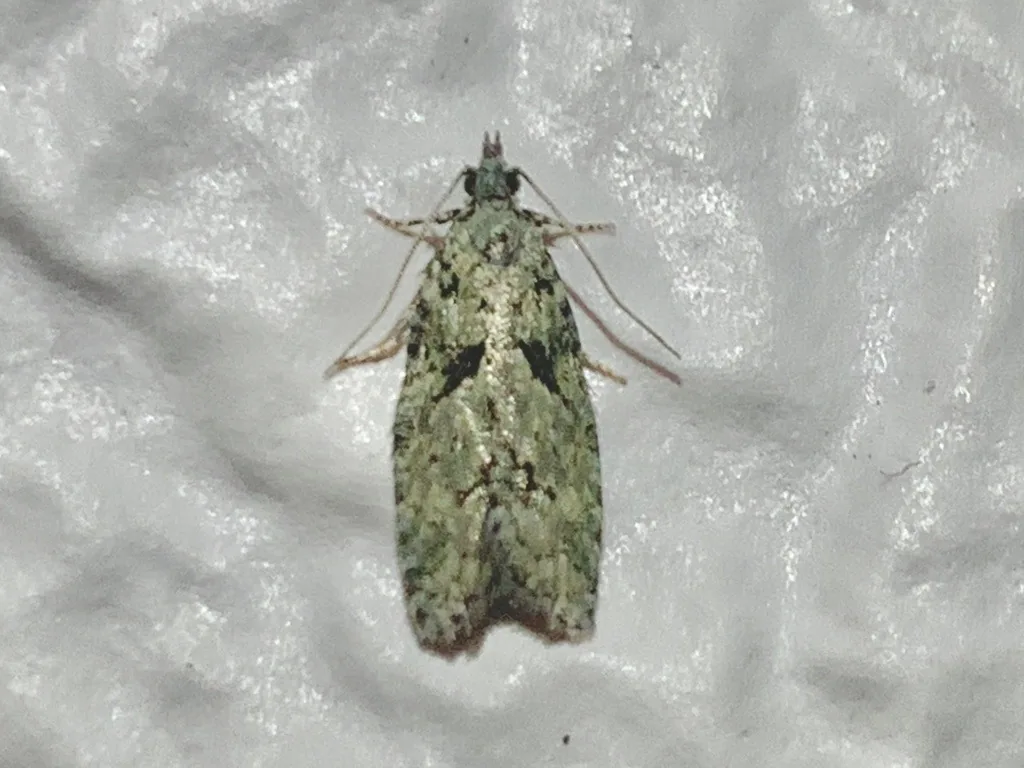
- The moth has a wingspread of 16 to 19 mm. Its forewings are mottled with brown and green scales, some of them raised in small tufts.[2]
- The full-grown caterpillar is 8 to 10 mm long and dirty white to purplish. The head is yellow to brown with a broad dark bar on each cheek and dark pigment around the eye spots, the plate behind the head is amber to brown, and the small plates at the base of the body hairs are grey and distinct.[1][2]
- Look for it from April to early June in swelling buds, newly flushed shoots and conelets of Sitka spruce and lodgepole or shore pine. Over winter the young caterpillar is hidden inside a needle it has mined.[1]
Look-alikes
| Look-alike | How to tell them apart |
|---|---|
| Spruce bud moth | Zeiraphera caterpillars on Sitka spruce also enter the opening buds in spring and web the tender new needles together under the bud cap, so the trees look reddish brown early in the season. Both are small mottled moths; the Zeiraphera caterpillar is dirty white to pale yellow with a dark brown head, while Epinotia hopkinsana's is dirty white to purplish with a yellow to brown head.[2][1] |
| Cypress leaftier | The cypress leaftier (Epinotia subviridis) is a close relative on the same coast, but it feeds on cypress, cedar and juniper, building cocoon-like feeding shelters that incorporate gnawed leaves and twigs. Epinotia hopkinsana is a spruce, pine and fir feeder; only its variety cupressi lives on Monterey cypress in California.[2] |
Where it lives
The moth ranges from California north to British Columbia, where it occurs throughout the coastal region.[1][2]
Biology and life cycle
The principal hosts are Sitka spruce and lodgepole pine, including the coastal shore pine. Canada yew, mugho pine, ponderosa pine, Rocky Mountain Douglas-fir and western redcedar are listed as secondary hosts, and the USDA manual adds true firs, Bishop's pine and the cones of Monterey pine.[1][2]
The moth overwinters as a young caterpillar, usually mined into a needle. In early spring, April to May, it leaves the needle and feeds on swelling buds, new growing shoots and conelets. Feeding ends in early June, the caterpillars pupate in June, and the moths emerge in July.[1]
The variety cupressi is darker as a moth and larger as a caterpillar. It feeds on the foliage, in the cones and under the bark of limbs of Monterey cypress in California.[2]
Epinotia is a large genus of some 60 species. Many feed on broad-leaved trees and shrubs, but several, including this one, feed on conifers.[2]
Damage and signs
Health risk
Both sources treat this moth only as a feeder on conifer shoots, buds and cones and mention no effect on people.[1][2]
Control
Prevention
Neither source recommends treatment. Natural Resources Canada rates the injury as relatively minor damage to newly flushed shoots, so on a landscape spruce or pine the usual outcome is a few spoiled shoot tips rather than a tree in trouble.[1]
Traps and physical control
If you want to confirm the insect, check swelling buds, new shoots and conelets between April and early June, when the caterpillars are feeding; before then they are hidden inside mined needles.[1]
Common questions
- What is eating the new shoots on my Sitka spruce in spring?
- One candidate on the Pacific coast is the caterpillar of Epinotia hopkinsana, which feeds on swelling buds, new shoots and conelets of Sitka spruce and lodgepole or shore pine from April to early June. Natural Resources Canada calls the damage relatively minor.[1]
- How big is Epinotia hopkinsana?
- The moth spans 16 to 19 mm and is mottled brown and green. The grown caterpillar is 8 to 10 mm long and dirty white to purplish.[1][2]
- Does it attack cypress?
- The typical form does not; it lives on spruce, pine and fir. A darker, larger variety called cupressi feeds on the foliage, cones and limb bark of Monterey cypress in California.[2]
Sources
- Natural Resources Canada, Canadian Forest Service, “Epinotia hopkinsana (Kraft), Trees, insects and diseases of Canada's forests.” tidcf.nrcan.gc.ca/en/insects/factsheet/11001 (accessed 2026-11-10)
- USDA Forest Service, “Western Forest Insects, Miscellaneous Publication 1339 (R. L. Furniss and V. M. Carolin, November 1977; scanned copy).” archive.org/details/CAT78702369 (accessed 2026-11-10)
- iNaturalist, “Epinotia hopkinsana taxon page (order and family).” www.inaturalist.org/taxa/344225 (accessed 2026-11-10)