On this page
How to identify it
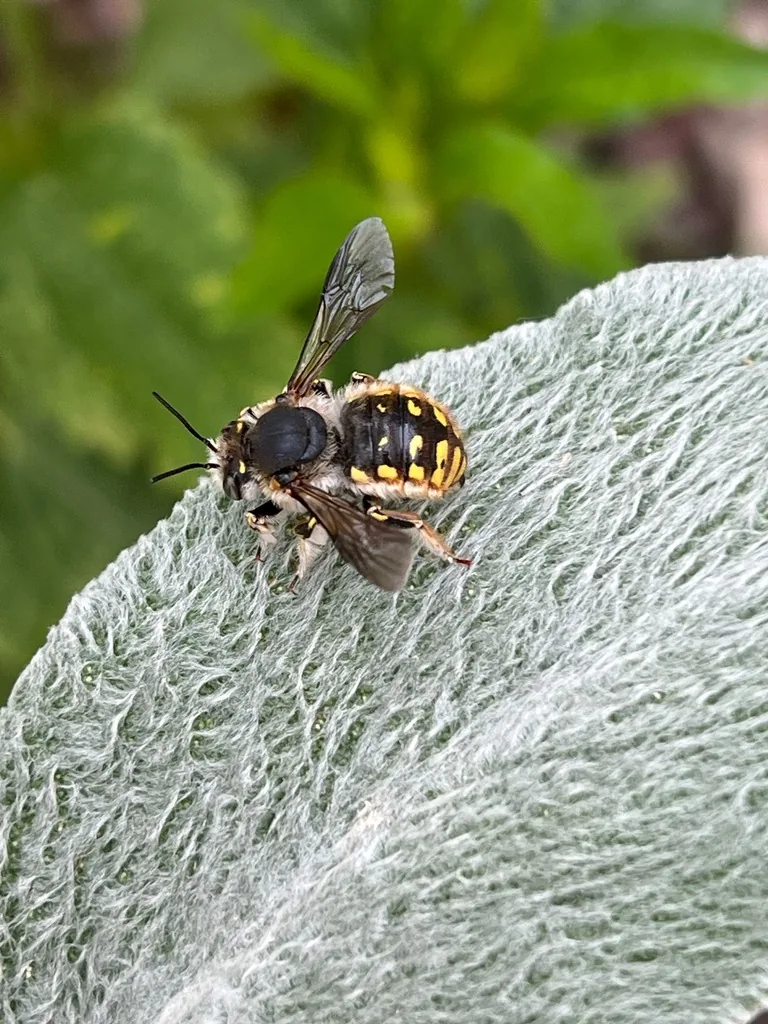
- About 11-17 mm (7/16 to 5/8 inch) long, roughly honey-bee size, robust, with a bright yellow-and-black patterned abdomen that is not very hairy.[1][2]
- Unusually for bees, males are larger than females (14-17 mm vs 11-13 mm) and carry sharp spines at the tip of the abdomen.[1][2]
- Females carry pollen on white to amber hairs under the abdomen and roll collected plant fuzz into a ball.[1]
Look-alikes
| Look-alike | How to tell them apart |
|---|---|
| Yellowjackets | At a glance they can be mistaken for yellowjackets, but wool carder bees are hairier and more robust.[1] |
Where it lives
Native to Europe, western Asia and northern Africa, it was first recorded in the U.S. near Ithaca, New York, in 1963 and now occurs across most of the United States and southern Canada; CSU reports it in Colorado's Front Range gardens.[1][2]
Biology and life cycle
Females nest in existing cavities: beetle holes in wood, hollow stems, cracks in walls or foundations, drill holes and bee houses.[1][2]
Each cell is lined with plant fuzz, provisioned with pollen and nectar, given one egg, and sealed; the cavity is filled cell by cell.[1][2]
UF reports at least two generations a year in most areas, with fall eggs overwintering as prepupae.[1]
Damage and signs
- Females gather fuzz mainly from lamb's ear and other mint-family plants, plus rose campion and mulleins; UF says the plants are not thought to be harmed.[1][2]
- CSU says females provision cells only from mint-family flowers, while UF describes them as generalists that also visit legumes and figworts.[1][2]
Health risk
Neither source reports a risk to people; the males' spines are used against other bees, and CSU notes they can fatally wound intruding bees.[1][2]
Control
Prevention
No control is needed; it nests in existing cavities rather than boring its own holes.[1][2]
Common questions
- What is the bee chasing other bees off my lamb's ear?
- Likely a male European wool carder bee guarding flowers for females.[1][2]
- Do wool carder bees damage plants?
- They scrape fuzz from leaves for nests, but UF says the plants aren't thought to be harmed.[1]
- Is it a yellowjacket?
- No; it is a stouter, hairier solitary bee.[1]
Sources
- University of Florida IFAS Extension (EDIS, Featured Creatures), “European Wool Carder Bee, Anthidium manicatum (EENY-746/IN1274).” ask.ifas.ufl.edu/publication/IN1274 (accessed 2026-10-15)
- Colorado State University Extension (Colorado Insects of Interest, W. Cranshaw), “Wool Carder Bee (Colorado Insect of Interest).” wci.extension.colostate.edu/wp-content/uploads/sites/14/2017/04/WoolCarderBee.pdf (accessed 2026-10-15)
- iNaturalist, “Anthidium manicatum taxon page (order and family).” www.inaturalist.org/taxa/62453 (accessed 2026-10-06)