On this page
How to identify it
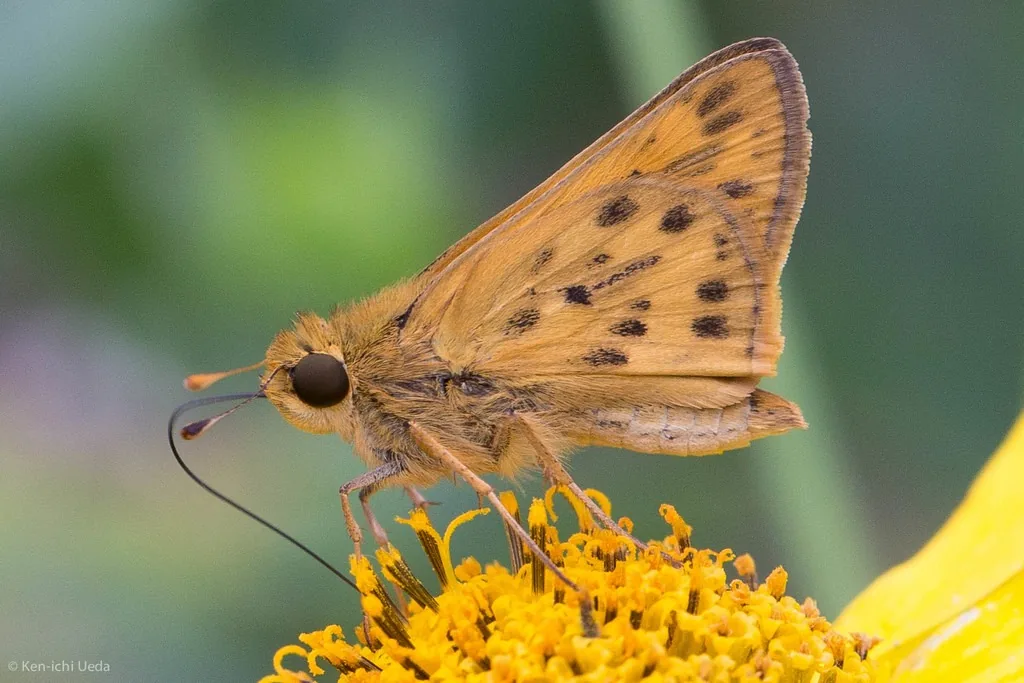
- Adults have short knobbed antennae and orange wings with small dark spots; males are brighter orange with a jagged dark border, females browner with more and larger brown patches. Wingspan is about 1 1/4 to 1 1/2 inches.[1][2]
- Caterpillars are green when young, then grayish tan to brown with narrow dark stripes and a black, knob-like head, growing to about 1 inch.[1][2]
Look-alikes
| Look-alike | How to tell them apart |
|---|---|
| Other grass skippers | Several other grass skippers are similar orange and brown; check the wing patterns.[2] |
Where it lives
Resident across the southern United States and south to Argentina; it moves north each summer and doesn't survive winters in places like Missouri, where it arrives in late May and flies until frost.[1][2]
Biology and life cycle
Females lay 50 to 150 eggs singly under grass blades and on stems; caterpillars feed at night and pupate in a loose silk shelter made from the host grass.[1]
Damage and signs
- Caterpillars feed on bermudagrass, St. Augustinegrass, bentgrass, Kentucky bluegrass, crabgrass and other grasses, and are commonly found near homes.[1]
Health risk
Control
Prevention
Numbers vary a lot from year to year; MDC notes adults are common in lawns and open grassy areas.[2]
Common questions
- What is the little orange butterfly darting around my lawn?
- Likely a fiery skipper.[1][2]
- Do fiery skipper caterpillars eat grass?
- Yes; they feed at night on bermudagrass, St. Augustinegrass and other turf grasses.[1]
- Do they overwinter in the North?
- No; in Missouri and farther north they arrive each summer from the south.[1][2]
Sources
- University of Florida IFAS Extension (EDIS, Featured Creatures), “Fiery Skipper, Hylephila phyleus (EENY-697/IN1194).” ask.ifas.ufl.edu/publication/IN1194 (accessed 2026-10-15)
- Missouri Department of Conservation, “Fiery Skipper (Field Guide).” mdc.mo.gov/discover-nature/field-guide/fiery-skipper (accessed 2026-10-15)
- iNaturalist, “Hylephila phyleus taxon page (order and family).” www.inaturalist.org/taxa/50340 (accessed 2026-10-06)