On this page
How to identify it
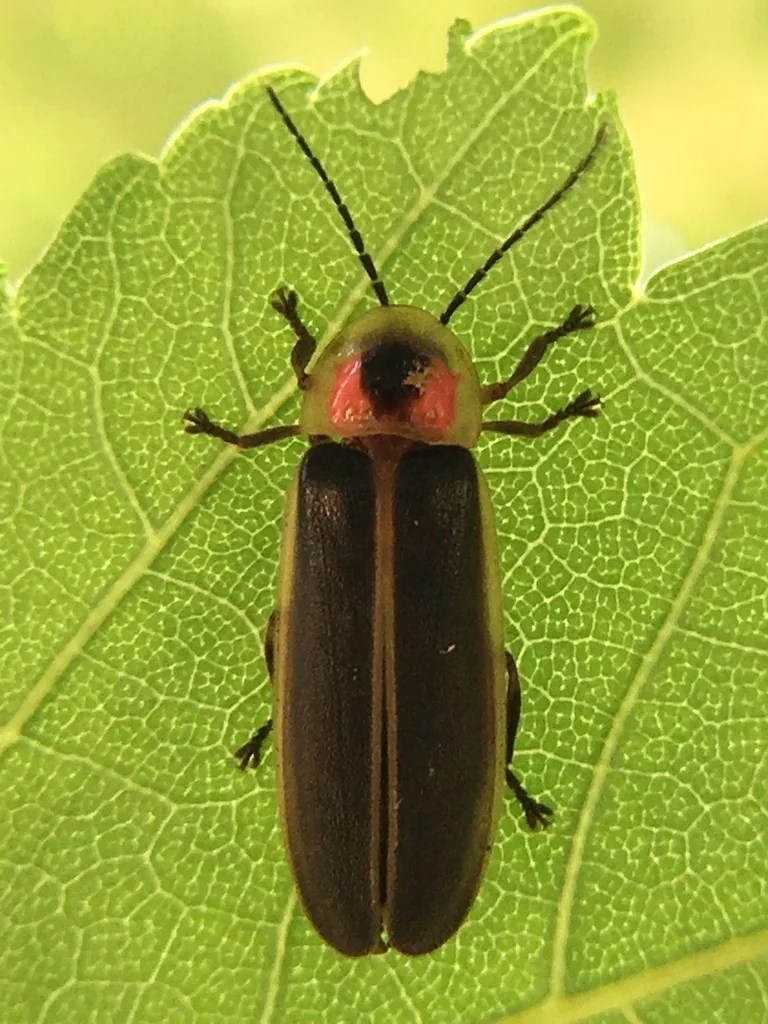
- Adults are elongate-oval, slightly flattened beetles with soft dark wing covers and a broad plate behind the head, usually edged with yellow, red or orange; most are about 10-15 mm long.[1]
- The big dipper firefly, the most common species in Missouri, is about half an inch long with a red plate behind the head marked with a black central spot and wing covers outlined in yellow.[2]
- In flashing species, the light organ ('lantern') sits at the tip of the abdomen; some species never light up and are active by day.[1][2]
Where it lives
About 125 species occur in North America; in drier western areas such as Colorado, flashing species are local and tied to permanent, shaded wetlands, while non-flashing species are common in irrigated lawns.[1][2]
Biology and life cycle
Light comes from luciferin reacting with the enzyme luciferase; each species has its own flash pattern, and males and females flash differently to find each other.[1][2]
Big dipper firefly males flash a J-shaped streak about every six seconds while hovering low at dusk, and females answer from the grass.[2]
Eggs are laid on or in moist soil; larvae, which can glow faintly in some species, hunt for one to two years before a short pupal stage.[1][2]
Most species spend winter as larvae; some day-active species overwinter as adults under tree bark.[1]
Damage and signs
Health risk
No health risk to people is reported; fireflies carry distasteful chemicals (lucibufagins) that protect them from predators.[1]
Control
Prevention
To keep fireflies around, leave a small area of leaf litter or grass clippings to hold moisture, use pesticides only when needed, and limit outdoor lighting when they are active (red bulbs disturb them less).[2]
Common questions
- Are fireflies harmful?
- No. They are predatory beetles that don't feed on plants, and their larvae eat slugs and snails.[1][2]
- Why are there fewer fireflies than there used to be?
- Firefly numbers drop where habitat shrinks and outdoor lighting increases; draining wetlands has also eliminated local populations.[1][2]
- Do fireflies live in the West?
- Yes, but flashing species are patchy there and tied to permanent, shaded wetlands; non-flashing species are more common in irrigated yards.[1]
Sources
- Colorado State University Extension (Colorado Insects of Interest, W. Cranshaw), “Fireflies (Lightningbugs) (Colorado Insects of Interest).” wci.extension.colostate.edu/wp-content/uploads/sites/14/2017/03/Fireflies.pdf (accessed 2026-10-15)
- University of Missouri Extension, “Fireflies illuminate landscapes with summer love (June 7, 2023).” extension.missouri.edu/news/fireflies-illuminate-landscapes-with-summer-love (accessed 2026-10-15)
- iNaturalist, “Photinus taxon page (order and family).” www.inaturalist.org/taxa/47730 (accessed 2026-10-06)