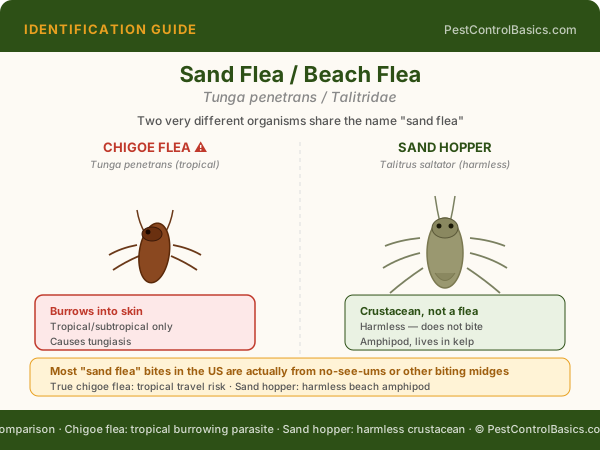
'Sand flea' means four different things depending on where you are. Knowing which one you're dealing with determines whether treatment even makes sense.
Original illustration by PestControlBasics.com. Use anatomical labels above to confirm your identification. For photo references, see the identification section below.
🔬
PestControlBasics Editorial Team
Reviewed by Derek Giordano · Updated 2026
🔍 Identification
Option 1 — Chigoe flea (Tunga penetrans): True flea; burrows into feet and toes; causes tungiasis; tropics only — not in continental US. Option 2 — Sand crab / mole crab (Emerita): Small crustacean in surf zone; harmless; doesn't bite. Option 3 — Biting midges / no-see-ums (Culicoides): Most common cause of 'sand flea bites' in US; tiny biting flies near sand; leave intensely itchy welts. Option 4 — Cat flea or dog flea: Actual fleas picked up from beach-visiting pets or wildlife.
🧬 Biology & Behavior
In the continental US, 'sand flea bites' are almost always biting midges (no-see-ums) or actual cat/dog fleas — not chigoe fleas (which require tropical regions). No-see-ums breed in wet organic material at beach margins and bite exposed skin, leaving clusters of intensely itchy welts that persist 1-2 weeks. The bites appear differently than mosquito bites — smaller, more intensely itchy, often in clusters on ankles and lower legs.
For midge bites: DEET or picaridin before beach exposure; wear light-colored clothing covering ankles; avoid beach at dawn/dusk when midges peak; fan creates enough airflow to prevent landing. For actual flea bites: treat pet and environment as standard flea protocol.
👷 When to Call a Pro
Never warranted for midge bites specifically — prevention through repellent is the approach.
❓ FAQ
What's actually biting me at the beach?
In the continental US: almost certainly biting midges (Culicoides no-see-ums) rather than true fleas. The telltale signs are: extremely itchy bites that are smaller than mosquito bites, appearing in clusters on exposed skin, at dusk or dawn, near wet sandy areas. DEET applied before beach exposure prevents these bites effectively.
Are sand fleas dangerous?
In the continental US, biting midges are a nuisance but don't transmit significant human pathogens. The chigoe flea (tungiasis) is a serious medical concern but only in tropical regions not found in the continental US. If you develop a painful nodule at a bite site on your foot after travel to tropical areas, see a doctor — that could be tungiasis.
DG
Derek Giordano
Certified Pest Control Operator · Former Business Owner
Derek ran his own pest control company in Florida for several years, servicing thousands of regular customers. All content is based on hands-on field experience and current EPA & university extension guidelines.
Prevention strategies that actually reduce Sand Flea — ID Guide pressure
Most pest pressure traces back to one or two environmental conditions that are easier to fix than the infestation itself is to spray. For Sand Flea — ID Guide, the highest-leverage changes typically involve moisture management, food access, and exclusion at structural entry points. Reducing standing water within 20 feet of the foundation eliminates more pest problems than any single chemical application, and the effect persists year over year rather than requiring a rebuy every quarter.
Exclusion work is unglamorous but durable. A common entry-point audit covers door sweeps, weep holes, utility penetrations, dryer vents, soffit gaps, and the base of siding. Most homes have between five and fifteen openings larger than the minimum required for the target pest to enter, and sealing even half of them measurably reduces indoor sightings within one season. Stainless steel mesh, copper wool, and exterior-grade sealant cover most situations; expanding foam alone is not sufficient because rodents and some insects chew through it.
Storage practices matter too. Pantry pests, fabric pests, and overwintering insects all exploit cardboard, paper, and natural-fiber storage in basements and garages. Switching to sealed plastic bins for seasonal storage removes a significant amount of harborage that is otherwise impossible to spray effectively.
Why timing changes everything with Sand Flea — ID Guide
The same product applied two weeks apart can produce a complete kill or near-zero effect depending on where the Sand Flea — ID Guide population sits in its life cycle. Egg-stage pests are nearly immune to contact sprays, so a perfectly applied treatment during a major hatch event will leave the next generation completely unaffected. The professional standard is two applications spaced 10 to 14 days apart for most household pests — the first kills the active adults, the second catches anything that emerges from eggs in the interim.
Temperature also drives treatment success. Most residual sprays lose efficacy above 90°F or below 50°F, and pyrethroid products in particular can repel rather than kill when applied during high heat. The best window is early morning when surface temperatures are still moderate and target pests are moving but not yet at peak activity. Indoor treatment is less weather-dependent but still benefits from being applied when household air movement is low — running ceiling fans during application redistributes droplets away from the intended surface.
Seasonal pressure for Sand Flea — ID Guide usually has two or three predictable peaks per year. A treatment calendar built around those peaks costs less and works better than reactive spraying after a problem is already established.
When to escalate Sand Flea — ID Guide control beyond DIY
Most Sand Flea — ID Guide situations are within the range of a careful homeowner, but a handful of scenarios genuinely warrant a licensed applicator. Multi-unit buildings are at the top of that list — shared walls, plumbing, and ductwork mean a localized treatment in one unit often just relocates the population to a neighbor. Any infestation that involves wall voids, attic insulation, or sub-slab plumbing is also harder to reach with consumer products and benefits from professional equipment and labeled product concentrations.
Health-sensitive situations are the second escalation trigger. Pregnancy, infants, immunocompromised residents, and pets with known sensitivities all narrow the available product list considerably. A licensed professional can apply restricted-use products and reduced-risk reformulations that achieve control with lower household exposure than over-the-counter alternatives. The cost difference is usually less than two seasons of DIY spending once the time investment is factored in.
The third escalation point is recurrence. If the same pest returns within six weeks of an apparently successful treatment, the source is usually structural or environmental rather than chemical, and a professional inspection often finds the cause faster than a second round of self-treatment.
Confirming a Sand Flea — ID Guide infestation in the field
Misidentification is the most common reason home treatment fails for Sand Flea — ID Guide. Look-alike species often respond to completely different active ingredients, so a 30-second confirmation step before any spraying or baiting saves the most time over a season. The practical workflow begins with where you found the specimen — kitchen, bathroom, garden, attic — because habitat narrows the candidate list faster than morphology alone.
Specific cues for Sand Flea — ID Guide include body proportions, leg count, antenna shape, and any wing structure if present. Adults are usually the easiest stage to identify, but most real-world infestations show juveniles or evidence (frass, shed skins, webbing, damage patterns) more often than adults themselves. Photograph the specimen against a ruler or coin for scale, then compare against a regional reference rather than a global one — range maps from state Extension services beat generic online identification sites.
When two species look genuinely similar, the deciding factor is often where they congregate at dusk versus dawn, or whether they leave a visible trail. A test of three common DIY treatments — one bait, one residual spray, one mechanical barrier — applied in different areas can also confirm identity by which works.
Published: Jan 1, 2025 · Updated: Apr 7, 2026
Pet treatment and home treatment: doing both matters
Effective flea control requires treating the pet and the home simultaneously, and homeowners who treat only one typically experience persistent problems. Pet treatment with veterinary-grade products — modern oral medications like nitenpyram, spinosad, or isoxazolines, or topical products containing fipronil or imidacloprid — kills adult fleas feeding on the pet within hours and prevents new flea-related egg production. But adult fleas on the pet represent only about 5% of the total flea population; the remaining 95% (eggs, larvae, pupae) lives in carpets, upholstery, pet bedding, and along baseboards in the home. Home treatment with IGR (insect growth regulator) products like methoprene or pyriproxyfen interrupts the flea life cycle by preventing larvae from maturing; combined with vacuuming (which removes eggs and larvae and stimulates pupae to emerge), this addresses the 95% off-pet population. The full treatment timeline typically runs 8-12 weeks because pupae can remain dormant for weeks and emerge after the initial treatment phase. Stopping treatment as soon as visible fleas disappear is the most common mistake and produces recurrence within weeks.
How structural moisture issues drive pest problems most homeowners miss
A surprising fraction of pest problems are downstream of moisture issues that go uncorrected because they don't produce obvious damage. Subterranean termites require moist soil contact; correcting drainage and downspouts often reduces termite pressure more than any chemical treatment. Carpenter ants nest in damp or previously-damp wood; the colony moves in only after moisture has softened the substrate. Drain flies, fungus gnats, and springtails are all moisture-driven and resolve when the moisture source resolves. Mold mites and booklice indicate humidity that exceeds about 70%, often in unventilated bathrooms or basements. Even rodent activity correlates with moisture: rodents need accessible water and follow water-supply intrusions to bring themselves into structures. The diagnostic question worth asking on any chronic pest problem: is something wet that shouldn't be? Common offenders are clogged gutters, downspouts that drain near the foundation rather than away from it, condensate lines from HVAC systems and water heaters, slow plumbing leaks under sinks, sweating cold-water pipes in unconditioned spaces, and crawlspaces without adequate vapor barriers. Fixing the underlying moisture issue typically yields permanent improvement that chemical treatment alone cannot match.
Flea infestation in homes without pets: more common than expected
Flea infestations in homes without current pets surprise residents but follow a predictable pattern. The most common scenario is a home with a recently-deceased or recently-rehomed pet; flea pupae can remain dormant in carpets for months and emerge en masse when vibration and CO2 from human movement signals their environment is again occupied. Less commonly, wildlife under or near the home — feral cats, raccoons, opossums, or squirrels — produces an outdoor flea population that migrates inside. Even less commonly, fleas hitchhike on humans returning from visits to infested homes or properties. Treatment in pet-free homes focuses on the environment exclusively: IGR application to carpets and upholstery, repeated vacuuming over several weeks to capture emerging adults and stimulate dormant pupae, and addressing any wildlife harborage under or near the structure. Without a current host to feed on, adult fleas have shorter lifespans, but the unfed adults will actively seek humans for blood meals, producing bites that are often the first sign of the infestation.
Pet bedding and soft furnishings as the actual reservoir
When a household has a persistent flea problem despite repeated treatment, the reservoir is usually in soft furnishings rather than in carpets in general. Pet beds, blankets the pet sleeps on, fabric furniture the pet uses, and car seat covers concentrate flea eggs and larvae because the pet spends extended time on those specific surfaces. Treating these surfaces is often more important than blanket carpet treatment, and the cleaning protocol matters: hot water washing — at least 130 degrees Fahrenheit — kills all life stages including eggs and pupae, while cooler washes do not. Bedding that can't be hot-washed should be replaced rather than salvaged, because the cost of replacement is small compared to the cost of an extended infestation. Vacuuming furniture seams, lifting cushions and vacuuming under and behind them, and disposing of vacuum bags or emptying canister contents into sealed outdoor trash immediately after each session removes both the visible debris and the eggs and larvae that would otherwise re-emerge. The geographic concentration of fleas in pet-favored locations makes targeted treatment of those locations dramatically more efficient than uniform whole-house treatment.
Pesticide residual life and reapplication intervals
The residual life of a pesticide is one of the most misunderstood properties in household pest management. Active ingredients vary widely in how long they remain bioavailable on a treated surface, and the same active can behave very differently depending on substrate, exposure to sunlight and rain, temperature, and the formulation it's carried in. A pyrethroid applied to a porous masonry surface in full sun will degrade in days; the same active in a microencapsulated formulation on a protected interior surface may remain effective for months. Understanding this is the difference between an evidence-based treatment schedule and one driven by superstition. Reapplying too soon wastes product and increases selection pressure for resistant individuals; reapplying too late creates gaps in coverage during which pest populations rebound. The right answer depends on specific conditions and is not the same number printed on the bottle in all circumstances. Field experience and willingness to monitor for early signs of pest return are what calibrate the schedule. The label is a guide, but conditions in front of you are the real input.
Environmental treatment timing tied to pet treatment
Flea control fails routinely when the pet and the environment are treated on uncoordinated schedules, and the failure mode is predictable. If the pet receives effective flea prevention but the environment isn't treated, eggs continue to drop off the pet — or off transient adults that find the pet briefly — and a baseline infestation persists in the carpet. If the environment is treated but the pet has untreated flea reservoir, every cycle re-seeds the environment. The right sequence is essentially simultaneous: aggressive vacuuming and indoor insecticide treatment combined with starting the pet on a fast-acting flea preventive on the same day, with both maintained for at least eight to twelve weeks to span the full life cycle. Veterinary preventives are dramatically more effective than over-the-counter products for the pet side of this, and the cost difference is small enough that the substitution rarely makes economic sense. Households that follow this sequence resolve flea problems on a predictable timeline; households that treat the pet and environment as independent problems generally don't.
🗺️ US Distribution — Sand Flea
Common Occasional Not Present
States Present
51
Occasional
0
Primary Region
All 50 states
📊 Source: University extension services, USDA, CDC vector data, and published entomological surveys.