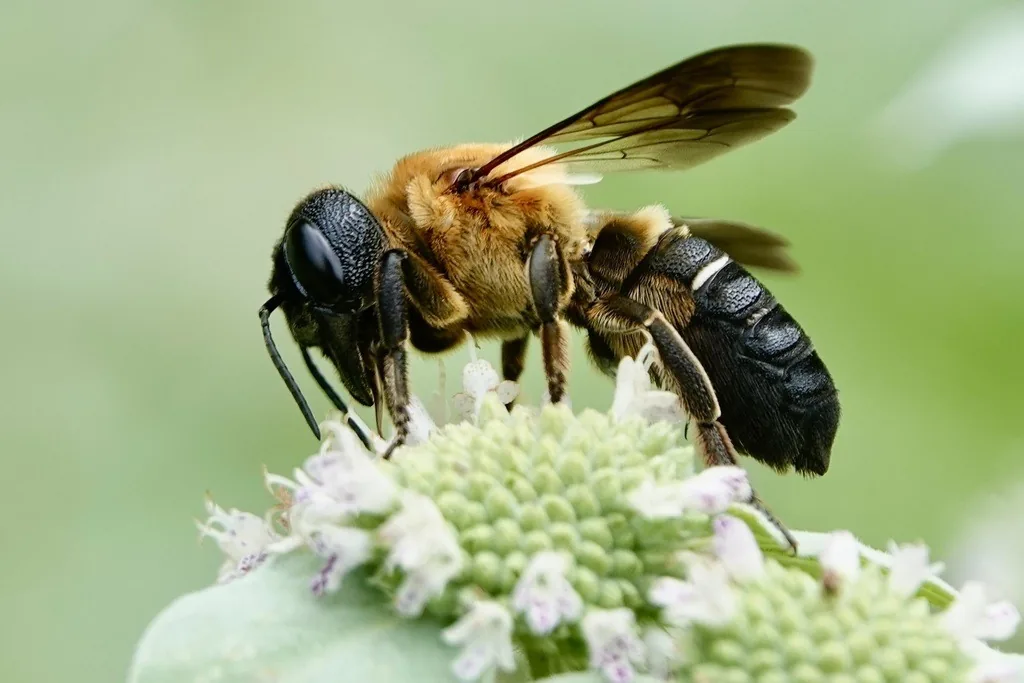
How to identify it
Look-alikes
| Look-alike | How to tell them apart |
|---|---|
| Other leafcutter bees | Most are 5 to 24 mm, considerably smaller than the giant resin bee.[1] |
| Carpenter bee | Carpenter bees chew nest tunnels in wood; the giant resin bee only reuses them.[1] |
Where it lives
First found at U.S. ports in North Carolina in 1994, it now lives in most states east of the Mississippi.[1]
Biology and life cycle
It's solitary, though females often nest near each other, sealing brood cells with wood bits, mud or resin.[1]
It forages on many plants but prefers ones introduced from Asia.[1]
Damage and signs
- It doesn't cause structural damage, but it displaces native carpenter bees from their tunnels.[1]
Health risk
UF/IFAS mentions no health risk; it's a solitary pollinator.[1]
Control
Keep them out
If control is needed, fill old carpenter bee holes with putty and paint wood so carpenter bees don't make new cavities.[1]
Common questions
Sources
- University of Florida IFAS Extension (Featured Creatures), “Giant Resin Bee, Megachile sculpturalis (EENY-733).” edis.ifas.ufl.edu/publication/IN1258 (accessed 2026-10-06)
- iNaturalist, “Megachile sculpturalis taxon page (order and family).” www.inaturalist.org/taxa/52785 (accessed 2026-10-06)