How to identify it
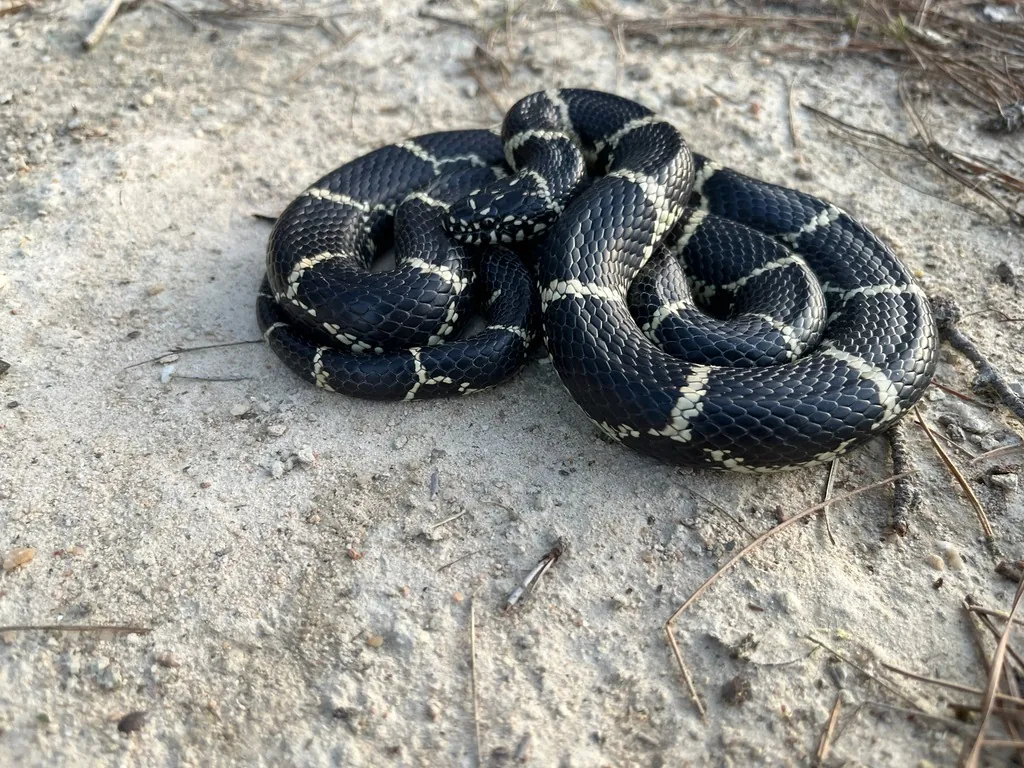
- Eastern kingsnakes are solid black to chocolate brown with narrow white to yellowish crossbands that join along the sides in a chain-like pattern.[1][4]
- Adults are usually 3 to 4 feet long, with smooth, shiny scales, a small head barely wider than the neck, and round pupils.[1][4]
- The belly is checkered with dark and light squares or may be mostly black.[1][4]
- Missouri's speckled kingsnake is black with a small yellow or white spot on each scale, giving a salt-and-pepper look.[3]
- The scarlet kingsnake is a small, thin relative, about 14 to 20 inches, with red, black and yellow rings and a red snout.[2]
Look-alikes
| Look-alike | How to tell them apart |
|---|---|
| Coral snake | The venomous harlequin coralsnake has red and yellow rings that touch and a black snout; on a scarlet kingsnake, black rings separate red from yellow and the snout is red.[2] |
| Rat snakes | Rat snakes reach similar sizes but have lightly keeled back scales, a larger head with bigger eyes, and a pattern dominated by gray, yellow or reddish orange.[4] |
| Eastern racer | Black racers are long, slender and mostly patternless, without the kingsnake's chain of pale crossbands.[4] |
| Copperhead | Copperheads are venomous pit vipers with a heat-sensing pit on each side of the face; kingsnakes have round pupils, no facial pits, and readily eat copperheads.[6][1][5] |
Where it lives
The eastern kingsnake, as now defined, ranges through the Atlantic coastal states from Florida to New Jersey and across Georgia; close relatives such as the speckled kingsnake occur farther west, including statewide in Missouri.[4][5][3]
Biology and life cycle
Eastern kingsnakes use pinelands, hardwood forests, marshes and the edges of streams and lakes, and sometimes turn up in suburban neighborhoods.[1][4]
They are mainly active from April through October, mostly by day, but may move at night in hot weather.[4][3]
They shelter under rocks, logs and rotten stumps and in small mammal burrows, and spend winter underground or in old building foundations.[3]
Their diet includes small mammals, birds and eggs, lizards, turtle eggs and other snakes; many populations favor reptiles and their eggs.[1][3]
Females lay roughly 3 to 30 eggs in rotting logs, debris or burrows, and the young hatch in late summer.[1][3]
Damage and signs
- Snakes do not damage buildings, lawns or gardens; they help reduce insect and rodent numbers and are usually considered beneficial.[7]
- Missouri's conservation department calls the speckled kingsnake beneficial because it eats many rodents.[3]
- Like other snakes, kingsnakes may take bird eggs; a nest that loses one egg a day with no broken shells is a classic sign of a snake.[7][1]
Health risk
Kingsnakes are not dangerous to people or pets. A cornered kingsnake may vibrate its tail, bite and release a foul musk; treat a bite from a nonvenomous snake like any minor wound.[1][3][7]
Control
Prevention
Leave a kingsnake alone; it usually flees for shelter, and almost all bites happen when people intentionally bother the snake.[1]
Keep them out
Snakes don't gnaw their way in, so sealing gaps of 1/8 inch or larger around doors, windows, pipes and foundations, as for mice, keeps them out.[8]
Sanitation
Keep vegetation mowed around buildings and remove boards, rocks, brush and debris near the house that shelter snakes and the rodents they eat.[8]
Traps and physical control
To coax a snake out of a basement, pile damp towels or burlap where it was seen, cover with a dry one, and check underneath after a couple of days.[8]
When to call a professional
If a snake is indoors and you can't identify it or move it safely, call a wildlife control operator or your state wildlife agency.[8][6]
Why kingsnakes are worth keeping around
Kingsnakes resist pit viper venom and readily eat copperheads, cottonmouths and rattlesnakes, and they can swallow snakes longer than themselves.[5][1]
Missouri's conservation department describes snakes like the speckled kingsnake as natural, nontoxic pest control because they eat many rodents.[3]
Most Georgia snakes are protected by law, and killing nonvenomous snakes there is illegal; check your own state's rules before acting.[5]
Eastern kingsnake numbers in Florida have dropped sharply because of habitat loss, road deaths, fire ants, pollution and collecting for the pet trade.[1][4]
Red-and-yellow rhyme: use with care
The rhyme 'red touches yellow, kill a fellow; red touches black, venom lack' usually separates scarlet kingsnakes from coralsnakes in Florida.[2]
The Florida Museum warns that unusual color variants can break the rule, so if you aren't sure of a snake's identity, leave it alone.[2]
Common questions
- Are kingsnakes venomous?
- No. Kingsnakes are nonvenomous constrictors and are not dangerous to people or pets, though they may bite and musk if grabbed.[1][3]
- Do kingsnakes really eat rattlesnakes and copperheads?
- Yes. Kingsnakes are resistant to pit viper venom and readily eat copperheads, cottonmouths and rattlesnakes, along with many other prey.[5][1][3]
- Why is a kingsnake shaking its tail like a rattlesnake?
- Tail vibrating is a bluff. Kingsnakes buzz the tail tip in dry leaves when alarmed, but they have no rattle and no venom.[1][3]
Sources
- Florida Museum of Natural History, University of Florida, “Eastern Kingsnake (Florida Snake ID Guide).” www.floridamuseum.ufl.edu/florida-snake-id/snake/eastern-kingsnake/ (accessed 2026-10-06)
- Florida Museum of Natural History, University of Florida, “Scarlet Kingsnake (Florida Snake ID Guide).” www.floridamuseum.ufl.edu/florida-snake-id/snake/scarlet-kingsnake/ (accessed 2026-10-06)
- Missouri Department of Conservation, “Speckled Kingsnake (Field Guide).” mdc.mo.gov/discover-nature/field-guide/speckled-kingsnake (accessed 2026-10-06)
- Florida Natural Areas Inventory, “Field Guide to the Rare Animals of Florida: Eastern Kingsnake, Lampropeltis getula (June 2021).” www.fnai.org/PDFs/FieldGuides/Lampropeltis_getula.pdf (accessed 2026-10-06). Florida Natural Areas Inventory is a nonprofit natural heritage program administered by Florida State University.
- University of Georgia Cooperative Extension, “Snakes Eating Snakes (Bartow County Extension, March 2024).” site.extension.uga.edu/bartow/snakes-eating-snakes/ (accessed 2026-10-06)
- Internet Center for Wildlife Damage Management, “Snakes: Identification.” icwdm.org/species/reptiles/snakes/ (accessed 2026-10-06). Run by university wildlife damage specialists (maintained at the University of Wisconsin-Stevens Point); species modules are based on Prevention and Control of Wildlife Damage (University of Nebraska Cooperative Extension, 1994).
- Internet Center for Wildlife Damage Management, “Snake Damage Identification.” icwdm.org/species/reptiles/snakes/snake-damage-identification/ (accessed 2026-10-06). Run by university wildlife damage specialists (maintained at the University of Wisconsin-Stevens Point); species modules are based on Prevention and Control of Wildlife Damage (University of Nebraska Cooperative Extension, 1994).
- Internet Center for Wildlife Damage Management, “Snake Damage Prevention and Control Methods.” icwdm.org/species/reptiles/snakes/snake-damage-prevention-and-control-methods/ (accessed 2026-10-06). Run by university wildlife damage specialists (maintained at the University of Wisconsin-Stevens Point); species modules are based on Prevention and Control of Wildlife Damage (University of Nebraska Cooperative Extension, 1994).
- iNaturalist, “Lampropeltis getula taxon page (order and family).” www.inaturalist.org/taxa/1676766 (accessed 2026-10-06)