On this page
How to identify it
- Caterpillars are slender, yellowish white and translucent, so the green leaf they've eaten shows through; they reach about 23 mm.[1][2]
- Several caterpillars may share one rolled leaf.[1][2]
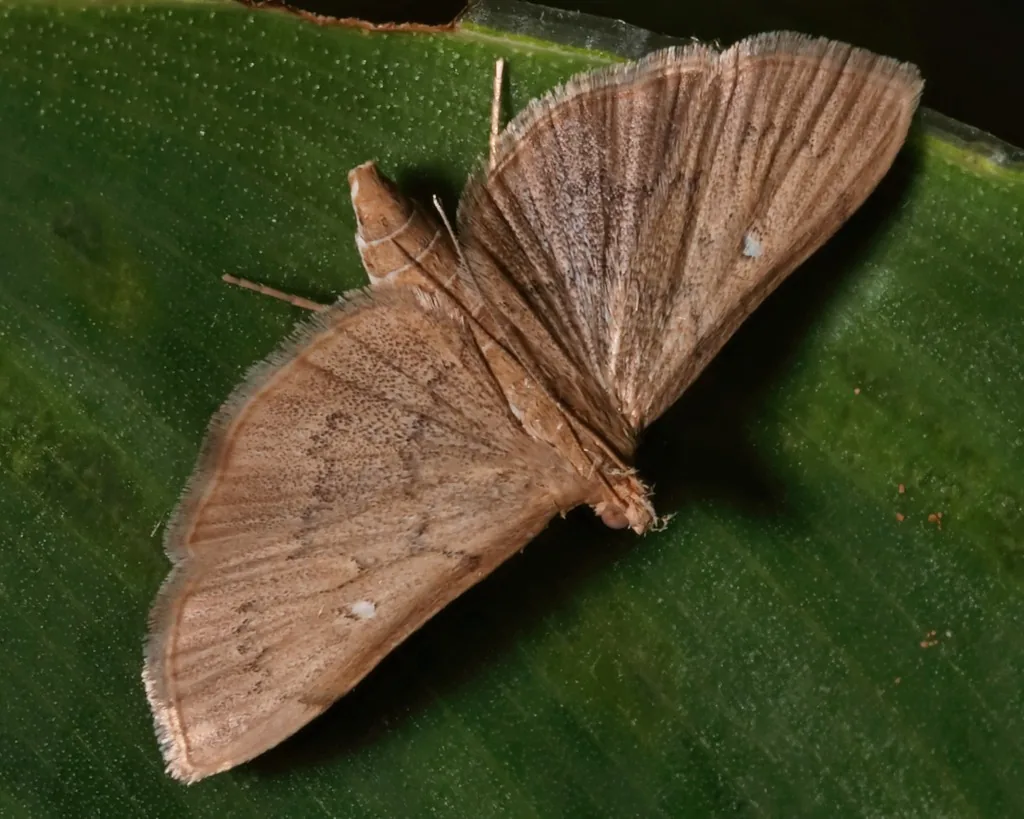
- The moth is small, plain and light brown with two dark lines across the wings and a small white patch on the forewing.[2]
Look-alikes
| Look-alike | How to tell them apart |
|---|---|
| Larger canna leafroller | The larger canna leafroller is a bigger, more voracious caterpillar on the same plants, and both may be present at once.[2] |
Where it lives
It appears to occur throughout the southeastern United States, with records from Florida, Texas, Louisiana, Tennessee and South Carolina; NC State covers it in North Carolina.[1][2]
Biology and life cycle
It spends winter in dead canna leaves and stems, as caterpillars per NC State or as pupae per UF.[1][2]
Young caterpillars mine inside leaves, then feed in still-rolled new leaves or tie older leaves shut; UF reports generations of about 28 to 35 days in Florida summers.[1][2]
Damage and signs
Health risk
Control
Sanitation
Cut back and destroy all dead canna leaves and stems after frost instead of leaving them as mulch; isolated plantings can be nearly cleared this way.[1]
Pesticides
Bacillus thuringiensis (Bt) sprays work; spray straight down into the rolled leaves so the spray reaches the caterpillars.[1]
Common questions
Sources
- NC State Extension, “Lesser Canna Leafroller (PDIC Factsheet).” content.ces.ncsu.edu/lesser-canna-leafroller (accessed 2026-10-15)
- University of Florida IFAS Extension (EDIS, Featured Creatures), “Lesser Canna Leafroller, Geshna cannalis (EENY-133/IN290).” ask.ifas.ufl.edu/publication/IN290 (accessed 2026-10-15)
- iNaturalist, “Geshna cannalis taxon page (order and family).” www.inaturalist.org/taxa/491637 (accessed 2026-10-06)