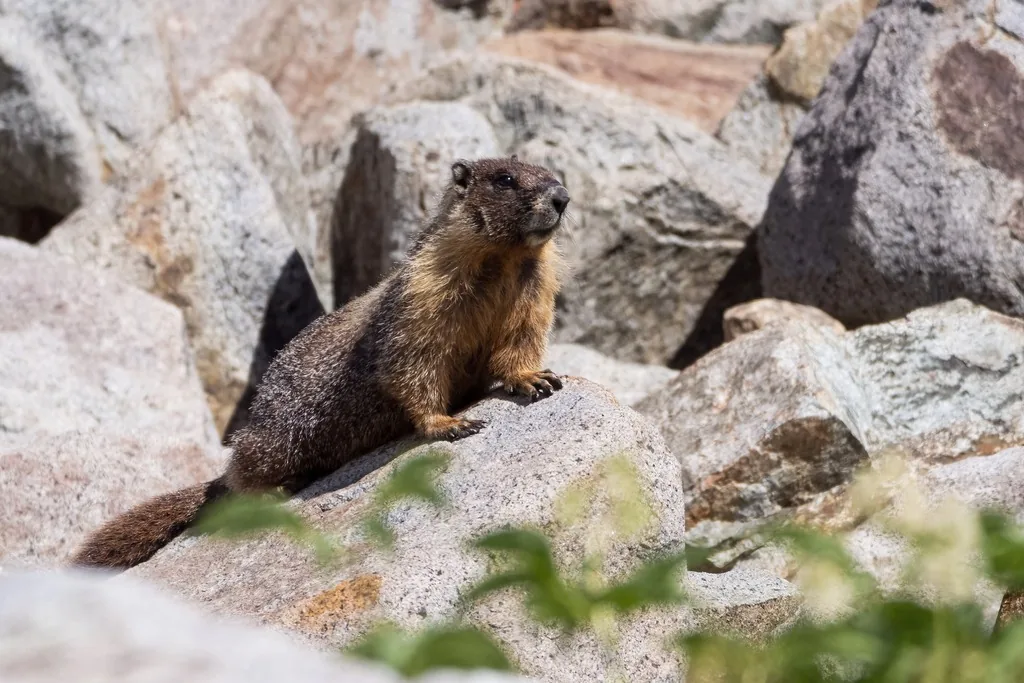
How to identify it
- A heavy-set, grizzled brown rodent with long, coarse fur, about the size of a housecat: roughly 18 to 30 inches long including the tail.[3][1][2]
- The belly and chest are yellowish to orange, often with white patches between the eyes and on the chin.[2][3][1]
- Yellow speckles mark the sides of the neck, and the tail is 5 to 9 inches long.[1]
- Adults weigh about 5 to 11 pounds and can look very fat by fall.[2][3]
- When alarmed it gives a sharp, piercing whistle and runs to its burrow.[2][1]
Look-alikes
| Look-alike | How to tell them apart |
|---|---|
| Groundhog (woodchuck) | The groundhog is the marmot of the East and Midwest; in the West, the yellowish belly and white face patches point to the yellow-bellied marmot.[3][2] |
| Ground squirrels | The marmot is the largest of Colorado's ground squirrels; adults are about 26 inches long and weigh up to about 11 pounds.[3] |
Where it lives
Widespread in western North America, from alpine meadows down to the lower foothills; in California it occurs in the Sierra Nevada and the northeast, and in Washington at lower, drier elevations.[3][1][2]
Biology and life cycle
Marmots favor rock slides, talus slopes and boulder fields bordering meadows, using a large rock as a lookout near the den.[1][2]
Burrows have several entrances and run about 3 feet deep, but hibernation burrows may be 16 to 22 feet deep and tunnels 30 to 200 feet long.[1]
They hibernate for up to seven or eight months without eating, living on stored fat; some go dormant as early as late June.[2][1]
They breed soon after emerging in spring, and after about a month females bear one litter of three to eight young.[1][2][3]
They are active by day and eat grasses, clover, vetch, flowering stalks and other green plants; they relish alfalfa.[1][3]
Damage and signs
- Marmots are serious pests of alfalfa when they live nearby, and they also damage other legumes and grasses next to orchards, gardens and fields.[1]
- Burrow systems with multiple entrances are dug in well-drained soil, often near boulders or rock piles.[1][2]
- At Mineral King in Sequoia and Kings Canyon National Parks, marmots chew radiator hoses and car wiring from spring through midsummer and can disable a vehicle.[4]
- Marmots have hitched rides in engine compartments to other parts of the parks, some as far as southern California.[4]
Health risk
Marmots generally pose no significant public health concern, but like any wild animal they can carry disease; they also host the tick that carries Rocky Mountain spotted fever. Don't handle or feed them.[2][1]
Control
Prevention
Address the root cause: remove tall grass and debris piles that offer cover, and protect garden beds with rocks, gravel or wire mesh.[2]
Parked in marmot country, drive over a tarp and wrap it around the whole vehicle, covering the wheel wells; chicken wire is no longer advised.[4]
Keep them out
Around gardens, orchards and alfalfa, use 2-inch mesh wire fence at least 3 feet high, buried 10 to 12 inches with an L-shaped bottom bent outward.[1]
Marmots climb well, so bend the top of the fence outward at about 45 degrees and add an electric wire; keep the fence line clear of plants.[1]
Traps and physical control
Live traps at main burrow entrances, baited with apple, carrot or lettuce, can work; check them twice a day. Washington notes that trap-and-release is effort-intensive and often ineffective.[1][2]
Pesticides
No toxicants are registered for marmots. Gas cartridges can fumigate burrows, but never use them near or under buildings because of fire hazard; follow the label.[1]
When to call a professional
Aluminum phosphide is a restricted-use fumigant, so burrow fumigation with it belongs to certified applicators; a wildlife control operator can also help.[1][2]
Protecting a parked car
Washing the outside, undercarriage and engine compartment before visiting marmot areas is the first step park rangers suggest.[4]
Before starting the car, look under the hood for marmots or chewing, and check hoses, belts, wiring, insulation and radiator fluid.[4]
Turn the key to on without starting and confirm all indicator lights come on; if they don't, wiring may be damaged.[4]
Use only non-toxic methods; the park says not to use any poison or substance that could harm people, animals, the environment or property.[4]
Legal status
In California marmots are nongame mammals, and owners or tenants may take those injuring crops or property; body-gripping traps are illegal in nearly all cases there.[1]
Washington's wildlife agency says lethal control is a last resort and rarely lasts, because other marmots move in if food and shelter remain.[2]
Rules differ by state, so check with your state wildlife agency before trapping or shooting.[1]
Common questions
- Do marmots really chew car wiring?
- Yes. In Mineral King in Sequoia and Kings Canyon National Parks, marmots chew hoses and wiring from spring to midsummer, and some have ridden away under the hood.[4]
- Is a marmot the same as a groundhog?
- They are close relatives in the same group; the groundhog lives in the East and Midwest, while the yellow-bellied marmot is the common marmot of the West.[3][1]
- When are marmots active?
- They come out from late winter to spring, depending on elevation, and may go dormant again by midsummer or early fall; they are active by day.[1][2]
Sources
- California Department of Food and Agriculture, “Vertebrate Pest Control Handbook, Mammals: Marmot (Marmota flaviventris).” www.cdfa.ca.gov/plant/IPC/vertebrates/docs/vpcrac/handbook/marmotpart3peter.pdf (accessed 2026-10-06)
- Washington Department of Fish and Wildlife, “Yellow-bellied Marmot (Marmota flaviventris).” wdfw.wa.gov/species-habitats/species/marmota-flaviventris (accessed 2026-10-06)
- Colorado Parks and Wildlife, “Yellow-Bellied Marmot (species profile).” cpw.state.co.us/species/yellow-bellied-marmot (accessed 2026-10-06)
- National Park Service, Sequoia and Kings Canyon National Parks, “Marmots: Protecting Your Vehicle.” www.nps.gov/seki/planyourvisit/marmots.htm (accessed 2026-10-06). Official National Park Service visitor guidance.
- iNaturalist, “Marmota flaviventris taxon page (order and family).” www.inaturalist.org/taxa/46086 (accessed 2026-10-06)