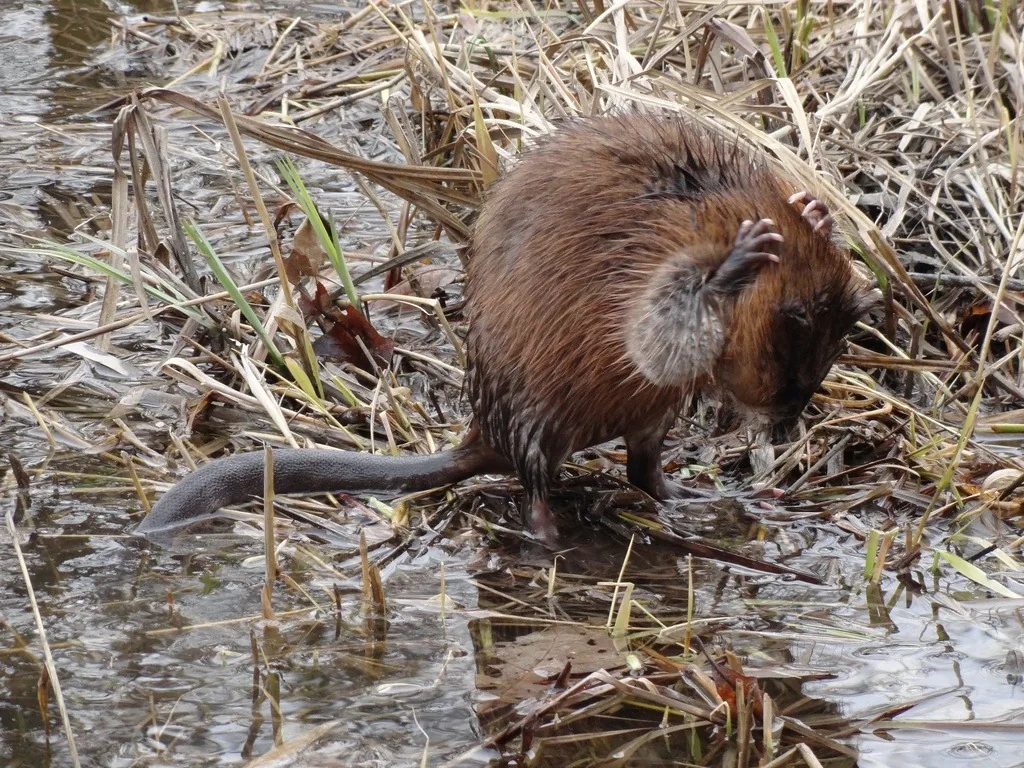
How to identify it
- An adult typically weighs about 2.5 pounds and is 22 to 25 inches long, including a tail of about 11 inches.[2][3]
- The tail is scaly, nearly hairless and flattened from side to side, unlike the wide, flat tail of a beaver or the round tail of a nutria.[1][2]
- Muskrats are stocky, with small eyes, very short rounded ears and large, partly webbed hind feet built for swimming.[1][3]
- Fur is dark tan to reddish brown, dark brown or even black on the back, with a lighter gray, silver or tan belly.[1]
- Signs include burrow entrances below the waterline, muddy water near dens, floating cut vegetation, and small pellet-sized droppings on rocks or logs at the shore.[2][3][1]
Look-alikes
| Look-alike | How to tell them apart |
|---|---|
| Beaver | Beavers are far larger, have a broad, horizontally flattened tail, and build dams and cut trees, which muskrats do not do.[1] |
| Nutria | Nutria are much bigger and have a round tail; their burrow entrances can be 14 to 20 inches across, while muskrat entrances are usually no more than 5 to 6 inches.[1] |
Where it lives
Muskrats live in marshes, wetlands and other aquatic habitats across North America, from northern Mexico to northern Alaska and much of Canada, but are uncommon in dry desert areas.[1]
Biology and life cycle
Muskrats either dig burrows into banks, dikes and dams or build dome-shaped lodges of plants and mud in open water, with underwater entrances and dry living chambers above.[1][2][3]
Burrow entrances are usually 6 to 18 inches below the water surface, and den entrances can sit from a few inches to about 3 feet deep.[2][3]
They feed mostly on the roots and stems of cattails, sedges, bulrushes and other water plants, but also eat crops near water and sometimes crayfish and mussels.[1][2][3]
Muskrats are mainly active at night, do not hibernate, and are excellent swimmers that can stay under water for 15 to 20 minutes.[1][3]
In northern areas litters average 4 to 7 young, with up to 3 litters a year; in the South, litters are smaller but breeding can go on all year.[1]
Damage and signs
- The main concern is burrowing into pond dams, levees and lake banks, which can cause water leaks, loss of stored water, muddy water and cave-ins.[2][3][1]
- Burrows can also damage dikes and road and railroad beds, and the damage may not be obvious until it is serious.[1]
- Muskrats eat garden and field crops grown near water, such as corn and rice, and heavy feeding can strip marsh areas of plants.[1][3]
- They may also gnaw into flotation material under boat docks and platforms.[1]
Health risk
Muskrats can carry tularemia, a bacterial disease spread through contaminated water, infected meat or an open cut, plus leptospirosis and ringworm. Wear rubber gloves when handling them, and expect a live muskrat to bite and scratch.[1]
Control
Prevention
Act early: watch the shoreline for burrows, muddy water and droppings, because muskrats are much easier to handle before a population becomes established.[2][3]
Lowering the pond at least 2 feet below normal exposes dens; fill the burrows and runs, then riprap the dam before refilling.[1][3]
Pond dams built with gentle slopes and a wide top are less prone to muskrat damage; repair any weak spots right away.[3]
Keep them out
Riprap the dam or bank with a layer of coarse stone or gravel about 6 inches thick, from 1 foot above to 3 feet below the waterline, to discourage burrowing.[2][3][1]
Galvanized wire mesh with 1- or 2-inch openings, laid flat on the bank from 1 foot above to at least 3 feet below the water and fastened every few feet, also stops digging; skip it in swimming ponds because it corrodes.[2][3]
Pesticides
No repellents are registered for muskrats, and frightening devices typically don't work.[1]
When to call a professional
Trapping is the most effective way to remove damaging muskrats, but it takes skill and must follow your state's seasons and trap rules; a licensed trapper or wildlife agency can help.[2][3][1]
Legal status varies by state
Muskrats are trapped as furbearers in virtually every state, and the rules on seasons, bag limits and allowed traps vary by state.[1][3]
Some states let landowners remove muskrats that are damaging property, and Missouri, for example, allows shooting or trapping nuisance muskrats year-round without a permit.[1][3]
Moving live muskrats to another site is not allowed in most states, so check with your state wildlife agency before trapping, shooting or relocating any.[1][2]
Common questions
- How do I know muskrats are damaging my pond?
- Walk the shoreline when the water is clear and look for underwater runs and burrow entrances, muddy water near the bank, floating plant pieces and small droppings on rocks.[2][1]
- How do I keep muskrats from digging into my dam?
- Cover the waterline zone of the dam with a thick layer of riprap or with galvanized wire mesh, from about a foot above to three feet below the water.[2][3]
- Are muskrats the same as beavers or nutria?
- No. Muskrats are much smaller and have a narrow tail flattened side to side, and unlike beavers they don't build dams or cut down trees.[1]
Sources
- USDA APHIS Wildlife Services, “Muskrats, Wildlife Damage Management Technical Series (J. E. Miller, January 2018).” www.aphis.usda.gov/sites/default/files/Muskrat-WDM-Technical-Series.pdf (accessed 2026-10-06)
- Penn State Extension, “Pond and Lake Wildlife: Muskrats (updated December 18, 2023).” extension.psu.edu/pond-and-lake-wildlife-muskrats (accessed 2026-10-06)
- University of Missouri Extension, “Controlling Nuisance Muskrats in Missouri Ponds and Lakes, Guide G9400 (R. A. Pierce II).” extension.missouri.edu/media/wysiwyg/Extensiondata/Pub/pdf/agguides/wildlife/g09400.pdf (accessed 2026-10-06)
- iNaturalist, “Ondatra zibethicus taxon page (order and family).” www.inaturalist.org/taxa/45763 (accessed 2026-10-06)