How to identify it
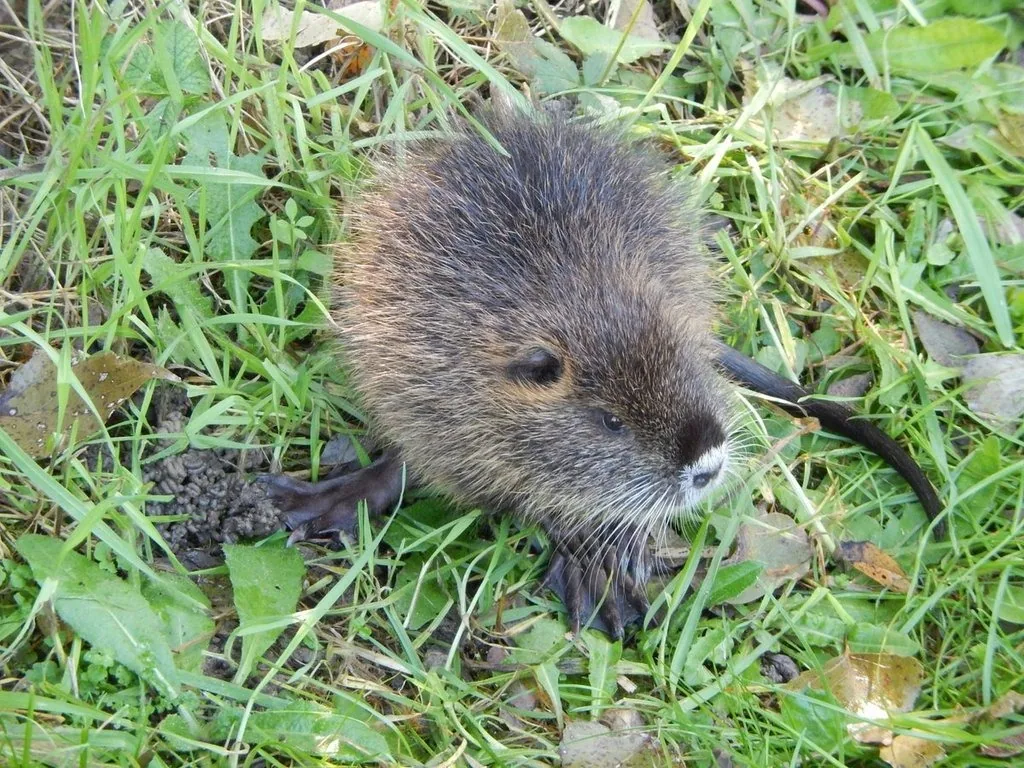
- Nutria have a robust, arched body about 24 inches long and a round, thinly haired tail 13 to 16 inches long; adults average about 12 pounds.[1]
- The large front teeth are yellow-orange to orange-red on the outside.[1]
- Fur is dense gray underfur covered by long, glossy guard hairs ranging from dark brown to yellow-brown.[1][5]
- Four of the five toes on each hind foot are webbed, and on land nutria often drag the chest and look hunched.[1]
- Droppings are dark green or black, about 2 inches long and half an inch thick, with deep grooves running their length.[1]
Look-alikes
| Look-alike | How to tell them apart |
|---|---|
| Beaver | Beavers have a broad, flat tail; nutria have a long, round, thinly haired tail. The two are easily confused when swimming.[1][7] |
| Muskrat | Muskrats are much smaller, with a tail flattened side to side. Nutria feeding platforms of piled plants are often mistaken for muskrat houses.[7][2] |
Where it lives
Nutria are established in 17 states, mostly across the South and East, with the densest U.S. populations in southwest Louisiana and southeast Texas; extreme cold limits their spread northward.[6][1]
Biology and life cycle
Nutria breed year-round, reach maturity in as little as 5 months, and females usually have 3 litters a year averaging 4 to 5 young each.[2]
Young are born fully furred and active, and can swim and eat plants shortly after birth.[2]
They live in burrows dug into steep, vegetated banks or taken over from other animals; tunnels are usually 4 to 6 feet long but can reach 150 feet.[2][6]
Nutria are mostly active at dusk and night, and they are almost entirely plant eaters, eating about a quarter of their body weight each day.[2]
Most wild nutria live less than 3 years; they keep small home ranges, and daily movements are usually under 600 feet.[2]
Damage and signs
- Burrowing is the biggest problem: tunnels weaken levees, dams, stream banks, roadbeds and canals, which can collapse when soil is soaked or carries heavy loads.[3][6]
- They burrow under buildings, causing uneven settling of foundations, and chew into foam floats under docks so they lean or sink.[3]
- Nutria eat the roots, rhizomes and tubers of marsh plants, not just the leaves, which can turn marsh into open water as the exposed soil erodes.[6][5][3]
- Sugarcane and rice are the main crops damaged, and they also eat garden vegetables, dig up lawns and golf courses, and girdle fruit, nut and shade trees.[3][6]
Health risk
Nutria can carry diseases such as tuberculosis and septicemia, and parasites that cause swimmer's itch and giardiasis; their droppings can foul water. Cornered nutria bite and scratch, and bites have happened where people fed them.[6][3][2]
Control
Prevention
Never feed nutria. Feeding makes them active and bold around people, and bites have occurred at feeding sites.[3][2]
Keep them out
Protect gardens and lawns with a 4-foot fence of 2-inch mesh with an apron buried at least 6 inches deep and extending 12 inches out.[4]
A single electric wire 6 inches above the ground has kept nutria out; use hardware cloth tubes around seedlings and sheet metal shields on trees and wooden or foam structures.[4]
Riprap, gabions, bulkheads or sheet piling can protect banks from burrowing but are costly and usually reserved for high-value sites.[4]
Sanitation
Clear brush piles, thickets and weeds near water, drain standing water from ditches, and grade steep banks to slopes under 45 degrees to discourage burrowing.[4]
Traps and physical control
Noise, water spray and other harassment work only briefly, and no repellents are registered for nutria.[4]
When to call a professional
Trapping and shooting are the main removal methods, and the only registered toxicant is a Restricted Use Pesticide for certified applicators; contact your state wildlife agency or USDA Wildlife Services for help.[4][6]
Invasive, but legal status varies by place
In some places nutria are protected furbearers and a permit may be needed to remove damaging animals; elsewhere they are unprotected invasive animals that can be taken at any time by legal means.[1]
Night shooting is illegal in many states without a permit, and cable restraints aren't legal everywhere, so check local rules first.[4]
USDA Wildlife Services led the first large-scale effort to eradicate a mainland nutria population, on Maryland's Delmarva Peninsula, and helps with nutria control in Gulf Coast states.[6]
Louisiana's Coastwide Nutria Control Program, started in 2002, pays registered trappers and hunters to remove nutria, and the state reports marsh damage has dropped by more than 90 percent since.[5]
Common questions
- Is a nutria a beaver or a giant rat?
- Neither. It's a separate South American rodent sometimes called coypu, nutria-rat or swamp beaver. Its long, round tail sets it apart from a beaver's flat paddle tail.[1]
- Why are nutria such a problem in marshes?
- They eat marsh plants down to the roots, leaving bare soil that tides wash away, so damaged marsh can become open water.[5][6]
- Can I trap nutria in my yard?
- It depends on where you live. Some areas treat nutria as unprotected invaders, while others require permits, so check with your state wildlife agency first.[1][6]
Sources
- Internet Center for Wildlife Damage Management, “Nutria: Identification.” icwdm.org/species/rodents/nutria/ (accessed 2026-10-06). Run by university wildlife damage specialists; species modules are based on Prevention and Control of Wildlife Damage (University of Nebraska Cooperative Extension, 1994).
- Internet Center for Wildlife Damage Management, “Nutria Biology.” icwdm.org/species/rodents/nutria/nutria-biology/ (accessed 2026-10-06). Run by university wildlife damage specialists; species modules are based on Prevention and Control of Wildlife Damage (University of Nebraska Cooperative Extension, 1994).
- Internet Center for Wildlife Damage Management, “Nutria Damage Identification.” icwdm.org/species/rodents/nutria/nutria-damage-identification/ (accessed 2026-10-06). Run by university wildlife damage specialists; species modules are based on Prevention and Control of Wildlife Damage (University of Nebraska Cooperative Extension, 1994).
- Internet Center for Wildlife Damage Management, “Nutria Damage Prevention and Control Methods.” icwdm.org/species/rodents/nutria/nutria-damage-prevention-and-control-methods/ (accessed 2026-10-06). Run by university wildlife damage specialists; species modules are based on Prevention and Control of Wildlife Damage (University of Nebraska Cooperative Extension, 1994).
- Louisiana Department of Wildlife and Fisheries, “Nutria (Myocastor coypus) and the Coastwide Nutria Control Program.” www.wlf.louisiana.gov/page/nutria (accessed 2026-10-06)
- USDA APHIS Wildlife Services, “Operational Activities: Nutria.” www.aphis.usda.gov/operational-wildlife-activities/nutria (accessed 2026-10-06)
- USDA APHIS Wildlife Services, “Muskrats, Wildlife Damage Management Technical Series (J. E. Miller, January 2018).” www.aphis.usda.gov/sites/default/files/Muskrat-WDM-Technical-Series.pdf (accessed 2026-10-06)
- iNaturalist, “Myocastor coypus taxon page (order and family).” www.inaturalist.org/taxa/43997 (accessed 2026-10-06)