On this page
How to identify it
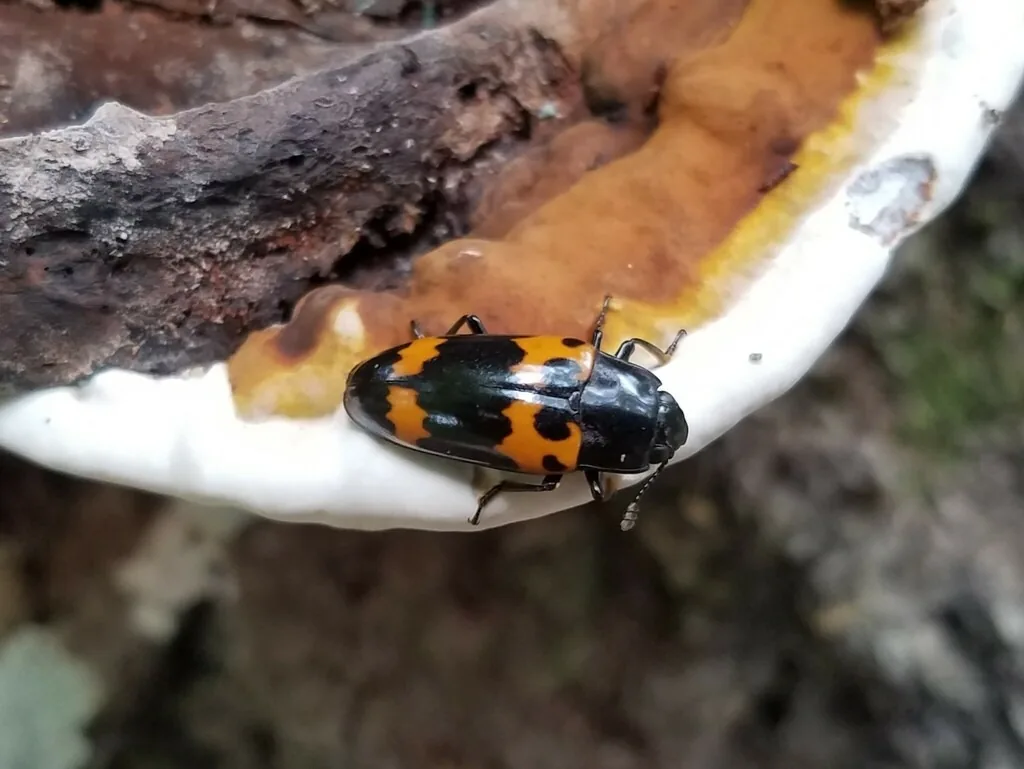
- Most eastern species are black with a red or orange head and thorax or with orange markings, smooth and hairless, with clubbed antennae.[1]
- Sizes range from about 1/16 inch in Dacne to 1/2 to 7/8 inch in Megalodacne; most Florida species are under 3/8 inch.[1]
- Colorado's common western species, Gibbifer californicus, has blue or purple wing covers with dark pits and fades after death.[2]
Where it lives
About 51 species occur in America north of Mexico, 18 in Florida; in Colorado the common species lives in pine and aspen forests.[1][2]
Biology and life cycle
Each species tends to specialize on certain fungi: larger species on hard bracket fungi on dead trees and stumps, others on oyster mushrooms or soft conks.[1][2]
Larvae develop quickly inside the fungus, sometimes two weeks from egg to pupa; adults gather on the fungus or under bark when fungi aren't fruiting.[1][2]
In Colorado there is one generation a year, and full-grown larvae may pupate in hanging clusters under logs.[2]
Damage and signs
- They are not economically important in the United States; they feed on fungi, not on plants or wood, and some feed on fungi that rot hardwood trees.[1]
Health risk
Control
Prevention
No control is needed; they live on fungi on dead wood.[1][2]
Common questions
- What are the shiny black-and-orange beetles on the shelf fungus on my stump?
- Likely pleasing fungus beetles, which feed on bracket fungi.[1]
- Do pleasing fungus beetles damage trees?
- No; they eat fungi, not wood or leaves.[1]
- Why are there so many of them together?
- Adults gather on their host fungus, or under bark when fungi aren't fruiting.[1]
Sources
- University of Florida IFAS Extension (EDIS, Featured Creatures), “Pleasing Fungus Beetles, Pseudischyrus, Tritoma, Megalodacne, Ischyrus spp. (EENY-091/IN248).” ask.ifas.ufl.edu/publication/IN248 (accessed 2026-10-15)
- Colorado State University Extension (Colorado Insects of Interest, W. Cranshaw), “Pleasing Fungus Beetle (Colorado Insect of Interest).” wci.extension.colostate.edu/wp-content/uploads/sites/14/2017/03/PleasingFungusBeetle.pdf (accessed 2026-10-15)
- iNaturalist, “Megalodacne taxon page (order and family).” www.inaturalist.org/taxa/82102 (accessed 2026-10-06)