On this page
How to identify it
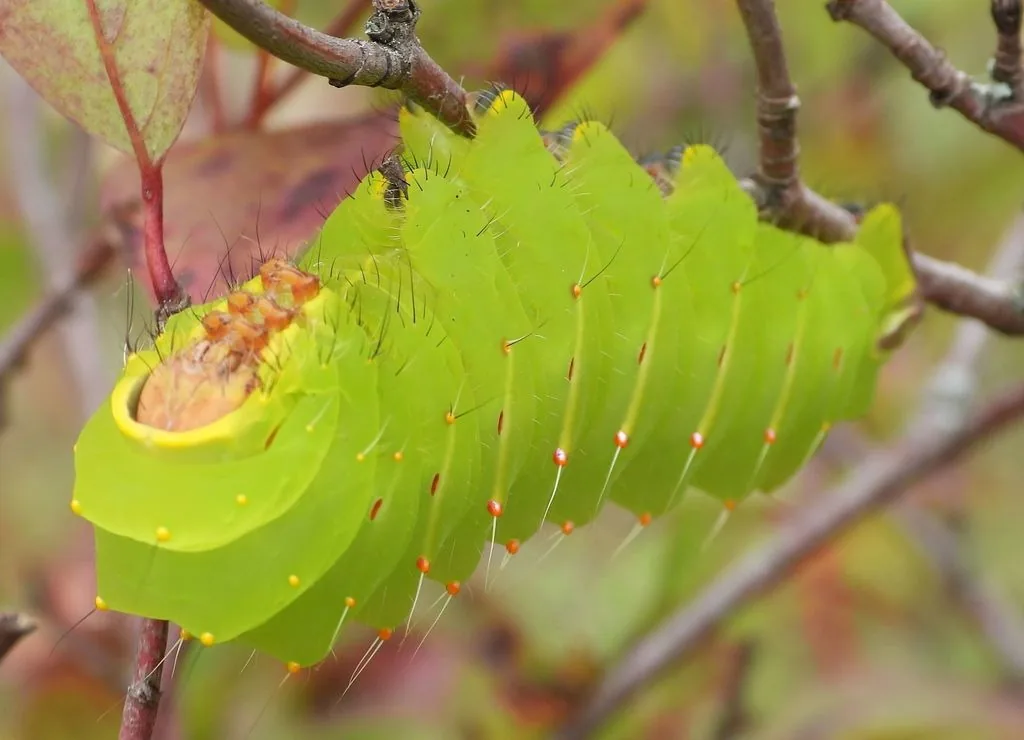
- Full-grown caterpillars are bright to yellowish green, about 2 1/3 to 3 inches long, with orange to red bristly bumps and a yellow line running through the spiracles on each side.[1][2]
- Adults have a 4- to 6-inch wingspan, are reddish brown, gray or yellow-brown, and have clear-centered eyespots, the hind-wing ones ringed in yellow, white and black.[1]
- Mature caterpillars spin tough silk cocoons attached to twigs or leaves or found on the ground.[1][2]
Look-alikes
Where it lives
A widespread native silk moth; MU Extension reports caterpillars in Missouri yards from May to October.[1][2]
Biology and life cycle
MU Extension reports caterpillars from May to October with multiple generations a year in Missouri.[2]
Caterpillars pupate in silk cocoons on twigs, leaves or the ground.[2]
Damage and signs
Health risk
Neither source reports any risk to people or pets; silk moth caterpillars are not considered pests.[1][2]
Control
Prevention
No control is needed; silk moth caterpillars are usually not considered pests.[2]
Common questions
- What is the huge green caterpillar on my oak?
- Possibly a polyphemus moth caterpillar, which grows to about 3 inches.[1][2]
- Will it hurt my tree?
- Rarely; their numbers seldom reach damaging levels.[2]
- Why does the moth have eyes on its wings?
- Its large hind-wing eyespots give it the name, after the one-eyed giant Polyphemus.[1]
Sources
- University of Florida IFAS Extension (EDIS, Featured Creatures), “Polyphemus Moth, Antheraea polyphemus (EENY-531/IN945).” ask.ifas.ufl.edu/publication/IN945 (accessed 2026-10-15)
- University of Missouri Extension (Caterpillars in Your Yard and Garden, IPM1019), “Caterpillars in Your Yard and Garden, page 34: Polyphemus moth.” extension.missouri.edu/publications/ipm1019-34 (accessed 2026-10-15)
- iNaturalist, “Antheraea polyphemus taxon page (order and family).” www.inaturalist.org/taxa/47919 (accessed 2026-10-06)