On this page
How to identify it
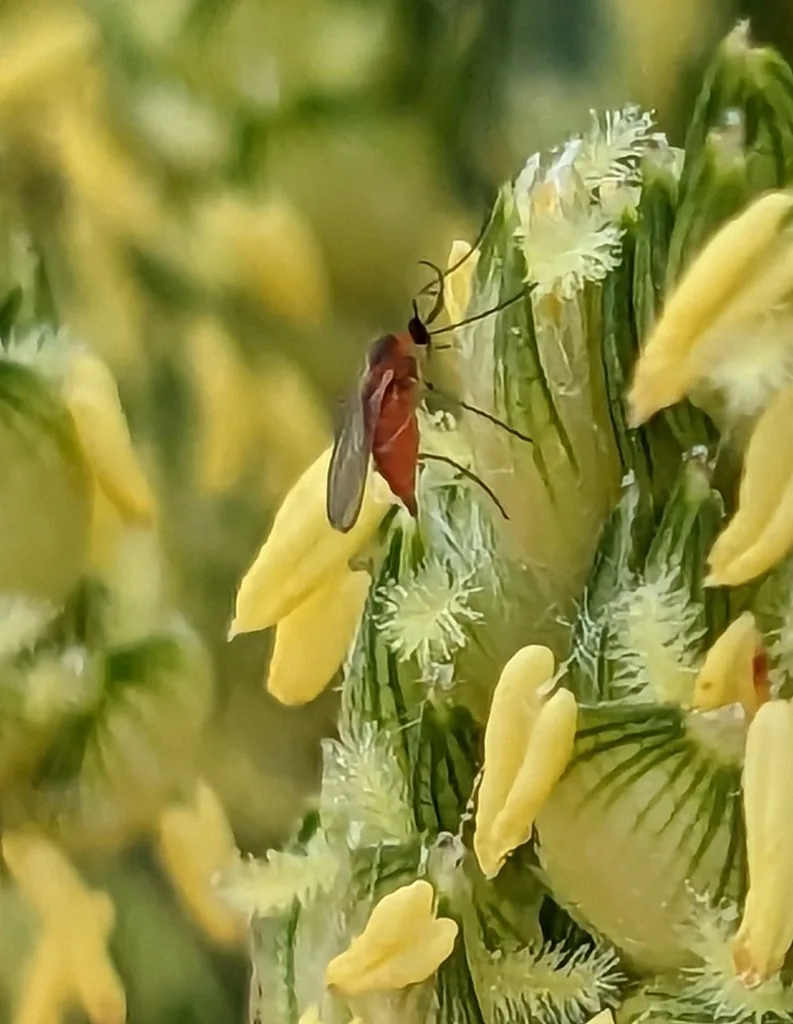
- The adult is a small, fragile-looking orange-red fly, barely 1/4 inch long, with a yellow head, brown antennae and legs and gray membranous wings; it looks slightly like a small red mosquito, and the red-orange abdomen is the easiest mark, with magnification needed to see the leg and antenna color.[1][2][3]
- The reddish, gnat-like adults crawl on or fly about flowering grain heads; they are weak fliers that depend on wind to disperse, so they are most abundant along field edges. Almost all the midges seen on flowering heads are females laying eggs.[1][2]
- Larvae are colorless at first and dark orange when fully grown, developing inside the spikelet. After the adult emerges it leaves a clear or white pupal skin at the tip of the spikelet, which Texas A&M calls a sure sign of sorghum midge damage.[1]
Look-alikes
| Look-alike | How to tell them apart |
|---|---|
| Sorghum aphid | Both are sorghum head pests, but the midge is a red fly on flowering heads rather than an aphid colony; treating for midge can flare sorghum aphid because the insecticides kill the aphid's natural enemies.[3] |
| Headworms (corn earworm and fall armyworm) | Headworm larvae feed on the flowers and then hollow out developing kernels, leaving frass and kernel fragments on the upper leaves and ground, whereas the midge larva is hidden inside a spikelet that simply never fills.[1] |
Where it lives
A pest of sorghum throughout subtropical regions and one of the most damaging sorghum insects in Texas, especially the southern half of the state; historically rare north of the Oklahoma border, but significant infestations occurred in southwest and southeast Kansas from 2017 to 2019.[1][3]
Biology and life cycle
Sorghum midges overwinter in cocoons inside spikelets of sorghum or johnsongrass that fall to the ground and become covered with litter. Adults emerge in spring before sorghum flowers and infest johnsongrass, and the midges that develop there disperse to sorghum when it flowers.[1][2]
The adult lives one day. During that day each female lays about 50 yellow-white eggs in flowering spikelets; the eggs hatch in two to three days, the larvae finish feeding in 9 to 11 days and pupate between the glumes, and the pupa works up to the spikelet tip before the adult emerges.[1]
A generation takes 14 to 16 days under favorable conditions (Kansas State says the cycle can be completed in 21 days), and there are many generations a year. Numbers climb with each generation, so late-planted or late-flowering sorghum is at the greatest risk from adults moving in from earlier fields; populations often drop late in the season.[1][3]
Eggs are laid only while yellow anthers are exposed. A single head takes 7 to 9 days to finish flowering and a field two to three weeks, and once the anthers turn reddish brown the head is no longer susceptible.[1]
Damage and signs
- The larva feeds on the newly fertilized ovary and prevents normal kernel development. The glumes of an infested spikelet fit tightly together because no kernel forms, and the head ripens with normal kernels scattered among blank spikelets distributed up and down the panicle.[1][3]
- The larvae from a single female destroy an average of 45 kernels, and grain loss can be extremely high; Kansas State notes the larvae may blast the grain.[1][3]
- Early-season infestations are usually below damaging levels; damage builds later in the season as populations grow and late-flowering sorghum becomes available.[1]
Health risk
The sources treat the sorghum midge only as a pest of sorghum and johnsongrass and mention no effect on people.[1][3]
Control
Prevention
Plant early and uniformly so the crop flowers before midge numbers reach damaging levels; cultural practices that give uniform heading and flowering shorten the window when the field is susceptible, and late-planted sorghum is especially vulnerable.[1]
Begin scouting at head emergence when the first yellow blooms appear, at midmorning once temperatures reach about 85 F, and almost daily because a new brood of one-day adults emerges each day. Inspect flowering heads up close, or slip a clear plastic bag over the head and tap it, or beat the head into a white bucket; Kansas State strikes at least 10 heads into a bucket at five spots per field. Check field borders downwind of earlier sorghum or johnsongrass first; if borders exceed one midge per flowering head, sample at least 20 flowering heads per 20 acres (40 in smaller fields) away from the edges.[1][2][3]
Kansas State uses an economic threshold of one midge per flowering head. Texas A&M calculates an economic injury level from control cost, grain value and the number of flowering heads per acre, with an online calculator.[3][1]
Sanitation
Use cultivation or herbicides to eliminate johnsongrass inside and outside the field, since the spring generation builds up on it, and where practical disk and deep-plow the previous year's sorghum residue to destroy overwintering midges.[1]
Pesticides
Insecticides labeled for sorghum midge in Texas include alpha-cypermethrin, beta-cyfluthrin, chlorpyrifos and chlorpyrifos mixed with gamma- or lambda-cyhalothrin, several of them restricted-use. Residues should kill adults and stop egg laying for one to two days; if adults are still present three to five days after the first spray, treat again, and repeated applications at three-day intervals may be justified when yield potential is high. These products harm the natural enemies that suppress sorghum aphid, so a midge treatment can flare that pest.[1][3]
Common questions
- Why are parts of my sorghum head empty?
- Sorghum midge larvae feeding on the fertilized ovaries prevent kernels from forming, leaving tight, empty glumes scattered among normal kernels along the panicle, often with a clear pupal skin at the spikelet tip.[1][3]
- When is sorghum vulnerable to midge?
- Only during flowering, while yellow anthers are exposed: about 7 to 9 days for a head and two to three weeks for a field. Once anthers turn reddish brown the head is safe, which is why early, uniform planting is the main defense.[1]
- How do I check for sorghum midge?
- Scout flowering heads at midmorning, nearly every day, starting along downwind field edges; watch a head for a moment, bag it and tap, or beat it into a white bucket and count the small red midges. One midge per flowering head is Kansas State's threshold.[1][2][3]
Sources
- Texas A&M AgriLife Extension Service, Department of Entomology, “Insects that feed on developing grain in the head, Managing Insect and Mite Pests of Texas Sorghum.” extensionentomology.tamu.edu/resources/management-guides/sorghum/insects-that-feed-on-developing-grain-in-the-head/ (accessed 2026-11-10)
- Texas A&M AgriLife Extension Service, “The Sorghum Midge, South Texas Field Crop Entomology pest identification page.” agrilife.org/sca/the-sorghum-midge/ (accessed 2026-11-10)
- Kansas State University Research and Extension, “Sorghum Insect Pest Management 2026, MF742.” bookstore.ksre.ksu.edu/pubs/MF742.pdf (accessed 2026-11-10)
- iNaturalist, “Stenodiplosis sorghicola taxon page (order and family).” www.inaturalist.org/taxa/259255 (accessed 2026-11-10)