On this page
How to identify it
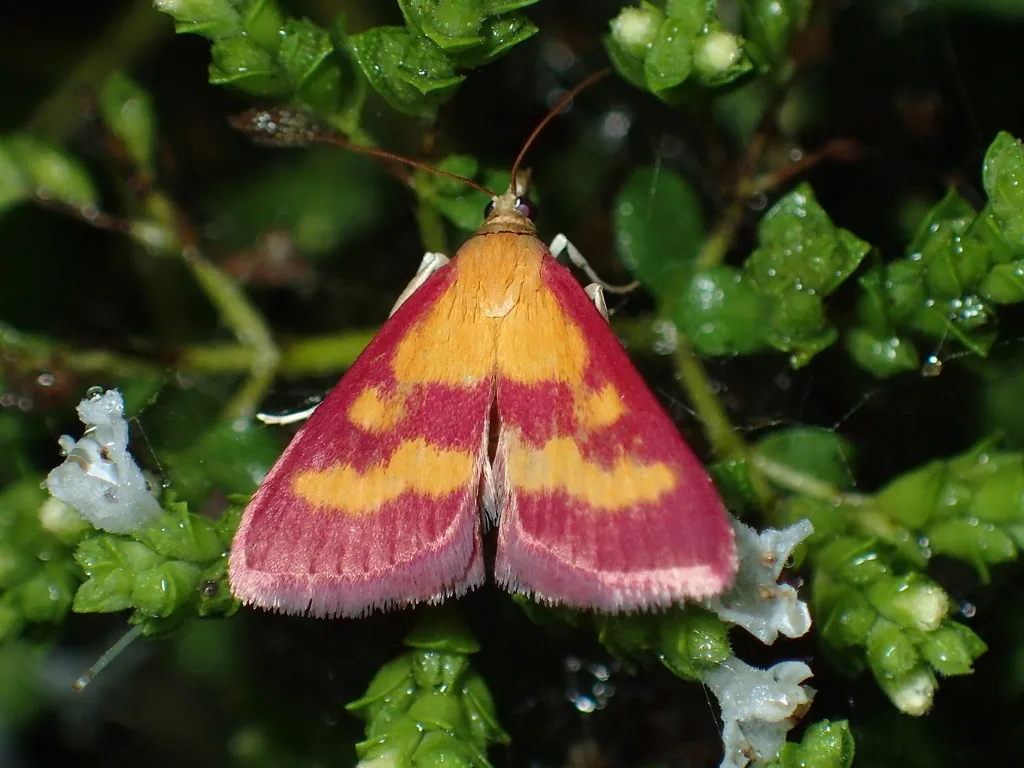
- Moths have a wingspan of about 3/4 inch, with reddish-purple to pinkish wings marked with yellow bands; they sit in a triangular shape.[1][2]
- Caterpillars are small and slender, pale brown to green, with rows of black spots down the back and sides.[1][2]
- Infestations show as masses of dead leaves held together by webbing studded with frass pellets, often on the upper parts of branches.[1][2]
Look-alikes
| Look-alike | How to tell them apart |
|---|---|
| Spider webbing | Clemson notes spider webs are sometimes mistaken for an early infestation; look for the spotted caterpillars.[2] |
Where it lives
Native to the Southeast; Clemson reports it on rosemary throughout the Charleston, South Carolina, area for over 10 years.[1][2]
Biology and life cycle
Little has been published on its biology; the caterpillars spin loose webbing as they feed, and frass collects in it.[1][2]
Damage and signs
Health risk
Control
Traps and physical control
Prune away and dispose of infested, webbed branches.[2]
Pesticides
Spray Bacillus thuringiensis (Bt) products labeled for caterpillars; they kill only caterpillars but may need several applications.[2]
Common questions
Sources
- NC State Extension, “Southern Purple Mint Moth (PDIC Factsheet).” content.ces.ncsu.edu/southern-purple-mint-moth (accessed 2026-10-16)
- Clemson Cooperative Extension Home & Garden Information Center, “Question of the Week: Southern Purple Mint Moth.” hgic.clemson.edu/question-of-the-week-southern-purple-mint-moth/ (accessed 2026-10-16)
- iNaturalist, “Pyrausta laticlavia taxon page (order and family).” www.inaturalist.org/taxa/204081 (accessed 2026-10-06)