On this page
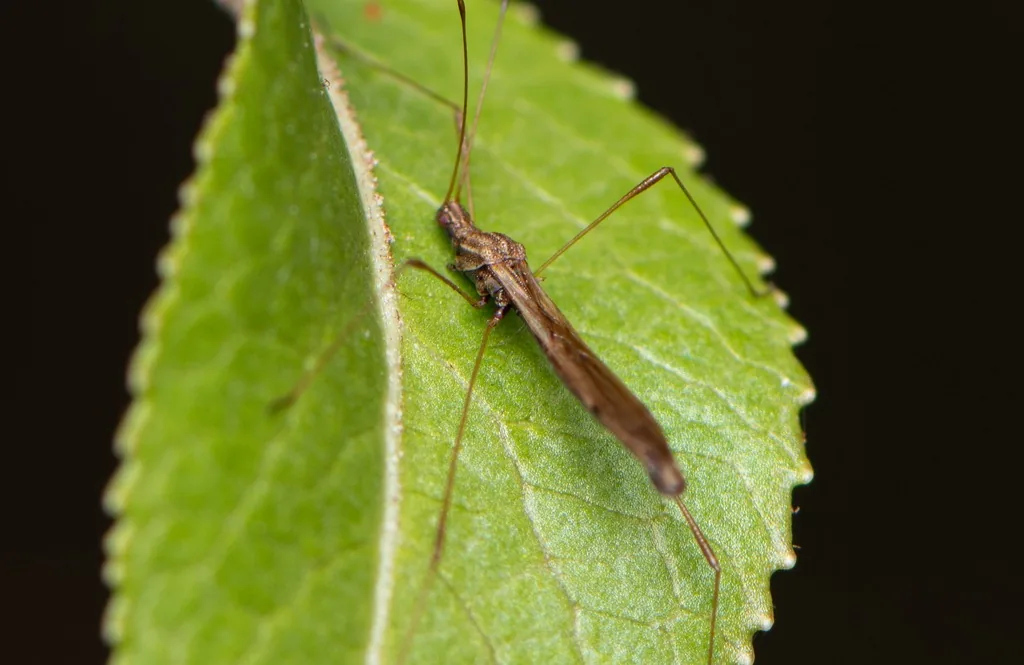
How to identify it
Look-alikes
| Look-alike | How to tell them apart |
|---|---|
| Jalysus spinosus | A similar stilt bug prefers grasses and is limited to eastern North America, while the spined stilt bug lives on hairy, sticky-leaved plants.[1] |
Where it lives
Found across North America from Canada to Mexico and recorded in almost every continental U.S. state.[1][2]
Biology and life cycle
Adults overwinter under grasses and leaves and lay eggs on weeds and other plants in spring; nymphs pass through five stages and need both plant and animal food.[1]
In North Carolina there are typically two generations a year.[1]
Damage and signs
Health risk
Control
Prevention
Penn State notes that control in tomatoes hasn't been studied; the products tested decades ago are no longer used, so there is no current tested recommendation for gardens.[2]
Biological control
It is a beneficial predator in tobacco; Bt sprays for caterpillars don't harm it.[1]
Common questions
- What is the very skinny, long-legged bug on my tomato plants?
- Likely a spined stilt bug.[1][2]
- Is the spined stilt bug good or bad?
- Both: it eats caterpillar eggs but can damage tomato flowers and fruit.[1][2]
- Why do my tomatoes have white blotches?
- Stilt bug feeding on unripe fruit is one cause of white blotches under the skin.[2]
Sources
- NC State Extension, “Spined Stilt Bug in Tobacco (PDIC Factsheet).” content.ces.ncsu.edu/spined-stilt-bug-in-tobacco (accessed 2026-10-15)
- Penn State Extension, “Spined Stilt Bug.” extension.psu.edu/spined-stilt-bug/ (accessed 2026-10-15)
- iNaturalist, “Jalysus wickhami taxon page (order and family).” www.inaturalist.org/taxa/416821 (accessed 2026-10-06)