How to identify it
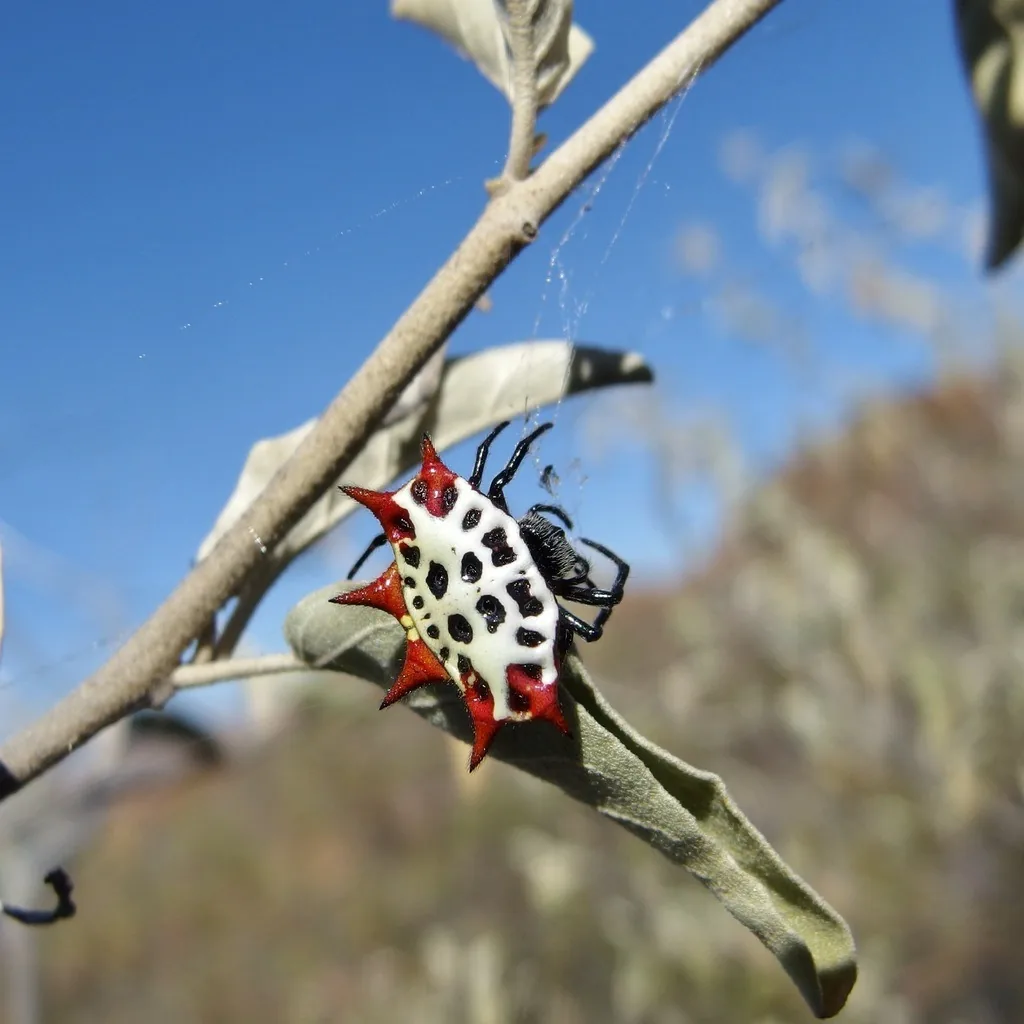
- Females have a hard, wider-than-long body about 3/16 to 1/3 inch long and 3/8 to 1/2 inch wide, with six pointed spines around the edge.[1][2]
- In Florida the top of the body is typically white with black spots and red spines; elsewhere it may be yellow or orange, with black or red spines.[1][2]
- The legs and the area behind the head are black, with white spots on the underside of the abdomen.[1]
- Males are tiny, about 1/16 to 1/8 inch long, grayish with white spots, and lack the large spines.[1][2]
- The web often has small tufts of silk along its support lines, and the spider rests at the center by day.[1][2]
Look-alikes
| Look-alike | How to tell them apart |
|---|---|
| Garden orb weavers | Other common orb weavers, such as Argiope garden spiders, are larger; some, the spiny-bellied orb weavers, have thorn-like points on the abdomen.[1][4] |
| Crab spiders | In parts of Florida people call this spider a crab spider, but it isn't related to true crab spiders, which hunt without webs.[1][3] |
Where it lives
Found from the southern United States to northern Argentina; common throughout the South, especially in late summer and fall.[1][2]
Biology and life cycle
Webs go up along wooded edges, in home landscapes, nurseries and citrus groves, anywhere from under 3 feet to nearly 20 feet off the ground.[2][1]
Webs are 1 to 2 feet across and catch whiteflies, flies, moths and beetles.[1]
In Florida, adult females occur all year but are most common from October through January.[1]
Females lay egg masses of about 100 to 250 eggs on the undersides of leaves next to the web, wrapped in white, yellow and dark green silk.[1]
The hard, spiny shell protects them from birds and other predators that might otherwise eat a spider sitting in the open.[2]
Damage and signs
Health risk
Bites are occasional and usually happen when someone walks into a web and swats the spider. Mississippi State compares the pain to a fire ant sting with no lasting ill effects.[2][1]
Control
Prevention
Outdoors, no control is needed; spiders are beneficial predators of insects.[3][4]
Traps and physical control
If a web is in a doorway or path, knock it down with a broom or a strong spray of water.[3]
Pesticides
UC IPM notes that insecticides won't provide long-term spider control and generally shouldn't be used against spiders outdoors.[3]
Common questions
- Is the spiny-backed orb weaver poisonous?
- Its bite is not known to cause serious effects in people. A bite feels about like a fire ant sting and usually leaves no lasting effects.[1][2]
- Why does it have spines?
- The hard, spiny shell makes it too hard and prickly for birds and other predators to swallow.[2]
- What are the little tufts of silk on its web?
- Their purpose is unknown; one idea is that they make the web more visible to birds so they don't fly through it.[1]
Sources
- University of Florida, UF/IFAS Extension (EDIS), “Spiny Orb Weaver Spider, Gasteracantha cancriformis (Linnaeus), EENY-167 (Featured Creatures, revised June 2024).” edis.ifas.ufl.edu/publication/IN324 (accessed 2026-10-06)
- Mississippi State University Extension Service, “Spinybacked Orbweaver (Bug's Eye View, Vol. 4, No. 31), by Blake Layton.” extension.msstate.edu/newsletters/bugs-eye-view/2018/spinybacked-orbweaver-vol-4-no-31 (accessed 2026-10-06)
- University of California Statewide IPM Program, “Spiders (Pest Notes, Home and Landscape).” ipm.ucanr.edu/home-and-landscape/spiders/ (accessed 2026-10-06)
- University of Kentucky Entomology, “ENTFACT-622: Common Spiders Found Around Homes and Buildings.” entomology.mgcafe.uky.edu/ef622 (accessed 2026-10-06)
- iNaturalist, “Gasteracantha cancriformis taxon page (order and family).” www.inaturalist.org/taxa/49540 (accessed 2026-10-06)