On this page
How to identify it
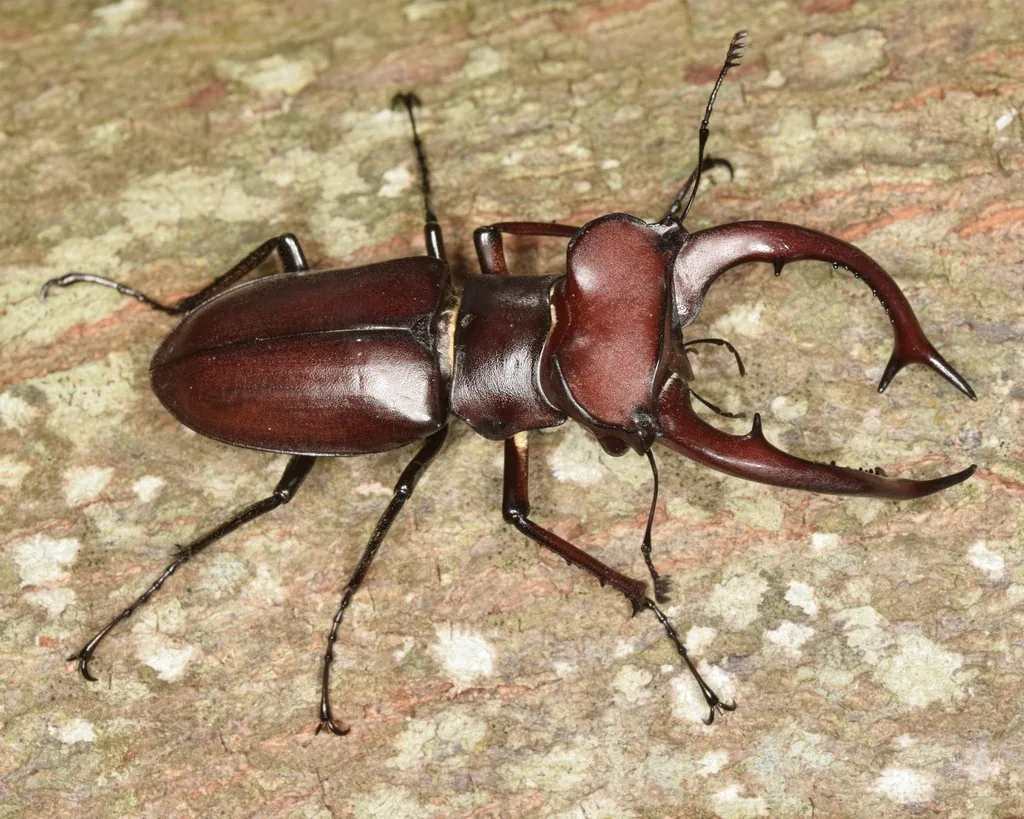
- Adults are dark reddish brown to nearly black; the southwestern stag beetle is 25-35 mm long, and males of the giant stag beetle have jaws that may be as long as the rest of the body.[1][2]
- Males have far larger jaws than females, which makes the sexes easy to tell apart.[1][2]
- Larvae are pale, C-shaped grubs found in rotting wood.[1][2]
Where it lives
Clemson reports seven species in South Carolina, with the giant stag beetle the largest; it ranges west to Oklahoma and Nebraska, while the southwestern stag beetle lives in forests of western and southwestern Colorado.[1][2]
Biology and life cycle
Most of the 3- to 5-year life cycle is spent as a grub feeding in decaying wood; the giant stag beetle's larvae develop in oak stumps.[1][2]
Adults live only a few months, mainly May to August in South Carolina and mid-July to mid-August for the southwestern species; they fly at night and come to lights.[1][2]
Damage and signs
Health risk
Clemson says they are harmless and will not hurt people or pets; the males' jaws are for fighting other males, not biting people.[1]
Control
Prevention
No control is needed; leave them be, or move a beetle outdoors.[1]
Common questions
- Do stag beetles pinch?
- They're sometimes called pinching bugs, but Clemson says they are harmless; the males' jaws are for fighting rivals.[1]
- Can stag beetles fly?
- Yes; despite their bulk, adults fly, mostly at night, and come to lights.[1][2]
- Where do stag beetle grubs live?
- In rotting wood, such as stumps and fallen trees, for several years.[1][2]
Sources
- Clemson Cooperative Extension Home & Garden Information Center, “Stag Beetles.” hgic.clemson.edu/stag-beetles/ (accessed 2026-10-15)
- Colorado State University Extension (Colorado Insects of Interest, W. Cranshaw), “Southwestern Stag Beetle (Colorado Insect of Interest).” wci.extension.colostate.edu/wp-content/uploads/sites/14/2017/03/SouthwesternStagBeetle.pdf (accessed 2026-10-15)
- iNaturalist, “Lucanus taxon page (order and family).” www.inaturalist.org/taxa/60813 (accessed 2026-10-06)