Multiple Lepidoptera species · Lepidoptera — Multiple families
The puss caterpillar is the most venomous caterpillar in North America — touching it feels like wasp stings and causes severe systemic reactions in some people. Six species cause injuries in the US annually.
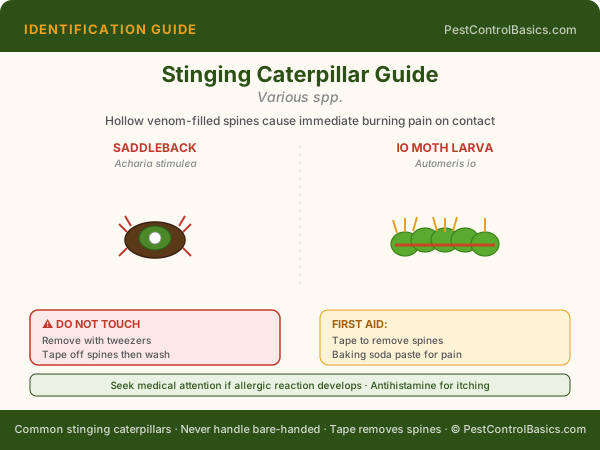
Original illustration by PestControlBasics.com. Use anatomical labels above to confirm your identification. For photo references, see the identification section below.
🔬
PestControlBasics Editorial Team
Reviewed by Derek Giordano · Updated 2026
🔍 Identification
Puss caterpillar (Megalopyge opercularis): 2-3cm; covered in soft grey-brown 'fur' concealing venomous spines — the most dangerous US caterpillar. Southeast US, Texas. Saddleback caterpillar (Acharia stimulea): 2cm; green with brown 'saddle' pattern; horn-like projections with hollow spines. Eastern US. Io moth caterpillar (Automeris io): 5-7cm; bright green with red-white side stripe; branching spines in tufts. Eastern US. Buck moth caterpillar (Hemileuca maia): dark with white spots; venomous spines; eastern US oaks. Hag moth caterpillar: bizarre twisted appearance with hooked lateral projections. Spiny oak slug: slug-shaped with venomous spines.
🧬 Biology & Behavior
All stinging caterpillars: venomous spines that break off in skin and inject venom causing immediate burning, redness, swelling, and in severe cases, systemic reactions including chest pain, nausea, and in rare cases, anaphylaxis. The puss caterpillar is particularly dangerous because its soft fur conceals spines — people pet it and receive full spine penetration.
⚠️ Damage & Health Risk
Painful sting with burning, swelling, rash; broken spines embedded in skin; systemic reactions in sensitive individuals; risk to children who handle caterpillars; severe puss caterpillar envenomation requiring medical treatment.
🔧 DIY Treatment
First aid: apply tape to affected area and remove by peeling off (removes embedded spines); apply baking soda paste; antihistamine and ice for swelling. Seek medical attention for systemic symptoms (chest pain, difficulty breathing, persistent severe pain).
👷 When to Call a Pro
Contact ASPCA Poison Control or Poison Control (1-800-222-1222) for severe reactions.
❓ FAQ
What should I do if I touch a puss caterpillar?
Do not rub the area — this breaks spines further into skin. Apply packing tape to the affected area and peel off repeatedly to extract spine fragments. Apply baking soda paste to neutralize venom. Ice for pain. Antihistamine (diphenhydramine) for swelling. If you experience chest pain, difficulty breathing, or the pain is severe and spreading, go to an emergency room — puss caterpillar stings can cause serious systemic reactions.
Are these caterpillars common?
Stinging caterpillars occur throughout the eastern US and Texas but are generally uncommon — most people never encounter one. Risk is highest in September-October when caterpillars are mature and searching for pupation sites. Children are most at risk because they handle caterpillars without knowing the danger. Teaching children not to touch fuzzy or spiny caterpillars is the most important prevention.
DG
Derek Giordano
Certified Pest Control Operator · Former Business Owner
Derek ran his own pest control company in Florida for several years, servicing thousands of regular customers. All content is based on hands-on field experience and current EPA & university extension guidelines.
Confirming a Stinging Caterpillars — ID Guide infestation in the field
Misidentification is the most common reason home treatment fails for Stinging Caterpillars — ID Guide. Look-alike species often respond to completely different active ingredients, so a 30-second confirmation step before any spraying or baiting saves the most time over a season. The practical workflow begins with where you found the specimen — kitchen, bathroom, garden, attic — because habitat narrows the candidate list faster than morphology alone.
Specific cues for Stinging Caterpillars — ID Guide include body proportions, leg count, antenna shape, and any wing structure if present. Adults are usually the easiest stage to identify, but most real-world infestations show juveniles or evidence (frass, shed skins, webbing, damage patterns) more often than adults themselves. Photograph the specimen against a ruler or coin for scale, then compare against a regional reference rather than a global one — range maps from state Extension services beat generic online identification sites.
When two species look genuinely similar, the deciding factor is often where they congregate at dusk versus dawn, or whether they leave a visible trail. A test of three common DIY treatments — one bait, one residual spray, one mechanical barrier — applied in different areas can also confirm identity by which works.
Why timing changes everything with Stinging Caterpillars — ID Guide
The same product applied two weeks apart can produce a complete kill or near-zero effect depending on where the Stinging Caterpillars — ID Guide population sits in its life cycle. Egg-stage pests are nearly immune to contact sprays, so a perfectly applied treatment during a major hatch event will leave the next generation completely unaffected. The professional standard is two applications spaced 10 to 14 days apart for most household pests — the first kills the active adults, the second catches anything that emerges from eggs in the interim.
Temperature also drives treatment success. Most residual sprays lose efficacy above 90°F or below 50°F, and pyrethroid products in particular can repel rather than kill when applied during high heat. The best window is early morning when surface temperatures are still moderate and target pests are moving but not yet at peak activity. Indoor treatment is less weather-dependent but still benefits from being applied when household air movement is low — running ceiling fans during application redistributes droplets away from the intended surface.
Seasonal pressure for Stinging Caterpillars — ID Guide usually has two or three predictable peaks per year. A treatment calendar built around those peaks costs less and works better than reactive spraying after a problem is already established.
Prevention strategies that actually reduce Stinging Caterpillars — ID Guide pressure
Most pest pressure traces back to one or two environmental conditions that are easier to fix than the infestation itself is to spray. For Stinging Caterpillars — ID Guide, the highest-leverage changes typically involve moisture management, food access, and exclusion at structural entry points. Reducing standing water within 20 feet of the foundation eliminates more pest problems than any single chemical application, and the effect persists year over year rather than requiring a rebuy every quarter.
Exclusion work is unglamorous but durable. A common entry-point audit covers door sweeps, weep holes, utility penetrations, dryer vents, soffit gaps, and the base of siding. Most homes have between five and fifteen openings larger than the minimum required for the target pest to enter, and sealing even half of them measurably reduces indoor sightings within one season. Stainless steel mesh, copper wool, and exterior-grade sealant cover most situations; expanding foam alone is not sufficient because rodents and some insects chew through it.
Storage practices matter too. Pantry pests, fabric pests, and overwintering insects all exploit cardboard, paper, and natural-fiber storage in basements and garages. Switching to sealed plastic bins for seasonal storage removes a significant amount of harborage that is otherwise impossible to spray effectively.
When to escalate Stinging Caterpillars — ID Guide control beyond DIY
Most Stinging Caterpillars — ID Guide situations are within the range of a careful homeowner, but a handful of scenarios genuinely warrant a licensed applicator. Multi-unit buildings are at the top of that list — shared walls, plumbing, and ductwork mean a localized treatment in one unit often just relocates the population to a neighbor. Any infestation that involves wall voids, attic insulation, or sub-slab plumbing is also harder to reach with consumer products and benefits from professional equipment and labeled product concentrations.
Health-sensitive situations are the second escalation trigger. Pregnancy, infants, immunocompromised residents, and pets with known sensitivities all narrow the available product list considerably. A licensed professional can apply restricted-use products and reduced-risk reformulations that achieve control with lower household exposure than over-the-counter alternatives. The cost difference is usually less than two seasons of DIY spending once the time investment is factored in.
The third escalation point is recurrence. If the same pest returns within six weeks of an apparently successful treatment, the source is usually structural or environmental rather than chemical, and a professional inspection often finds the cause faster than a second round of self-treatment.
Published: Jan 1, 2025 · Updated: Apr 7, 2026
Bite identification: what bite patterns suggest about source
Distinguishing bite types is difficult because individual reactions vary widely, but patterns can suggest probable source when individual bites can't. Bed bug bites typically appear in linear groups of three or four (the 'breakfast, lunch, dinner' pattern), are concentrated on body areas exposed during sleep (face, neck, arms, upper back if sleeping uncovered), and develop reddened raised welts that itch persistently for days. Flea bites cluster on lower legs and ankles, are smaller than bed bug bites, develop a small dark central puncture point, and itch intensely. Mosquito bites are typically isolated rather than grouped, develop within minutes of exposure, and resolve within a day or two with antihistamine. Chigger bites cluster around clothing constriction points (sock tops, waistbands, bra lines) and often present as multiple small intensely itchy welts after outdoor activity. No identification scheme is reliable from bite appearance alone in any single case — finding the source insect is the only definitive answer. But pattern recognition narrows the diagnostic space, particularly distinguishing bed bug bites (which warrant immediate investigation) from outdoor sources (which are usually self-limiting).
How structural moisture issues drive pest problems most homeowners miss
A surprising fraction of pest problems are downstream of moisture issues that go uncorrected because they don't produce obvious damage. Subterranean termites require moist soil contact; correcting drainage and downspouts often reduces termite pressure more than any chemical treatment. Carpenter ants nest in damp or previously-damp wood; the colony moves in only after moisture has softened the substrate. Drain flies, fungus gnats, and springtails are all moisture-driven and resolve when the moisture source resolves. Mold mites and booklice indicate humidity that exceeds about 70%, often in unventilated bathrooms or basements. Even rodent activity correlates with moisture: rodents need accessible water and follow water-supply intrusions to bring themselves into structures. The diagnostic question worth asking on any chronic pest problem: is something wet that shouldn't be? Common offenders are clogged gutters, downspouts that drain near the foundation rather than away from it, condensate lines from HVAC systems and water heaters, slow plumbing leaks under sinks, sweating cold-water pipes in unconditioned spaces, and crawlspaces without adequate vapor barriers. Fixing the underlying moisture issue typically yields permanent improvement that chemical treatment alone cannot match.
When bites need medical attention vs. home management
Most insect bites resolve with home care, but specific situations warrant prompt medical evaluation. Signs of severe allergic reaction — facial or throat swelling, difficulty breathing, hives spreading rapidly across the body, faintness — are anaphylaxis and warrant immediate emergency care. Bites that develop expanding red rings (particularly the bull's-eye pattern of erythema migrans) several days after exposure suggest Lyme disease and warrant medical evaluation with appropriate testing. Bites that become warm, increasingly painful, develop purulent drainage, or are accompanied by red streaking up a limb suggest secondary bacterial infection and warrant medical care. Children's bite reactions are sometimes more severe than adults', particularly with multiple bites at once; pediatric assessment for unclear bite events is reasonable. Flu-like symptoms developing within days to weeks of tick exposure warrant evaluation for tick-borne disease (anaplasmosis, ehrlichiosis, babesiosis, RMSF, Powassan) with specific testing rather than reliance on Lyme testing alone. Saving and photographing any suspect specimen helps physicians make better decisions about empirical treatment.
Bite timing as a clue to source identification
When bites appear without an obvious source, the timing of when bites occur is one of the most useful diagnostic clues. Bites that appear overnight on areas covered by bedding suggest bed bugs, which feed during sleep and target exposed skin near where the body contacts mattress and bedding. Bites appearing on lower legs while sitting indoors during the day suggest fleas, which jump and target the lowest accessible skin. Bites appearing outdoors in the evening suggest mosquitoes, particularly Culex species. Bites appearing while showering or shortly after suggest tropical rat mites or bird mites that have been disturbed from nests in attics or walls. Bites appearing after working with stored items or moving furniture suggest spiders disturbed from harborage. When the timing pattern is established, the source investigation can be targeted accordingly: bedding inspection for night bites, pet inspection for indoor day bites, outdoor habitat assessment for evening bites. Without timing information, the source can be very difficult to identify; with it, the search narrows dramatically. Asking specifically about when bites appear, and not just where, is the diagnostic question most home assessments don't ask.
The role of inspection in long-term cost reduction
An inspection is the cheapest tool in pest management, and homeowners systematically underspend on it. The economics are unambiguous: an annual or semiannual inspection costs a small fraction of what any moderate treatment costs, and it catches problems while they're still cheap to address. Termite damage detected in its first season requires perimeter treatment; the same damage discovered three years later may require structural repairs running into five figures. Rodent activity detected through droppings before nesting establishes requires sealing and a few traps; the same activity discovered after a multi-generation infestation has set up in wall voids requires removal, exclusion, sanitation, and sometimes drywall work. The pattern repeats across nearly every pest category. Even households that don't engage a regular pest service should treat the annual inspection as a baseline expense — equivalent to the way they probably treat HVAC tune-ups, gutter cleaning, or smoke detector battery changes. The marginal cost of one trained set of eyes on the property each year is one of the most defensible expenses in home maintenance.
Secondary infection risk from insect bites and what it changes
The primary medical concern from most insect bites is not the venom or saliva itself but the secondary infection risk created when scratching breaks the skin and introduces bacteria. This shifts the practical priorities of bite management: minimizing itching is not just a comfort issue but a complication-prevention issue, particularly in children, immunocompromised individuals, and people with diabetes. Topical antihistamines and hydrocortisone applied early reduce the itch response and the resulting scratching; cool compresses provide additional symptomatic relief without the side effects of repeated topical application. The signs that warrant medical attention are spreading redness beyond the original bite site, warmth, swelling that increases rather than decreases over the first 48 hours, drainage, or fever. These suggest cellulitis or another bacterial infection that won't resolve without treatment. Most bites do not progress to this point, but the threshold for medical evaluation is lower in vulnerable populations and in bites on locations particularly prone to complications — lower legs in adults, face in children, anywhere on someone with peripheral circulation issues.
🗺️ US Distribution — Stinging Caterpillars
Common Occasional Not Present
States Present
49
Occasional
2
Primary Region
All agricultural regions
📊 Source: University extension services, USDA, CDC vector data, and published entomological surveys.