On this page
How to identify it
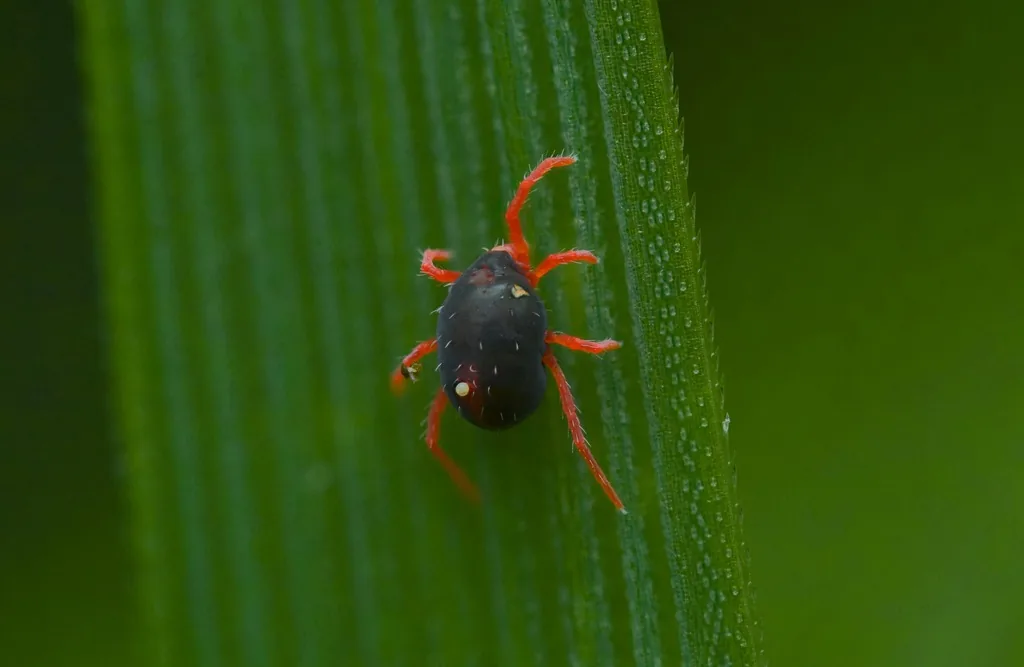
- The body is dark brown to almost black, or dark bluish black, with conspicuous reddish-orange legs. It is about 0.04 inch (1 mm) long, larger than the brown wheat mite.[1][2]
- Its best mark is a tan to orange spot on top of the abdomen. This is the anal pore: it is the only economically important mite in the region with the anal pore on top of the abdomen, where most other mites have it underneath or at the tip. It shows best under a microscope but can be seen with a hand lens.[1][2]
- The front legs are longer than the others, though less so than on the brown wheat mite, and each leg ends in two claws.[1]
Look-alikes
| Look-alike | How to tell them apart |
|---|---|
| Brown wheat mite | The brown wheat mite is metallic brown to black with pale yellow legs, and its front legs are distinctly longer than the rest. It feeds by day, most actively in mid-afternoon, while the winter grain mite has red-orange legs and feeds at night or in cool, cloudy weather.[3][1] |
| Banks grass mite | The Banks grass mite is the only prominent wheat mite that webs the leaves. Winter grain mite injury shows as yellowish leaves and stunted plants, with no webbing.[2] |
Where it lives
Kansas State describes it as a pest of small grains and grasses throughout the temperate regions of the world. In Kansas, significant infestations are more common in the central part of the state. UC IPM lists it among the mites of small grains in California, where mites seldom cause enough damage to be of concern.[1][2]
Biology and life cycle
There are generally two generations a year. The first begins in September or October, when the over-summering eggs hatch, and peaks in December or January. The second comes from eggs laid by the first and peaks in March or April. Females of the second generation lay the eggs that wait out the summer.[1]
Cool weather suits it, and it is most active between 40 and 70°F. As temperatures climb in spring, numbers drop. The over-summering eggs do not hatch in fall until rain provides enough moisture.[1]
Larvae feed on leaf sheaths and tender shoots near the ground. Nymphs and adults climb higher to feed at night and on cloudy or cool days, then move down to the moist soil surface under the foliage as the sun comes up. In dry soil with little cover they crawl into the soil, and on hot, dry days you may need to dig 4 or 5 inches down to find them.[1]
The mites are not harmed by high humidity, rain, short spells of sleet or ice, or ground frozen several inches deep in fall. Heavy spring rains, though, can make populations disappear.[1]
Damage and signs
- The mites puncture individual leaf cells as they feed, which gives leaves a silvery-gray look. Heavily damaged leaves get brown tips.[1]
- Infested plants often do not die but become stunted and produce little forage or grain. UC IPM describes yellowish leaves and stunted plants and says the damage resembles winter-kill.[1][2]
- Young plants suffer more than large, healthy ones. Fields on loose, sandy or loamy soils are more at risk than those on hard clay, and persistent dry weather lets damage build up.[1]
Health risk
Kansas State and UC IPM describe it only as a pest of grain crops and grasses and mention no risk to people or animals.[1][2]
Control
Prevention
Rotate crops. Fall populations develop from eggs laid the previous spring, so problems are worse in continuous wheat, and both Kansas State and UC IPM say rotation works against this mite. Field borders can still be invaded by mites moving in from wild grasses.[1][2]
Pesticides
UC IPM does not generally recommend chemical control because cultural methods usually suffice, and it warns that sprays aimed at aphids can lead to mite build-up. Kansas State says control may be necessary if large portions of a field show symptoms and mites are abundant relative to the amount of plant growth; look for them at night, on cloudy days, or in the soil. Recovery of damaged plants often depends on available moisture.[2][1]
Common questions
- Why can't I find any mites on my wheat during the day?
- Winter grain mites feed higher on the plants at night and on cloudy or cool days, and spend the warm part of the day on the moist soil surface under the foliage. On hot, dry days they may be 4 or 5 inches down in the soil.[1]
- Does crop rotation help with winter grain mite?
- Yes. Fall populations hatch from eggs laid the previous spring, so continuous wheat has more trouble, and rotation works against the mite. Borders near wild grasses can still be invaded.[1][2]
- Is it winter-kill or winter grain mite?
- The damage looks much like winter-kill. Look for a grayish or silvery cast, brown leaf tips and stunted plants, then check plants at night or on a cool, cloudy day for dark mites with red-orange legs and an orange spot on the back.[2][1]
Sources
- Kansas State University Department of Entomology, “Winter Grain Mite (Wheat Pests).” entomology.k-state.edu/extension/crop-protection/wheat/winter-grain-mite.html (accessed 2026-11-08)
- University of California Statewide IPM Program, “Mites (Pest Management Guidelines: Small Grains).” ipm.ucanr.edu/agriculture/small-grains/mites (accessed 2026-11-08)
- Kansas State University Department of Entomology, “Brown Wheat Mite (Wheat Pests).” entomology.k-state.edu/extension/crop-protection/wheat/brown-wheat-mite.html (accessed 2026-11-08)
- iNaturalist, “Penthaleus major taxon page (order and family).” www.inaturalist.org/taxa/297453 (accessed 2026-11-08)