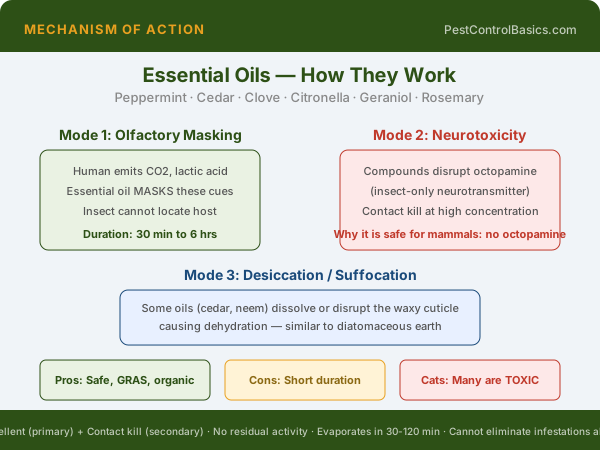
Geraniol is a naturally occurring terpene found in geraniums, roses, citronella, and lemongrass. EPA research shows it's one of the most effective plant-based mosquito and tick repellents — significantly outperforming citronella in head-to-head studies.
Mosquitoes (strong repellent — outperforms citronella by 2-5x in studies), ticks (proven repellent in multiple studies), flies (good repellent), gnats, ants (moderate). Several studies show geraniol approaching DEET effectiveness for mosquito repellency at 20%+ concentrations.
🏷️ Products & Brand Names
Proven Insect Repellent (geraniol-based, consumer reports top rated natural), Bug Band, Skin So Soft Bug Guard Plus (contains geraniol), Buggins Natural insect repellent, ThermaCell natural refills. Pure geraniol essential oil for DIY applications.
⚠️ Safety & Precautions
Excellent safety profile. FDA GRAS as a food flavoring. Widely used in cosmetics and perfumes. Minimal skin sensitization risk. Safe around children and most pets. Pleasant floral/rose scent that most people find agreeable — unlike DEET.
✅ Best natural repellent? Multiple independent studies rank geraniol as one of the top 2-3 plant-based repellents (alongside OLE/PMD and some neem formulations). If you want a natural repellent that actually works, geraniol deserves serious consideration.
Example
0.5 oz
per gallon
⚗️ Mixing Calculator
Enter your sprayer size and target rate — get the exact amount to pour. Backpack, hand sprayer, hose-end, or skid unit.
Why geraniol over citronella: Head-to-head tests consistently show geraniol provides 2-5 times longer protection than citronella against Aedes mosquitoes. A 2020 USDA study found 25% geraniol provided 4+ hours of mosquito protection — approaching low-concentration DEET.
For ticks: Geraniol shows genuine tick-repellent activity. A 2016 Journal of Medical Entomology study found geraniol reduced tick attachment by 90%+ in field conditions. One of the few natural ingredients with credible tick data.
Formulation matters: Pure geraniol evaporates quickly. Commercial products use encapsulation and slow-release formulations to extend duration. Pre-formulated products significantly outperform DIY geraniol sprays for this reason.
🐛 Pests This Treats — Learn More
Click any pest to view its full identification guide, biology, and treatment options.
💡 Natural compound. EPA 25(b) exempt. Short residual. Generally safe for pollinators.
⏱️ Residual & Re-entry Timeline
🔹
Apply
Follow label mixing and application rates
🔸
Re-entry: Immediate
Keep people and pets out of treated area
🟢
Effective period: 1–3 hours
Active residual — killing or repelling target pests
🔄
Reapply
Re-treat when pest activity returns or residual expires
❓ Frequently Asked Questions
Q: Is geraniol safe for pets?
Follow the product label. Keep pets out of treated areas until completely dried (2–4 hours for sprays). Once dry, treated surfaces pose minimal risk to dogs and cats.
Q: Can I use geraniol indoors?
Check the specific product label — formulations vary. Baits and dusts often have indoor labeling; concentrates and granulars are typically outdoor.
Q: How long does geraniol last after application?
Residual varies by formulation, surface type, weather, and UV exposure. Indoor applications last longer than outdoor. Check the product label for re-application intervals.
Q: What should I do if exposed?
Remove contaminated clothing, wash skin with soap and water. For eye contact, rinse 15–20 minutes. For ingestion or severe symptoms, call Poison Control (1-800-222-1222). Have the product label available.
📋 Safety Data Sheet (SDS)
📋
Geraniol for Pest Control — Safety Data Sheet
View the official SDS document for this product directly on the CDMS label database.
💡 Did you know? Geraniol is the primary scent compound that gives roses their characteristic fragrance. It's also a key component of citronella oil — and research suggests it may be the most active mosquito-repelling fraction of citronella, meaning it's actually the reason citronella 'works.'
🔮
Reviewed by Derek GiordanoContent reviewed by a licensed pest management professional. Last reviewed: April 2026.
Practical safety considerations for Geraniol for Pest Control
The label is the law, and it covers the legal minimum. Practical safety for Geraniol for Pest Control in a household setting goes beyond label compliance — children, pets, and food-contact surfaces all merit precautions above the regulatory floor. Re-entry intervals on consumer labels are typically calibrated for healthy adults; for nurseries, pet bedding areas, and pregnant-occupant homes, doubling the indicated interval is a reasonable default.
Ventilation matters more than most homeowners realize. Even low-VOC formulations release detectable airborne residues for several hours post-application, and an HVAC system that is running during treatment will redistribute those residues throughout the structure. Standard practice is to turn off forced air for the treatment window and the first hour after, then run on high circulation for 30 minutes before normal occupancy resumes.
Personal protective equipment listed on the label is the minimum. For larger volumes, a half-face respirator with organic-vapor cartridges adds meaningful protection at modest cost. Nitrile gloves outperform latex for solvent-based formulations and are inexpensive enough to use single-use.
Known limitations of Geraniol for Pest Control
No active ingredient is universal, and Geraniol for Pest Control has specific weak points worth understanding before purchase. Resistance is the most common limitation — populations in heavily-treated areas (commercial kitchens, multi-unit housing, urban cores) often show measurable tolerance compared to populations in less-treated environments. Rotating between chemical classes every two or three applications reduces resistance pressure significantly.
Substrate binding is another limitation. Geraniol for Pest Control on highly absorbent surfaces like unfinished wood or carpet can become bound to the substrate within hours of application and never reach the pest in active form. For these surfaces, dust formulations or baits perform better than liquid sprays. Crack-and-crevice application using a precision tip places product where it reaches the pest while minimizing exposed-surface residue.
Pollinator and beneficial-insect impact is the third limitation to plan around. Outdoor application timing should avoid blooming plants, and any application near beneficial habitat (gardens, water features, pollinator strips) should be made in late evening when beneficials are inactive.
Comparing Geraniol for Pest Control to alternatives
Choosing between Geraniol for Pest Control and a comparable product usually comes down to four factors: speed of kill, residual length, target spectrum, and household-sensitivity profile. No single product wins on all four — fast-acting contact kills typically have short residuals, while long-residual products often act slowly enough that homeowners assume they have failed within the first 48 hours. Matching the product to the situation is more important than picking the strongest available option.
Cost per application is a useful but incomplete metric. A cheaper concentrate that requires more frequent reapplication often costs more per season than a more expensive product with a longer effective window. Coverage area per gallon at the label rate is the better comparison number, and it is usually printed clearly on the label.
For most households, keeping two complementary products — one fast-acting and one long-residual, ideally from different chemical classes — covers more situations than a single all-purpose product and supports the resistance-management rotation noted above.
Published: Jan 1, 2025 · Updated: Apr 7, 2026
Active ingredient classes and rotation principles
Pesticide active ingredients are organized into classes based on their mode of action — the biological mechanism through which they affect target pests. The EPA mode-of-action (MoA) classification (and the analogous IRAC classification used internationally for insecticides) labels products by their MoA group, which is the relevant grouping for resistance management. Common residential MoA classes include pyrethroids (group 3, affecting sodium channels), neonicotinoids (group 4, affecting acetylcholine receptors), spinosyns (group 5, separate acetylcholine mechanism), insect growth regulators (group 7, hormone disruption), avermectins (group 6, chloride channels), and several others. Rotating among MoA classes — not just product brands — is the resistance management practice that matters. A homeowner using a pyrethroid product for two seasons then switching to another pyrethroid brand has not rotated meaningfully; switching to a spinosyn or neonicotinoid would be a real rotation. Product labels typically list the IRAC group number on the front panel.
Reading reviews of pest control products critically
Online reviews of pest control products are noisier than reviews in most categories because outcomes depend heavily on application and identification — both of which are usually wrong when DIY treatment fails. A one-star review saying "didn't work on bedbugs" often reflects insufficient coverage, untreated harborage, or a misidentified pest, not product failure. Reviews are most useful when they describe specific application conditions (substrate, dilution, target pest stage, environmental conditions) and least useful when they're brief judgments without context. Independent testing from Consumer Reports, university entomology trial publications, and the EPA's BEAD (Biological and Economic Analysis Division) reports give more reliable efficacy data than aggregated retailer reviews. For consumer products, the EPA registration alone confirms basic safety and that the product does what the label claims; outperformance among registered products is usually a matter of formulation choice for the specific substrate and pest.
Pesticide rotation and the resistance management problem
Resistance management — using multiple active ingredients in sequence so that no single mode of action selects for resistant individuals — is standard practice in agricultural and commercial pest control but rarely makes it into residential treatment decisions. The underlying concern is real: chronic use of a single pyrethroid product against bed bugs has produced widespread pyrethroid resistance, with some populations now showing resistance factors of 1000x or more. The same pattern is documented in German cockroach resistance to chlorpyrifos and other historical actives, mosquito resistance to organophosphates in heavy-use regions, and house fly resistance across multiple compound classes. For residential treatment, the practical implication is to avoid using the same active ingredient repeatedly across multiple treatment cycles; rotating between products in different chemical families (e.g., pyrethroid → neonicotinoid → insect growth regulator → carbamate, or whatever subset is appropriate to the target pest) reduces selection pressure and preserves efficacy. The product label specifies the active ingredient family, allowing rotation choices to be made on actual chemistry rather than brand name.
Seasonal pest calendars: building one for your specific property
Generic seasonal pest calendars list typical activity windows by region, but every property has its own micro-calendar shaped by orientation, vegetation, drainage, neighbor properties, and structural features. After one or two years of observation, most homeowners can map their property's specific patterns: when wasps start scouting (typically early to mid spring as queens emerge), when ants first appear indoors (often after a specific rain pattern), when stored-product pests show up in pantries (often late spring through fall), when rodent activity increases (typically late fall as outdoor food declines and indoor warmth attracts them), when mosquito pressure peaks (varies enormously by local conditions), and when seasonal nuisances like cluster flies or boxelder bugs arrive (usually first hard cooling in fall). A personal calendar drives preventive timing — exterior perimeter treatment shortly before ant pressure builds is dramatically more effective than treatment after they're inside, exclusion work for rodents in early fall beats trapping in late fall, and wasp prevention in early spring beats removal in summer. Two years of observation produces a calendar more useful than any published guide for the specific property.
Application timing within the day and weather conditions
Pesticide applications produce significantly different results depending on application timing, and matching application to conditions improves outcomes substantially. For outdoor liquid applications, early morning (after dew has evaporated, before pollinators are active) and late evening (after pollinators have stopped foraging, before evening dew) produce best results: temperatures are moderate, wind is typically lower, and non-target exposure is reduced. Mid-day applications during high temperatures cause volatility losses and faster degradation. For interior treatments, timing depends on the pest: cockroach baiting works at any time but should follow rather than precede cleaning; bed bug treatments need to follow vacuuming and clutter reduction; ant baits work best when active trails are present, which often means specific times of day for specific species. Rain within 4 hours of outdoor liquid application washes off most surface residue except specifically rainfast formulations; checking the next 24-hour forecast before any outdoor treatment is the basic discipline that prevents this loss. Temperatures above 90°F or below 50°F outside the product label's recommended range produce reduced efficacy.
Pesticide drift and the neighbor dimension
Pesticide drift — the off-target movement of applied product through air, water, or runoff — is an under-discussed dimension of residential pesticide use, but it's an increasingly common source of conflict between neighbors and a real factor in the cumulative environmental load of pesticide use. Foliar sprays applied in even light wind drift further than most homeowners expect, particularly with finer droplet sizes. Granular products applied near property lines wash into adjacent properties in significant rainfall. Mosquito fogging can move across multiple properties depending on conditions. The implications are partly legal — drift onto neighboring property without consent has been the basis of successful nuisance claims in some jurisdictions — and partly ethical. Applying products only in low-wind conditions, choosing coarser droplet sizes when possible, using granulars rather than sprays near property lines, and timing applications to avoid imminent rainfall all reduce drift. For homeowners concerned about pesticide exposure from neighbors' applications, the productive conversation is usually about timing and product choice rather than about pesticide use in general, and approaching it that way tends to produce cooperation rather than escalation.
The economics of preventive versus reactive treatment
Preventive treatment costs money in a year when nothing is happening, which is precisely why most households avoid it. The decision to spend on prevention requires a willingness to compare what you actually spend against a counterfactual you never directly observe — the infestations you would have had without it. This is a hard mental move, and it's why preventive pest control consistently underconsumed relative to its economic value. The way to think about it more clearly is to compute the expected annual cost of treatment for a property like yours given local pest pressure, then compare that against the cost of a preventive program. In most regions and for most property types, a preventive program comes in lower in expected value, sometimes substantially. The variance is also lower: instead of a year with zero pest spending followed by a year with a large unexpected expense, you have a small consistent line item that smooths out the cash flow. For households where unexpected expenses are particularly painful, that variance reduction is itself worth something even before counting the expected-value benefit.
Reduced-risk pesticide selection: a category worth knowing
The EPA's reduced-risk pesticide program identifies active ingredients and formulations that meet specific criteria for lower toxicity to non-target organisms, reduced potential for groundwater contamination, lower likelihood of resistance development, or better compatibility with integrated pest management. Products in this category aren't free of toxicity — they're pesticides, and all pesticides have some toxic profile — but they represent the lower end of the risk distribution within their pest categories. For homeowners who want to use pesticides but are concerned about minimizing exposure and environmental impact, looking for products with reduced-risk actives is a defensible filter. Examples include some of the diamide insecticides, spinosyns, and certain microbial products. The catch is that retail availability lags behind the professional market for many reduced-risk products, and consumer pesticide aisles still skew heavily toward older pyrethroid and carbamate formulations. For homeowners willing to source products from agricultural supply channels or work with a pest control company that uses these products, the option exists; for those buying off the shelf at typical retail, the choices are narrower.