On this page
How to identify it
- The caterpillar is green with a velvety skin and a white stripe along each side, which sets it apart from other caterpillars in alfalfa. The Missouri Department of Conservation adds a pale stripe down the back and black edging on the side stripe.[2][1][3]
- UC IPM gives about 1.5 inches for a full-grown caterpillar; Kansas State gives a smaller figure (see below).[2][1]
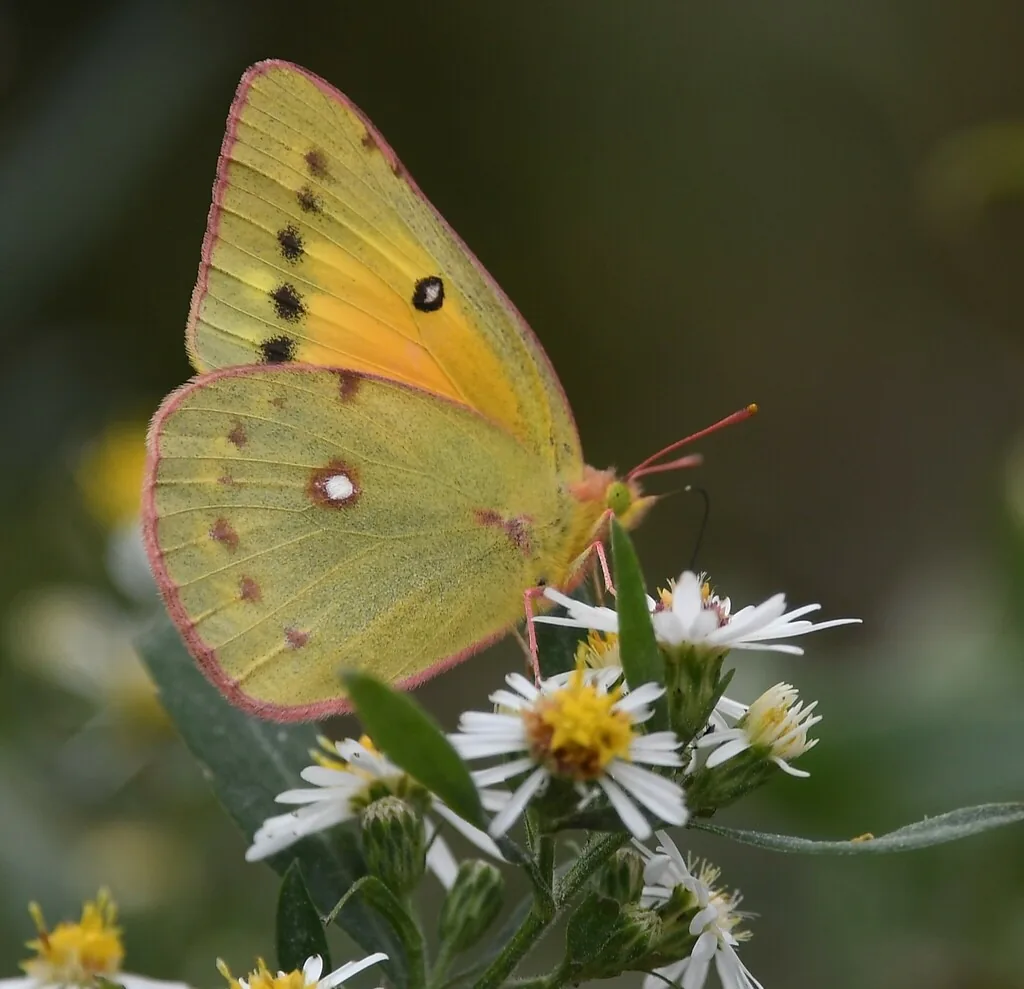
- Adults are sulphur butterflies with a wingspan of 1 1/4 to 2 1/4 inches, orange above with a dark border (females have pale spots inside it) and yellow-orange below with a double silver spot rimmed in red. They lay their eggs on new alfalfa growth.[3][2]
- Some females are white, and the white form can't be told apart in the field from white clouded sulphurs.[3]
- A caterpillar parasitized by the small wasp Cotesia medicaginis is lighter in color, somewhat shiny instead of velvety, and swollen toward the rear, and it dies before reaching half an inch long.[2]
Look-alikes
| Look-alike | How to tell them apart |
|---|---|
| Armyworms, including the beet armyworm | Armyworms skeletonize alfalfa leaves, while alfalfa caterpillars eat the whole leaf, midrib included.[2] |
| Clouded sulphur (Colias philodice) | The adult is clear yellow above rather than orange, though the amount of orange on an orange sulphur varies and hybrids between the two are common. Its caterpillar is also slender and green with a white or yellowish side stripe, and it feeds mostly on clovers.[4][3] |
Where it lives
The orange sulphur occurs statewide in Missouri, in fields, along roads and in gardens. Kansas State reports damaging numbers mainly in southwest Kansas in late summer, and UC IPM describes very large flights of adults moving between fields from June to September in California's Central Valley and from May to October in the southern desert. GBIF holds about 61,000 US records since 1990 from 47 states, counting the District of Columbia, most from Texas, Illinois and California.[3][1][2][6]
Biology and life cycle
Eggs hatch in 3 to 7 days. The young caterpillars move to the undersides of leaves and start eating at the tip, and they feed mostly at night.[2][3]
In California's low-altitude areas the caterpillars spend the winter almost entirely in annual vetch and move into alfalfa as the vetch dies back in May and June.[2]
Besides alfalfa and vetch, the butterfly breeds on clovers, sweet clovers and occasionally lupines; the Missouri Department of Conservation names white clover and white sweet clover.[2][3]
In California there are four to seven generations a year, each so closely tied to the hay-cutting cycle that the caterpillars pupate before the field is cut. In Missouri, adults fly from late April into December with at least three broods.[2][3]
Outbreaks usually start when butterflies fly into a field while the alfalfa is under 6 inches tall, and swarms seem to be set off when growers cut and bale while adults are abundant.[2]
Slow, uneven crop growth, a lack of natural enemies, hyperparasites that attack the beneficial wasps, and hot, dry weather all favor damaging numbers.[2]
The butterfly needs a body temperature above 30 °C to fly. When cold it turns its wing undersides broadside to the sun, when too warm it turns them away, and the darker forms that appear in cool seasons heat up faster.[5]
The yellow and orange wing pigments are rich in nitrogen; white-form females put that nitrogen into faster development and egg production instead.[3]
Damage and signs
- Alfalfa caterpillars can eat entire leaves, and the larger larvae do the most damage.[2]
- Infestations seldom reach economic levels in Kansas, but damaging numbers can build in southwest Kansas in late summer, especially in fields left five weeks or longer between cuttings.[1]
- The Missouri Department of Conservation calls it a periodic pest of alfalfa whose larvae can do substantial damage in years when the butterfly population peaks.[3]
Health risk
Kansas State and UC IPM treat it only as a pest of alfalfa, and the Missouri Department of Conservation describes a common butterfly; none of them reports a risk to people or animals.[1][2][3]
Control
Prevention
Border-strip harvesting helps keep parasite larvae in the field. From early summer, sweep fields 2 to 3 times a week and count healthy and parasitized caterpillars separately; Kansas State suggests sampling five spots per field with a sweep net when larvae are abundant.[2][1]
Traps and physical control
Cutting an infested field early kills many caterpillars, preserves yield and avoids reducing natural enemies; Kansas State notes that cutting within the next few days can substitute for treatment.[2][1]
Biological control
Natural enemies are the most important control. Parasites and diseases usually keep alfalfa caterpillars in check, and the wasp Cotesia medicaginis is an important parasite. To protect them, avoid unnecessary spring sprays for aphids or weevils and use selective insecticides against caterpillars in summer.[1][2]
Pesticides
Both Kansas State and UC IPM use a threshold of an average of 10 caterpillars per sweep (UC counts only nonparasitized ones), with treatment considered when cutting is not practical soon. Sprays of Bacillus thuringiensis are acceptable on organically certified alfalfa.[1][2]
Where sources disagree
Caterpillar size: UC IPM gives about 1.5 inches for a full-grown caterpillar, while Kansas State's fact sheet says they reach 1/4 to 1/2 inch.[2][1]
How many generations: UC IPM counts four to seven a year in California; the Missouri Department of Conservation says at least three broods in Missouri.[2][3]
How serious: Kansas State says infestations seldom reach economic levels, while the Missouri Department of Conservation says larvae can do substantial damage to alfalfa in peak years.[1][3]
Common questions
- Are the yellow and orange butterflies over my alfalfa a problem?
- They are the adults of the alfalfa caterpillar. Outbreaks usually start when butterflies fly into fields where the alfalfa is under 6 inches tall, but parasites and diseases usually keep the caterpillars in check, and in Kansas infestations seldom reach economic levels.[2][1]
- How can I tell if a caterpillar is parasitized?
- Parasitized alfalfa caterpillars are lighter in color, shiny rather than velvety, and swollen toward the rear. Grasping one at each end of the swelling and pulling it apart exposes the shiny white parasite larva inside.[2]
- Is the orange sulphur the same insect?
- Yes. The orange sulphur, or alfalfa butterfly, is the adult; the alfalfa caterpillar is its larva.[3][1]
Sources
- Kansas State University Department of Entomology, “Alfalfa Caterpillar (J. P. Michaud, Facts and Information on Alfalfa Pests, updated April 2024).” entomology.k-state.edu/extension/crop-protection/alfalfa/alfalfa-caterpillar.html (accessed 2026-11-11)
- University of California Statewide IPM Program, “Alfalfa Caterpillar (Pest Management Guidelines: Alfalfa).” ipm.ucanr.edu/agriculture/alfalfa/alfalfa-caterpillar/ (accessed 2026-11-11)
- Missouri Department of Conservation, “Orange Sulphur (Alfalfa Butterfly) (field guide).” mdc.mo.gov/discover-nature/field-guide/orange-sulphur-alfalfa-butterfly (accessed 2026-11-11)
- Missouri Department of Conservation, “Clouded Sulphur (field guide).” mdc.mo.gov/discover-nature/field-guide/clouded-sulphur (accessed 2026-11-11)
- Proceedings of the National Academy of Sciences, via PubMed, “Adaptive significance of pigment polymorphisms in Colias butterflies, II: thermoregulation and photoperiodically controlled melanin variation in Colias eurytheme (Watt 1969).” pubmed.ncbi.nlm.nih.gov/16591777/ (accessed 2026-11-11). Cited from the PubMed abstract.
- Global Biodiversity Information Facility (GBIF), “Colias eurytheme: US occurrence records since 1990 by state (GBIF occurrence search API).” api.gbif.org/v1/occurrence/search?taxonKey=5137694&country=US&hasGeospatialIssue=false&occurrenceStatus=PRESENT&year=1990%2C2026&facet=stateProvince&facetLimit=400&limit=0 (accessed 2026-11-11). State counts are records reported (iNaturalist research-grade, museum specimens, surveys), not abundance.
- iNaturalist, “Colias eurytheme taxon page (order and family).” www.inaturalist.org/taxa/58532 (accessed 2026-11-11)