On this page
How to identify it
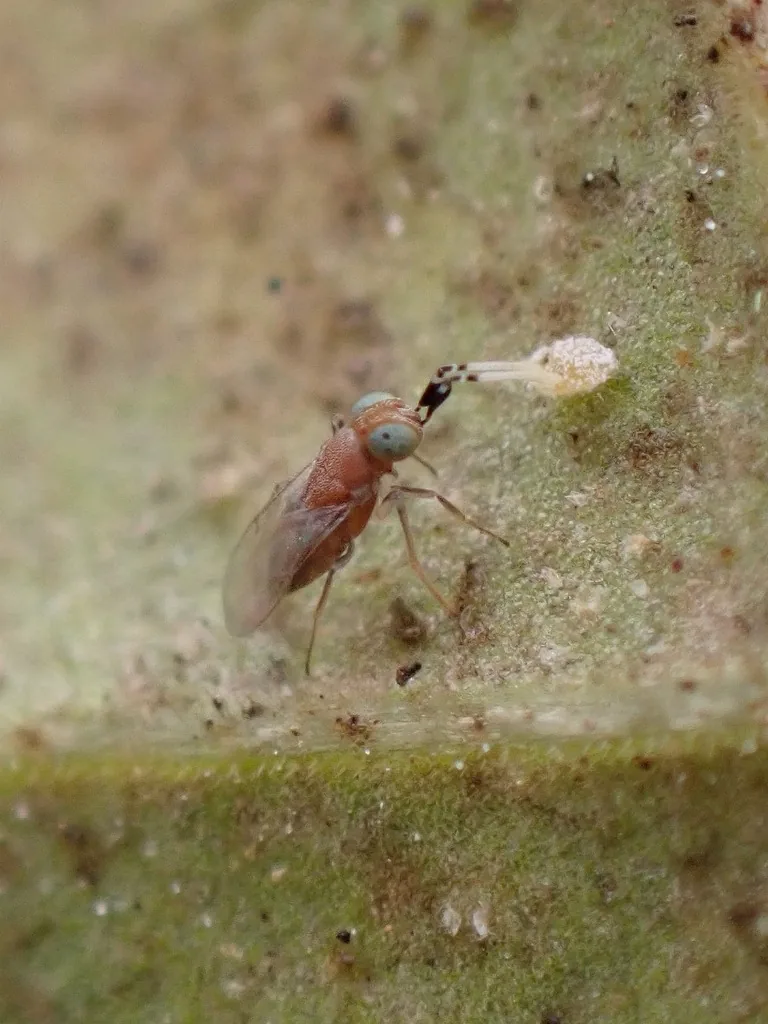
- Females are about 1.5 to 2 mm long and dull orange to brownish, with a yellow, triangular head and distinctively black-and-white banded antennae. The wings are clear with brownish veins.[1]
- Males are smaller, about 0.7 to 1.25 mm, and mostly black, with silvery hairs on the lower face and mostly yellow legs.[1]
- Parasitized mealybugs become yellow-brown mummies. The adult wasp leaves through an irregular hole it chews in the rear end of the mummy.[1]
Look-alikes
| Look-alike | How to tell them apart |
|---|---|
| Leptomastix dactylopii | Another small wasp sold for mealybug control; it is yellowish brown with long, dark antennae rather than black-and-white banded ones.[1][3] |
Where it lives
It is native to parts of the Mediterranean, the Middle East and Asia, including Italy, Israel, Egypt, Pakistan and China. It was brought to California from Brazil in 1934 to fight citrus mealybug and again from South America in 1953, and it is now widely established there. It has also been used in greenhouses in Texas.[1]
Biology and life cycle
A female lays one egg inside each mealybug, slipping it between the wax filaments at the edge of the body; she prefers larger mealybugs, and adult mealybugs produce the most female wasps. A black scar shows on the mealybug a day later.[1]
The parasitized mealybug keeps moving for a few days, but by the time the wasp larva reaches its third stage, about five days in warm weather, the mealybug can no longer move. By about the eighth day at 28 °C (82 °F) it is a mummy.[1]
Development speeds up with heat: it took about 79 days at 14 °C (57 °F) but only about 10.5 days at 34 °C (93 °F). It stops at 35 °C (95 °F), and larvae spend the winter inside mealybugs.[1]
Females can lay eggs without mating; unfertilized eggs become males. Adults live about a week and feed on nectar.[1]
Its hosts include citrus, longtailed, Comstock, pink hibiscus and pineapple mealybugs, and in the laboratory it has been reared on vine mealybug. The parasites that attack grape and obscure mealybugs don't attack vine mealybug, which is why this wasp was released against it.[1][2]
Damage and signs
- It does no damage. It is a beneficial insect used against mealybugs in vineyards, citrus, orchards and greenhouses.[1]
Health risk
The sources describe it only as a tiny parasite of mealybugs; none mentions stings or any risk to people or pets.[1][2]
Control
Prevention
No control is needed. It is a beneficial insect, so leave it alone.[1]
Biological control
In California vineyards it has parasitized up to 20 percent of vine mealybugs in the Coachella Valley and up to 90 percent of exposed mealybugs late in the season in the San Joaquin Valley. It works best late in the season, because in spring it doesn't come out of its overwintering stage until about bloom; growers can buy and release wasps early to fill that gap.[2]
Ants that tend mealybugs interfere with it, so control ants where it is being used. Commercial wasps are shipped inside mealybug mummies and emerge within one to five days after delivery when the container is set in a dry spot in the crop.[1][2]
Common questions
- Is Anagyrus pseudococci enough to control vine mealybug?
- Not on its own. It is the most effective parasite of vine mealybug in California, but its parasitism has not kept populations low enough, and it gives little help early in the season.[1][2]
- How do I know Anagyrus has been at work?
- Look for yellow-brown, mummified mealybugs with an irregular exit hole chewed in the rear end.[1]
Sources
- University of Florida IFAS Extension (EDIS Featured Creatures), “Anagyrus pseudococci Girault (Insecta: Hymenoptera: Encyrtidae) (EENY619, 2015).” journals.flvc.org/edis/article/view/128209 (accessed 2026-11-09)
- University of California Statewide IPM Program, “Grape Pest Management Guidelines: Vine Mealybug.” ipm.ucanr.edu/agriculture/grape/vine-mealybug/ (accessed 2026-11-09)
- University of Florida IFAS Extension (EDIS Featured Creatures), “Leptomastix dactylopii Howard (Hymenoptera: Encyrtidae): parasitoid of mealybugs (EENY-807, 2024).” journals.flvc.org/edis/article/view/134441 (accessed 2026-11-09)
- iNaturalist, “Anagyrus pseudococci taxon page (order and family).” www.inaturalist.org/taxa/1083808 (accessed 2026-11-09)