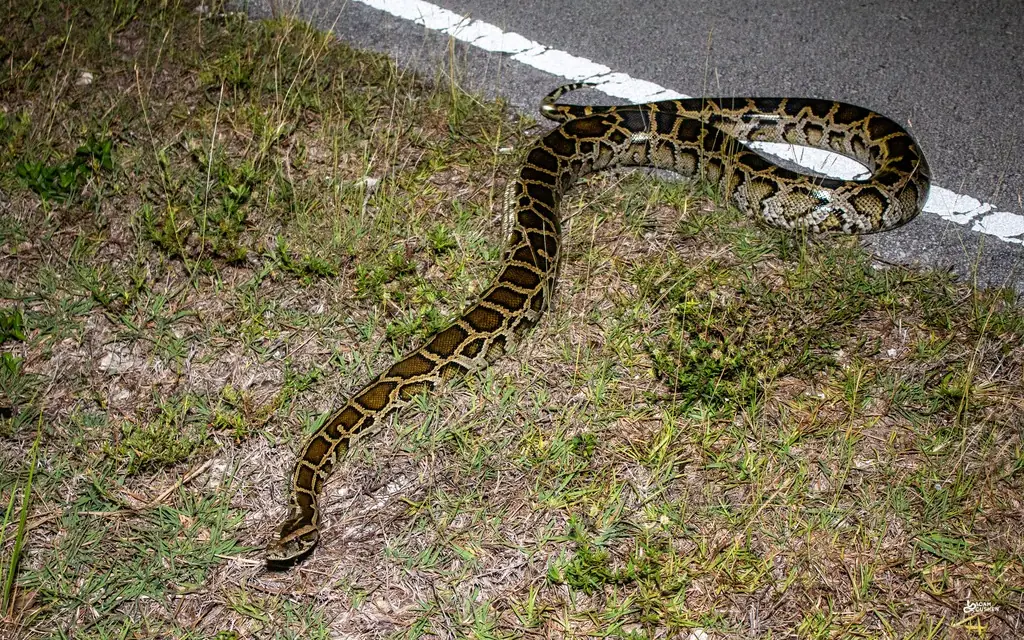
How to identify it
- One of the largest snakes in the world. Pythons caught in Florida are usually 6 to 10 feet long, though the species can pass 20 feet.[3][1][6]
- The body is tan with large, irregular dark brown blotches down the back and sides that fit together like puzzle pieces or a giraffe's pattern.[3][1][6]
- A dark arrowhead-shaped wedge sits on top of the head and points toward the nose, with a light line down its center.[1][6]
- FWC notes dark wedges on top of the head, below the head and behind the eye; UF/IFAS describes dark and light wedge marks under each eye.[3][6]
- Young pythons look nearly identical to adults, just smaller.[6]
Look-alikes
| Look-alike | How to tell them apart |
|---|---|
| Rat snakes (native) | FWC lists the red rat snake among native snakes often mistaken for pythons. Check for the python's puzzle-piece blotches on tan and the dark arrowhead on the head.[3] |
| Eastern diamondback rattlesnake (native) | A venomous native snake that FWC says is often misidentified as a python. Check for all three python marks before deciding a big snake is a python.[3] |
| Cottonmouth (native) | Another venomous native snake on FWC's list of snakes mistaken for pythons. Adult Burmese pythons are larger than almost all native Florida snakes.[3] |
| Water snakes (native) | Harmless native snakes near water that FWC says people confuse with pythons; they lack the python's interlocking giraffe-like blotches and head wedges.[3] |
Where it lives
Native to India, southern China, the Malay Peninsula and some East Indies islands. In Florida it is established from just south of Lake Okeechobee to Key Largo, and from western Broward County west to Collier County.[1]
Biology and life cycle
Pythons are semi-aquatic and are often found in or near water, but they use both marshy lowlands and drier uplands.[1][6]
They are mostly nocturnal and kill prey by constriction. UF/IFAS reports they can travel more than 40 miles in a season.[6]
Females can breed at about four years old and lay up to 100 eggs, though clutches of one to three dozen are typical. Lifespan is 15 to 25 years.[6]
They are generalist predators of mammals, birds and reptiles and can swallow a meal equal to their own body weight.[1]
Pythons found outside the established South Florida range are most likely escaped or released captive snakes.[1]
Damage and signs
- In Florida, pythons eat more than 20 native species, including deer, alligators and bobcats, and imperiled animals such as wood storks and Key Largo woodrats.[6][1]
- Because adults have few predators other than people, they may reduce native animal populations locally.[1]
- Pythons may also prey on pets such as cats and dogs.[1]
Health risk
Burmese pythons are not venomous, but these large constrictors can threaten human safety, especially if someone handles or harasses one. The Florida Department of Health advises people not to eat python meat because of high mercury levels.[2][1][6][5]
Control
Prevention
Never release a pet snake. Florida's Exotic Pet Amnesty Program accepts unwanted nonnative pets with no questions asked and no penalties.[1]
Traps and physical control
In Florida, pythons may be humanely killed on private land at any time with the landowner's permission. No permit is required and there is no bag limit.[4][1]
Pythons must be humanely killed where they are captured; FWC does not allow members of the public to transport them alive.[4][5]
FWC follows the AVMA's two-step approach for reptiles: the animal must lose consciousness immediately, and then the brain must be destroyed so it cannot regain consciousness.[5]
When to call a professional
Report any python you see: take a photo, note the location, and contact FWC's Exotic Species Hotline at 888-483-4681, the free IveGot1 app or IveGot1.org.[1][4]
FWC offers Python Patrol training to teach people how to capture pythons safely. UF/IFAS warns these snakes are most dangerous when handled or harassed.[2][1][6]
Florida rules on Burmese pythons
Like all nonnative reptiles in Florida, Burmese pythons are protected only by the state's anti-cruelty law, so any killing must be humane.[1][5]
Since April 29, 2021, Burmese pythons have been on Florida's Prohibited species list, and they cannot be kept as pets in the state.[1]
The U.S. Fish and Wildlife Service also lists them as an Injurious Species under the Lacey Act, which bars importing them into the country.[1]
Pythons may also be humanely killed year-round, with no permit or hunting license, on 32 Commission-managed lands in South Florida, following each area's rules.[4][1]
Python skins or meat may be kept or sold, but FWC pays for pythons only through its contracted removal program and Florida Python Challenge prizes.[5][4]
Common questions
- What should I do if I see a Burmese python?
- Keep your distance, take a photo, note the exact location and report it to FWC by phone at 888-Ive-Got1, the IveGot1 app or IveGot1.org.[1][6]
- Can I kill a python on my property in Florida?
- Yes. FWC allows pythons to be humanely killed on private land with the landowner's permission, with no permit, at the spot where they are caught.[4][1][5]
- Is it safe to eat python meat?
- It is not illegal, but some Everglades pythons carried too much mercury, and the Florida Department of Health advises not to eat python.[1][5]
Sources
- Florida Fish and Wildlife Conservation Commission, “Burmese Python (Python molurus bivittatus) species profile.” myfwc.com/wildlifehabitats/profiles/reptiles/snakes/burmese-python/ (accessed 2026-10-06)
- Florida Fish and Wildlife Conservation Commission, “Burmese Pythons in Florida.” myfwc.com/wildlifehabitats/nonnatives/python/ (accessed 2026-10-06)
- Florida Fish and Wildlife Conservation Commission, “Identification of Burmese Pythons.” myfwc.com/wildlifehabitats/nonnatives/python/identification/ (accessed 2026-10-06)
- Florida Fish and Wildlife Conservation Commission, “Removing Pythons in Florida.” myfwc.com/wildlifehabitats/nonnatives/python/removing/ (accessed 2026-10-06)
- Florida Fish and Wildlife Conservation Commission, “Humane Killing Methods for Nonnative Reptiles.” myfwc.com/wildlifehabitats/nonnatives/python/humane-killing-methods/ (accessed 2026-10-06)
- University of Florida IFAS Extension (EDIS), “Florida Invader: Burmese Python (EDIS publication WEC288/UW333, S. A. Johnson and M. E. McGarrity, 2010; archival).” journals.flvc.org/edis/article/view/118751 (accessed 2026-10-06)
- iNaturalist, “Python bivittatus taxon page (order and family).” www.inaturalist.org/taxa/238252 (accessed 2026-10-06)