On this page
How to identify it
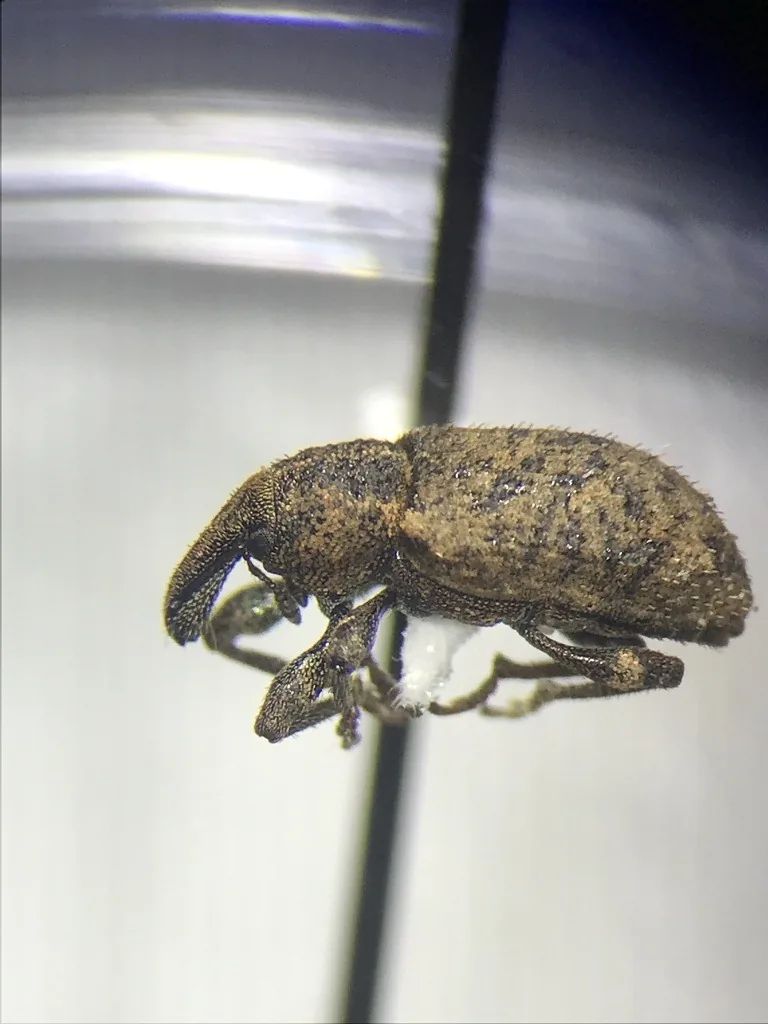
- Adults are mottled dark brown beetles with a typical weevil snout, under 1/4 inch long (0.2 to 0.6 cm according to Ohio State, about 6 mm according to the Western Australian factsheet); they rarely fly and play dead when disturbed.[1][2][3]
- Larvae are legless, cream-colored, C-shaped grubs up to about 1/3 inch long, found tunneling in the roots.[2]
- Look for small, circular, dark egg-laying scars on the leaf stalks, and for leaves that wilt as the roots are tunneled.[2][1]
Look-alikes
| Look-alike | How to tell them apart |
|---|---|
| Wireworms | Also tunnel into carrot roots, but the larvae are thin, shiny, jointed and yellow to reddish brown, and they are more common in gardens that were recently grass or sod.[2] |
Where it lives
A major pest in the Great Lakes region of the United States and Canada; it occurs in northeastern North America and Atlantic Canada, while a related species, Listronotus texanus, occurs farther south in Texas.[1][3]
Biology and life cycle
Adults overwinter in plant debris in and around fields or gardens where carrots, celery or parsley grew the previous season, and in spring they walk, rather than fly, to new plantings.[3][1]
Females lay eggs in the leaf stalks or crowns once plants reach about the four-leaf stage, and the grubs then tunnel into the roots.[1]
Adults also feed on the foliage of carrot-family plants, and the weevils are present throughout the growing season.[1][2]
Damage and signs
Health risk
It feeds only on plants; none of the sources reports any harm to people or pets.[1][2]
Control
Prevention
Because adults rarely fly and spread slowly, avoid planting carrots, celery or parsley on or next to a spot that was infested the year before.[3]
Traps and physical control
Look for egg-laying scars on the leaf stalks, or set a wooden trap baited with a carrot at the edge of the bed early in the season, before the crop comes up, checking and re-baiting it every three to four days and disposing of the weevils it catches.[1]
Pesticides
Ohio State gives action thresholds for growers (1 percent of plants with egg scars, or 1.5 weevils per trap); follow the label of any product used.[1]
Common questions
- What is tunneling into my carrots?
- Small, cream-colored, C-shaped grubs in the tunnels point to carrot weevil; thin, shiny, jointed larvae are wireworms instead.[2]
- Why did my parsley plants suddenly die?
- Carrot weevil grubs tunneling in the roots often kill parsley plants; look for egg scars on the leaf stalks and grubs in the roots.[1][2]
Sources
- Ohio State University Extension (Ohioline), “Monitoring Carrot Weevils Using Wooden Boivin Traps (ENT-83, E. Justus and E. Long, November 27, 2017).” ohioline.osu.edu/factsheet/ent-83 (accessed 2026-10-17)
- University of Minnesota Extension (What's wrong with my plant?), “Carrot: holes in root (What's wrong with my plant?).” apps.extension.umn.edu/garden/diagnose/plant/vegetable/carrot/rootholes.html (accessed 2026-10-17)
- Department of Agriculture, Western Australia (copy hosted by AUSVEG), “Carrot weevil, Listronotus oregonensis and L. texanus: exotic threat to Western Australia (Factsheet 18/2001).” ausveg.com.au/app/data/technical-insights/docs/TL6.pdf (accessed 2026-10-17)
- iNaturalist, “Listronotus oregonensis taxon page (order and family).” www.inaturalist.org/taxa/223956 (accessed 2026-10-06)