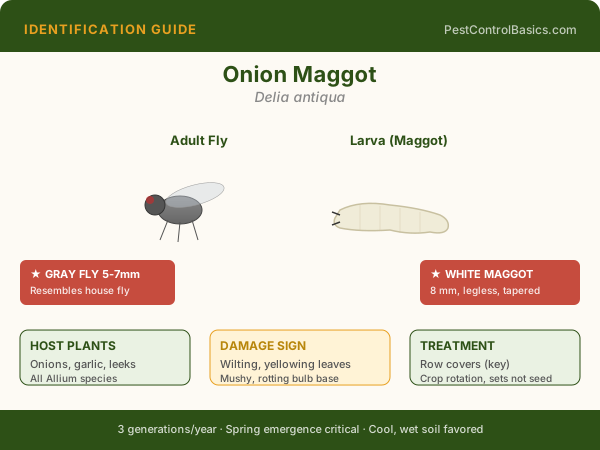
Delia antiqua / D. radicum / D. floralis · Diptera: Anthomyiidae
Root maggot damage is underground and invisible until plants wilt — by then the crop is lost. Understanding the fly adult stage timing enables the one effective prevention window.
FlyDipteraAnthomyiidaeRoot PestOnionBrassica
🪰
Risk Level
Vegetable Pest
📐 FIELD GUIDE ILLUSTRATION
Original illustration by PestControlBasics.com. Use anatomical labels above to confirm your identification. For photo references, see the identification section below.
🔬
PestControlBasics Editorial Team
Reviewed by Derek Giordano · Updated 2026
🔍 Identification
Adults: small grey flies resembling house flies; 5-7mm. Larvae (maggots): white, legless; found in plant roots. Onion Maggot (D. antiqua): attacks onions, leeks, and garlic — plants yellow and collapse. Cabbage Maggot (D. radicum): attacks brassica roots — plants wilt and die. Turnip Maggot (D. floralis): attacks fall brassicas.
🧬 Biology & Behavior
Adult flies emerge in spring and lay eggs in the soil at the base of host plants. Larvae burrow into roots and feed for 3-4 weeks. Multiple generations: spring (most damaging to early crops), summer, and fall generations. Timing of adult flight correlates with plant emergence — flies find host plants by volatile compounds.
⚠️ Damage & Health Risk
Root destruction causing wilting, yellowing, and plant death; secondary bacterial soft rots entering through damaged roots; complete crop losses in unprotected plantings in high-pressure areas.
🔧 DIY Treatment
Row covers placed immediately at transplanting (before adult flies arrive) provide complete physical exclusion — the most effective organic management. Crop rotation (2+ years away from host crops). Beneficial nematodes (Steinernema feltiae) applied to soil target larvae. Parasitic wasps (Aleochara bilineata) as biological control.
👷 When to Call a Pro
Commercial onion and brassica production uses combination approaches: nematode soil drench, row covers on transplants, and monitoring with yellow sticky traps for adult activity.
❓ FAQ
How do I know if I have root maggots?
Pull a wilting plant and examine the root system. Onion maggot: white maggots inside onion bulb and rotting tissue. Cabbage maggot: maggots in brassica roots and hollowed root tissue; secondary soft rot. The presence of grey flies around plants at soil level in spring is an early warning.
Do row covers really stop root maggots?
Yes — row covers placed before adult flies arrive provide complete physical exclusion. The critical timing: place row covers at or before transplanting, before any adult flies have had access to the plants. Plants can be left under row covers for the entire season for brassicas; remove for onions when bulbing begins.
DG
Derek Giordano
Certified Pest Control Operator · Former Business Owner
Derek ran his own pest control company in Florida for several years, servicing thousands of regular customers. All content is based on hands-on field experience and current EPA & university extension guidelines.
Confirming a Root Maggot Complex infestation in the field
Misidentification is the most common reason home treatment fails for Root Maggot Complex. Look-alike species often respond to completely different active ingredients, so a 30-second confirmation step before any spraying or baiting saves the most time over a season. The practical workflow begins with where you found the specimen — kitchen, bathroom, garden, attic — because habitat narrows the candidate list faster than morphology alone.
Specific cues for Root Maggot Complex include body proportions, leg count, antenna shape, and any wing structure if present. Adults are usually the easiest stage to identify, but most real-world infestations show juveniles or evidence (frass, shed skins, webbing, damage patterns) more often than adults themselves. Photograph the specimen against a ruler or coin for scale, then compare against a regional reference rather than a global one — range maps from state Extension services beat generic online identification sites.
When two species look genuinely similar, the deciding factor is often where they congregate at dusk versus dawn, or whether they leave a visible trail. A test of three common DIY treatments — one bait, one residual spray, one mechanical barrier — applied in different areas can also confirm identity by which works.
Why timing changes everything with Root Maggot Complex
The same product applied two weeks apart can produce a complete kill or near-zero effect depending on where the Root Maggot Complex population sits in its life cycle. Egg-stage pests are nearly immune to contact sprays, so a perfectly applied treatment during a major hatch event will leave the next generation completely unaffected. The professional standard is two applications spaced 10 to 14 days apart for most household pests — the first kills the active adults, the second catches anything that emerges from eggs in the interim.
Temperature also drives treatment success. Most residual sprays lose efficacy above 90°F or below 50°F, and pyrethroid products in particular can repel rather than kill when applied during high heat. The best window is early morning when surface temperatures are still moderate and target pests are moving but not yet at peak activity. Indoor treatment is less weather-dependent but still benefits from being applied when household air movement is low — running ceiling fans during application redistributes droplets away from the intended surface.
Seasonal pressure for Root Maggot Complex usually has two or three predictable peaks per year. A treatment calendar built around those peaks costs less and works better than reactive spraying after a problem is already established.
Prevention strategies that actually reduce Root Maggot Complex pressure
Most pest pressure traces back to one or two environmental conditions that are easier to fix than the infestation itself is to spray. For Root Maggot Complex, the highest-leverage changes typically involve moisture management, food access, and exclusion at structural entry points. Reducing standing water within 20 feet of the foundation eliminates more pest problems than any single chemical application, and the effect persists year over year rather than requiring a rebuy every quarter.
Exclusion work is unglamorous but durable. A common entry-point audit covers door sweeps, weep holes, utility penetrations, dryer vents, soffit gaps, and the base of siding. Most homes have between five and fifteen openings larger than the minimum required for the target pest to enter, and sealing even half of them measurably reduces indoor sightings within one season. Stainless steel mesh, copper wool, and exterior-grade sealant cover most situations; expanding foam alone is not sufficient because rodents and some insects chew through it.
Storage practices matter too. Pantry pests, fabric pests, and overwintering insects all exploit cardboard, paper, and natural-fiber storage in basements and garages. Switching to sealed plastic bins for seasonal storage removes a significant amount of harborage that is otherwise impossible to spray effectively.
When to escalate Root Maggot Complex control beyond DIY
Most Root Maggot Complex situations are within the range of a careful homeowner, but a handful of scenarios genuinely warrant a licensed applicator. Multi-unit buildings are at the top of that list — shared walls, plumbing, and ductwork mean a localized treatment in one unit often just relocates the population to a neighbor. Any infestation that involves wall voids, attic insulation, or sub-slab plumbing is also harder to reach with consumer products and benefits from professional equipment and labeled product concentrations.
Health-sensitive situations are the second escalation trigger. Pregnancy, infants, immunocompromised residents, and pets with known sensitivities all narrow the available product list considerably. A licensed professional can apply restricted-use products and reduced-risk reformulations that achieve control with lower household exposure than over-the-counter alternatives. The cost difference is usually less than two seasons of DIY spending once the time investment is factored in.
The third escalation point is recurrence. If the same pest returns within six weeks of an apparently successful treatment, the source is usually structural or environmental rather than chemical, and a professional inspection often finds the cause faster than a second round of self-treatment.
Published: Jan 1, 2025 · Updated: Apr 7, 2026
Choosing a pest control company: questions worth asking
Pest control companies vary substantially in approach, training, and pricing, and the questions to ask before signing a contract often aren't the obvious ones. Worth asking: what's the technician's training and certification (state pest control certification is the floor; advanced training in IPM, structural inspection, or specific pest specialties is meaningful additional credentialing); what does the service include beyond visiting and spraying (inspection, monitoring, exclusion recommendations, follow-up scheduling); what guarantees apply if pests return between visits; what's the protocol for hard-to-resolve issues (some companies escalate to senior technicians or supervisors; others repeat the same approach); what active ingredients are used and whether the company will use specific products on request (homeowners with chemical sensitivities, pollinator gardens, or other concerns may want specific products); and what's the contract structure (per-visit, annual, multi-year). Worth less than expected: brand recognition and advertising spend (large national chains and small local operators both produce excellent and mediocre service); 'green' or 'organic' labels (which mean different things to different companies and often don't correspond to specific product or practice differences); price alone (typical pricing variance is modest, and the floor of cheap options often includes poor service).
The role of caulk, sealant, and exclusion in long-term pest control
Sealing entry points is the most underrated pest control activity in residential settings, partly because it produces no immediate visible result and partly because it feels like home repair rather than pest control. The yield is substantial: a thoroughly sealed structure with appropriate exterior caulking, intact weatherstripping, sealed utility penetrations, and screen integrity has dramatically lower pest pressure than the same structure without those interventions. Specific high-yield targets include gaps around dryer vents, electrical and plumbing penetrations through exterior walls, gaps where siding meets foundation, mortar joints in older brick, weep holes in newer brick (which should be screened, not sealed), garage door bottom seals (where rodents commonly enter), and the gap above door thresholds where many ants and small insects pass. Materials matter: silicone-based caulk for moisture areas, polyurethane sealant for foundation cracks, copper mesh for rodent exclusion at utility penetrations (steel wool degrades), and 1/4-inch hardware cloth for larger openings. A weekend of methodical sealing in spring or fall — when activity is moderate and weather permits exterior work — produces lasting reduction that no single treatment matches.
The role of local cooperative extension in pest decisions
State cooperative extension services — university-based educational and advisory programs in every state — are dramatically underused resources for residential pest decisions. Most state extensions employ entomologists who answer homeowner questions free of charge through county offices, online query forms, or scheduled call hours. The information available is specific to the state's pest pressure, climate, and recommended practices, and is typically much more locally accurate than national resources. Extension publications cover identification, life cycle, treatment options, and specific product recommendations for state conditions; the publications are peer-reviewed by university scientists and updated periodically based on current research. For any pest situation where identification is uncertain or treatment options are unclear, a clear photograph submitted to the state extension produces an identification, a brief biological explanation, and one or more treatment options within typically a few days. The benefit beyond any single inquiry is building familiarity with the local resource — extension contacts become a reference for future situations and produce better decisions than aggregated online advice.
Finding regional pest data sources worth trusting
The quality of pest information available to homeowners varies enormously by source, and finding the reliable sources for your specific region is a one-time investment that pays off across years of pest management decisions. Cooperative extension services associated with land grant universities in each state are usually the highest-quality regional resource, producing fact sheets, identification guides, and treatment recommendations specifically calibrated to local conditions, pest species, and regulatory environments. State department of agriculture pest fact sheets are typically similar in quality and orientation. Local pest control company blog content varies in quality but can be useful when produced by experienced practitioners writing about their actual work rather than generic SEO content. National pest control sites tend to be less useful for the specific reason that they average across regions and don't address the conditions you're actually facing. Bookmarking two or three high-quality regional resources at the outset, and consulting them before making significant pest management decisions, raises the average quality of your decisions dramatically without much ongoing effort.
Pet-safe pest control: what the label actually communicates
Pet-safe is a marketing phrase that does specific work, and the work it does is narrower than most pet owners assume. A product labeled pet-safe is generally one that, when used according to label directions and after the specified re-entry interval, presents a low risk of acute toxicity to pets at expected exposure levels. That is not the same thing as zero risk, and it doesn't say anything about chronic exposure, behavioral effects, or exposure to pets with unusual physiology, age, or pre-existing conditions. The other thing it doesn't account for is real-world misuse: pets that lick treated surfaces immediately after application, products applied in higher concentrations than directed, or applications in locations the label didn't anticipate. The practical interpretation is that pet-safe products are a reasonable choice when used carefully, but the safer overall practice with any pet in the home is to keep animals out of treatment areas until products are fully dry or absorbed, choose lower-toxicity formulations like bait stations over surface sprays when feasible, and ask explicitly about ingredients and re-entry intervals rather than relying on the label phrase alone.
Pest control and HOA dynamics: where they overlap
Homeowners' associations vary widely in how they engage with pest control, and the variations create practical issues that affect individual treatment decisions. Some HOAs maintain common-area pest treatment programs that handle perimeter spraying, mosquito treatment, or rodent monitoring on shared property; others leave all pest control to individual homeowners. Some have rules about treatment products or notification requirements; others don't. Some include treatment in the HOA fee structure; others bill separately. For homeowners in HOA communities dealing with persistent pest pressure, understanding what the HOA does and doesn't do is the first step in figuring out what additional individual action is needed. For HOAs without coordinated programs in areas with significant pressure, organizing a neighborhood-level treatment plan often produces dramatically better results than individual treatment efforts that don't coordinate timing or coverage. The conversations are sometimes politically awkward in HOA contexts, but the underlying problem — that some pests are neighborhood-scale and unit-level treatment can't address them — is structural rather than personal. Bringing the issue to an HOA meeting with concrete proposals tends to produce more constructive responses than complaint-style framing.
🗺️ US Distribution — Onion Maggot, Root Maggot & Cabbage Maggot
Common Occasional Not Present
States Present
49
Occasional
2
Primary Region
Continental US
📊 Source: University extension services, USDA, CDC vector data, and published entomological surveys.