On this page
How to identify it
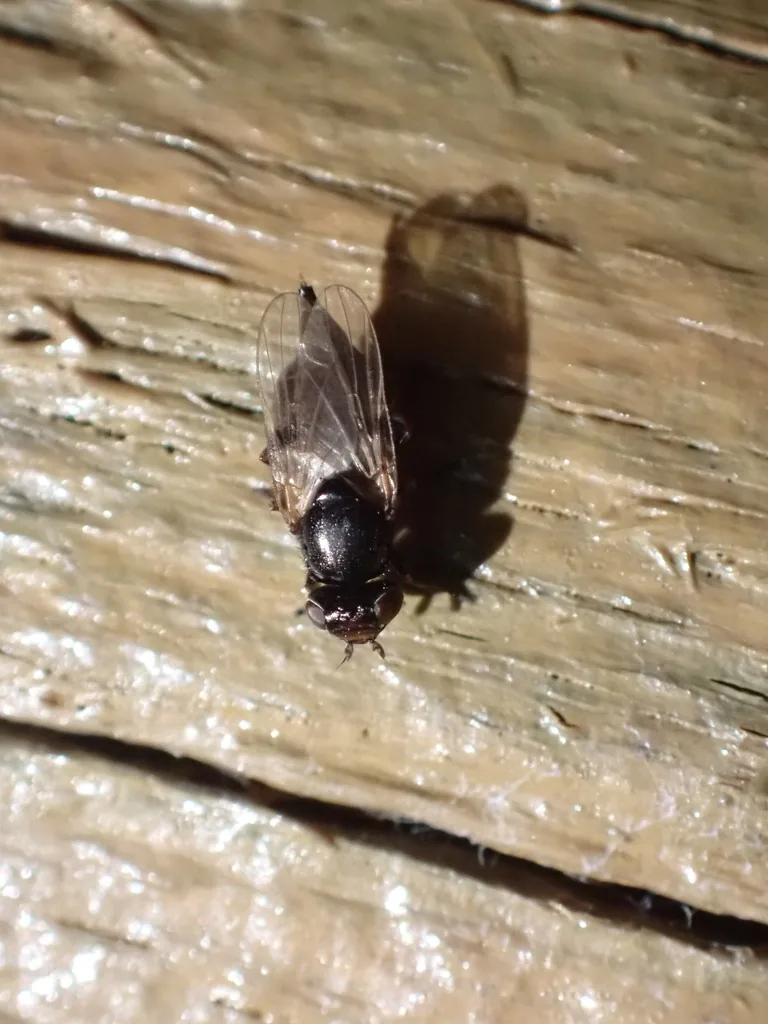
- The adult is a stout, shiny black fly about 1/4 inch (6 mm) long, about the size of a house fly but less hairy and shinier, without bristles or stripes.[1]
- Each wing is clear except for one opaque, smoky brown patch along the front edge, about a third of the way out from the body. The legs are black except for yellow-white knees and ankles.[1]
- The maggot is legless and white, with no distinct head or eyes; it is blunt at the rear and tapered at the front. First-stage maggots are only 1/32 to 1/16 inch long and transparent white, so they can look like root hairs; full-grown maggots reach up to 1/2 inch.[1][2]
- Eggs are white, slightly curved and about 1/25 inch (1 mm) long. The pupa has a hard brown case.[1]
Look-alikes
| Look-alike | How to tell them apart |
|---|---|
| Beet leafminer fly | The beet leafminer is one of the anthomyiid flies that also land on sugarbeet root maggot sticky traps. The root maggot fly is shiny black with no bristles or stripes and has a single smoky patch on each otherwise clear wing.[1] |
| Onion maggot and seedcorn maggot flies | These anthomyiid flies are common on the same traps. To pick out a root maggot fly, look for the stout, shiny black body, the one smoky spot on the leading edge of each wing, and black legs with yellow-white joints.[1] |
Where it lives
University of Wyoming Extension describes it as native to the region. It is widespread in Idaho and the adjoining Oregon beet-growing region, where it reaches damaging levels every year, it is a sugar beet pest in Wyoming, and North Dakota State University calls it the most economically significant insect pest in the Red River Valley beet-growing area.[2][3][4]
Biology and life cycle
Full-grown larvae spend the winter 10 to 16 inches deep in the soil of the previous year's beet fields, congregating along the harvested rows. When the soil warms to the mid-40s Fahrenheit, they move up into the top few inches of soil to pupate.[1][2]
In Idaho, adults begin emerging by mid-April in the west and in late April or May in the east, and they are usually most abundant from mid- to late May into early June. Cold, wet weather delays emergence and unusually warm weather speeds it up.[1]
Females start laying eggs 3 to 10 days after emerging, putting them in the soil next to young beet plants in clusters of 10 to 20. Each female may lay about 120 eggs, which hatch in 1 to 3 days, and the maggots begin feeding on the roots right away.[1][2][3]
Larvae feed for about a month and reach full size by early to mid-July, then stop feeding and enter a resting state (diapause) until the next spring. There is generally one generation a year in Idaho, though a few may emerge as adults in August; Wyoming reports up to two generations.[1][2][3]
Besides sugar beets, the maggots attack table beets, Swiss chard and spinach. Weeds such as spear saltbush, garden orache, common lambsquarters and redroot pigweed are hosts but not preferred ones.[1]
The adult flies are highly mobile and keep moving into fields from long distances during an egg-laying period of about six weeks.[3]
Damage and signs
- Only the maggots cause damage. They scrape the surface of the root with a pair of mouth hooks. In seedlings, feeding can sever the thin taproot and make the plant wilt or die, and feeding on the root tip of young plants can lead to a forked taproot in the mature beet.[4][1]
- On larger roots the maggots leave shallow, oozing black lesions from pinhead size to about 3/4 inch long, which can cover the whole root in severe infestations. Root-rot organisms can invade the wounds, and the stand losses can be severe, especially in fields with a history of root rot.[1]
- First-generation maggots on young beets do the most damage; in severe infestations stand losses can reach 80 to 90 percent, and the loss may not be noticed until it is too late to replant. NDSU reports yield losses of up to 45 percent, and injured young beets can die when drought or root disease adds to the stress.[2][4]
Health risk
These extension sources discuss it only as a beet pest. The adult fly has sponging mouthparts and the maggots feed on roots; no source mentions any harm to people.[1][2][3][4]
Control
Prevention
Rotate out of sugar beets: rotation greatly reduces the fly population. New beet plantings close to old beet fields can still be damaged, and infestations are heaviest where beets are grown year after year.[2]
Plant early, so that beets are past the vulnerable seedling stage when the flies peak.[1]
Traps and physical control
Deep fall tillage exposes overwintering larvae to freezing temperatures and predators. Frequent irrigation drives larvae toward the soil surface, where their feeding does less harm and insecticides reach them more easily, but overwatering encourages soil-borne root diseases.[1]
Biological control
Avoid broad-spectrum insecticides where you can, to conserve the natural predators of root maggots.[1]
Pesticides
Soil-applied granular insecticides aimed at the larvae work best. In most of Idaho, post-emergence granules applied within 10 days of the peak fly flight pay off better than at-plant treatments, and seed treatments may be enough where pressure is low to moderate. In the Red River Valley most growers apply an insecticide at planting, and those in high-risk areas add at least one post-emergence treatment.[1][3][4]
Spraying the adult flies takes repeated applications, because new flies keep arriving, and it can select for insecticide resistance and set off outbreaks of aphids and leaf-feeding caterpillars by killing their natural enemies.[3][1]
Monitoring the flies
Orange sticky traps track the flies. The University of Idaho suggests three or more traps per field along fencerows or ditches next to beet fields, several hundred yards apart, with the sticky face toward the north or east and about 1 foot above the soil, checked at least twice a week until fly catches clearly peak, usually between late May and early June.[1]
Treatments work best when they coincide with the seasonal peak in fly catches. In the Pacific Northwest, a season total of 40 to 50 flies per trap through the peak justifies a post-emergence treatment; Idaho Extension also offers an action-threshold table and calculator based on beet price and treatment cost.[3][1]
NDSU's degree-day model forecasts peak fly activity, which usually comes at about 651 degree-days, two to three days after 600, in warm (about 80 degrees F), calm weather. Winds over 10 mph, heavy rain or temperatures below 70 degrees F around the expected peak can delay or reduce fly activity.[5][4]
Common questions
- What plants does the sugarbeet root maggot attack?
- Mainly sugar beets, but also table beets, Swiss chard and spinach. Spear saltbush, garden orache, common lambsquarters and redroot pigweed are hosts too, though not preferred ones.[1]
- When are sugarbeet root maggot flies most active?
- Adults emerge from mid-April to May, depending on location and spring weather, and catches usually peak from late May to early June. The peak comes on warm, calm days.[1][5]
- Why not just spray the flies?
- The flies are highly mobile and keep moving into fields during an egg-laying period of about six weeks, so killing them takes repeated sprays. That risks insecticide resistance and outbreaks of aphids and caterpillars, so extension specialists favor soil-applied treatments aimed at the larvae.[3][1]
Sources
- University of Idaho Extension, “Sugar beet root maggot (D. Wickwar and E. J. Wenninger, University of Idaho IPM).” www.uidaho.edu/extension/food/ipm/ag-pests/sugarbeet-root-maggot (accessed 2026-11-09)
- University of Wyoming Cooperative Extension Service, “Sugar Beet Root Maggot, Tetanops myopaeformis, B-1013.16 (M. J. Brewer, April 1995).” www.wyoextension.org/agpubs/pubs/B1013.16.pdf (accessed 2026-11-09)
- Pacific Northwest Pest Management Handbooks (Oregon State, Washington State and University of Idaho Extension), “Sugar beet: Sugar beet root maggot (Pacific Northwest Insect Management Handbook).” pnwhandbooks.org/insect/agronomic/sugar-beet/sugar-beet-sugar-beet-root-maggot (accessed 2026-11-09)
- North Dakota Agricultural Weather Network, North Dakota State University, “Calculating Degree-day Accumulations for Sugarbeet Root Maggot Development (NDAWN help page).” ndawn.ndsu.nodak.edu/help-sugarbeet-root-maggot.html (accessed 2026-11-09)
- iNaturalist, “Tetanops myopaeformis taxon page (order and family).” www.inaturalist.org/taxa/1265670 (accessed 2026-11-09)