On this page
How to identify it
- Young caterpillars are pale and feed inside webs near the base of the leaves. Older caterpillars turn olive green, with a dark stripe down the middle of the back and three round spots on each body segment on either side of it; a long hair grows from each spot.[2][3]
- Utah State University describes the caterpillars as mainly green with light stripes and white spots that have black centers.[1]
- Full-grown caterpillars reach about 1 to 1-1/2 inches long and are slender.[2][3]
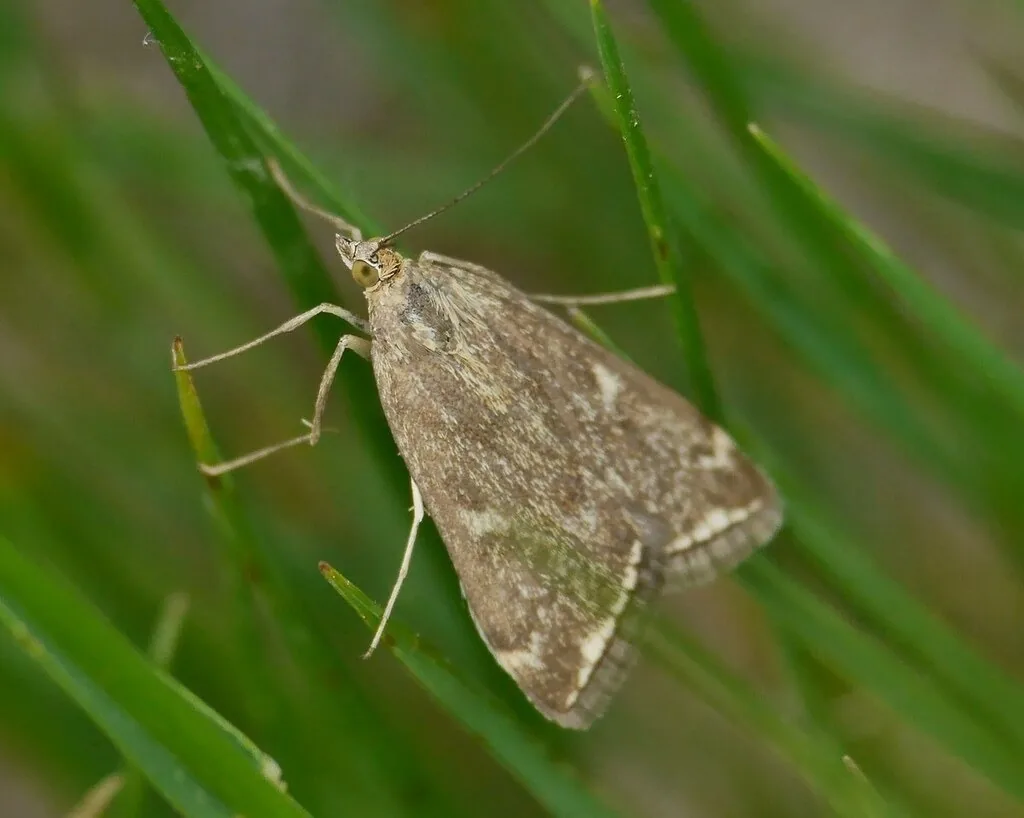
- The moth is brownish tan with white markings on the wings and a wingspan of about 1 inch.[1][3]
- Eggs are pearly white and laid singly, in small groups, or in short overlapping rows on the undersides of leaves.[3][2]
Look-alikes
| Look-alike | How to tell them apart |
|---|---|
| Alfalfa webworm (Loxostege commixtalis) | A close relative that also feeds on sugarbeet and has the same hair-bearing spots, but the light stripe down its back is broad, covering nearly all the space between the spots.[2] |
| Garden webworm | Also feeds on sugarbeet and has similar markings, but it is the least common of the three beet-feeding webworms and only reaches about 1 inch.[2] |
Where it lives
The sources describe it as a pest in the West: Utah State University covers it on hemp, the High Plains IPM Guide (a joint guide from Wyoming, Nebraska, Colorado State and Montana State universities) covers it on sugarbeet, and a 1912 USDA study followed it in the Arkansas Valley of Colorado and Kansas.[1][2][3]
Biology and life cycle
Hosts include beets, field-grown hemp, amaranth (Amaranthus), legumes, spinach, cotton, corn, eggplant and a variety of weeds. Females are especially drawn to lambsquarters and Russian thistle for egg laying.[1][2]
It spends the winter as full-grown caterpillars (some sources also mention pupae) in the soil, inside tube-like cases they spin there. Moths emerge in May or June.[1][2][3]
Each female can lay at least 200 eggs. Caterpillars hatch whitish with black heads, turn green as they grow, and when full grown burrow into the soil near the plant to pupate.[3][1]
Utah State University and the High Plains IPM Guide give two generations a year; the 1912 USDA study counted three in Colorado's Arkansas Valley, where eggs took 3 to 5 days, caterpillars 17 to 20 days and pupae usually 11 days.[1][2][3]
Moths feed on nectar in alfalfa and other blossoms. When large numbers of moths fly up in clouds from a beet field, the 1912 study warned, a crop of caterpillars can be expected within a week or 10 days.[3]
Damage and signs
- Young caterpillars chew the underside of the leaf without breaking through the upper surface, leaving pits that are easy to miss. Larger caterpillars eat through the leaves, and feeding speeds up quickly; heavy infestations leave only the midveins and can damage the growing point.[2][3]
- The second generation has the greatest potential for damage. Small beets can be killed outright if the crown is eaten, and defoliation slows the growth of beet roots.[2][3]
Health risk
The sources describe it only as a plant-feeding pest; they mention no harm to people.[1][2]
Control
Prevention
Control weeds in and around fields, since lambsquarters and Russian thistle attract egg-laying females.[2]
Scout early for the first signs of infestation, such as pitted leaf undersides, so a developing population is caught before the large caterpillars defoliate the crop.[2]
Traps and physical control
Plowing out beets at harvest crushes or buries many of the caterpillars overwintering in the soil.[3]
Biological control
Blackbirds gather in flocks in infested fields and eat the caterpillars, though mostly once they are nearly full grown. Parasites, including a small braconid wasp, also kill overwintering caterpillars.[3]
Pesticides
Insecticide is warranted only if significant defoliation has occurred and caterpillars are still feeding. The High Plains IPM Guide lists Bacillus thuringiensis and conventional insecticides such as carbaryl; follow the label.[2]
Common questions
- What are the green caterpillars webbing my beet or spinach leaves?
- If they are olive green with a dark stripe down the back and rows of round spots, each with a long hair, they may be beet webworms.[2][1]
- How fast can beet webworms damage a field?
- Quickly. Early feeding often goes unnoticed, but older caterpillars eat through the leaves and can strip plants to the midveins in a short time.[2]
Sources
- Utah State University Extension, “Beet Webworm, Loxostege sticticalis (hemp IPM).” extension.usu.edu/planthealth/ipm/notes_ag/hemp-beet-webworm (accessed 2026-11-09)
- High Plains IPM Guide (University of Wyoming, University of Nebraska, Colorado State University and Montana State University), hosted by Bugwood, “Sugarbeets: Webworms (G. L. Hein, High Plains IPM Guide, 2006).” bugwoodcloud.org/bugwoodwiki/Webworms-Sugarbeets.pdf (accessed 2026-11-09)
- U.S. Department of Agriculture, Bureau of Entomology (via govinfo.gov), “A report of progress regarding the sugar-beet webworm (H. O. Marsh), Bureau of Entomology Bulletin 109, Part VI, 1912.” www.govinfo.gov/content/pkg/GOVPUB-A-ed6a89df851b96005ce813a3c96f2dd3/pdf/GOVPUB-A-ed6a89df851b96005ce813a3c96f2dd3.pdf (accessed 2026-11-09)
- iNaturalist, “Loxostege sticticalis taxon page (order and family).” www.inaturalist.org/taxa/224154 (accessed 2026-11-09)