On this page
How to identify it
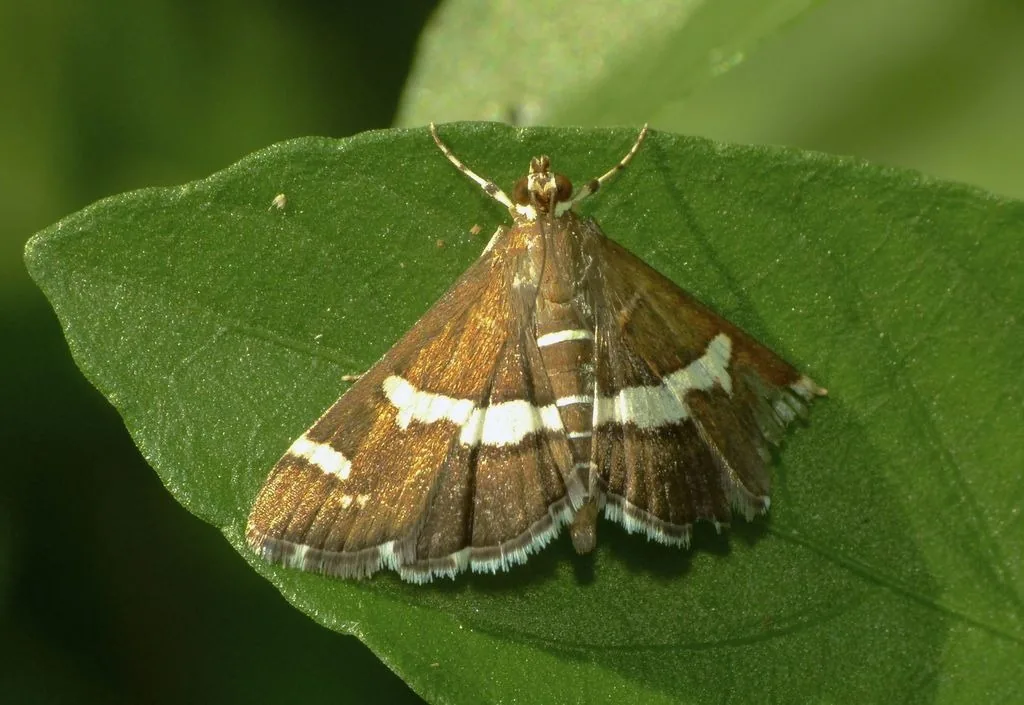
- The adult is a brownish gray moth that, at rest, shows a broad white band across its back and white dashes along the wing edges.[1]
- Young caterpillars feed on the undersides of leaves, leaving large, smooth-edged holes or skeletonized patches. Older caterpillars may pull a leaf together into a tube with silk and hide in it when disturbed.[1]
- Look for a little webbing and plenty of frass, which comes as small, dark, wet-looking round pellets.[1]
Look-alikes
| Look-alike | How to tell them apart |
|---|---|
| Other webworm caterpillars | Hawaiian beet webworms often spin much less webbing than other webworm species.[1] |
Where it lives
It breeds year-round in warmer regions to the south and migrates north as the season warms. It cannot overwinter in New England, and if it reaches Massachusetts at all, it usually arrives in mid- to late September or later. It is an important agricultural pest on several continents; DNA barcodes show that populations in Australia and nearby regions differ genetically from those in North America, Africa, Europe and Asia, although the moths of the two groups look the same.[1][2]
Biology and life cycle
Its principal hosts are beet, spinach, lambsquarters and pigweeds (Amaranthus), and it also attacks carrots, cabbage-family crops and purslane.[1]
Once it arrives in the North late in the season, it keeps breeding until cold weather kills it.[1]
It is a major pest of amaranth worldwide and can cause complete loss of the foliage in severe outbreaks.[4]
Damage and signs
- The caterpillars can eat large amounts of foliage and can also crack or deform the crowns of beet roots.[1]
- As they grow, they may eat whole leaves, and they can completely defoliate a field in a very short time.[1]
- On vegetable amaranth farms in Jamaica, where it is one of a complex of five caterpillar pests, crop damage stayed high or variable (10 to 46%) even with weekly pyrethroid sprays.[3]
Health risk
None of these sources mentions any risk to people; they deal only with crop damage.[1][3]
Control
Prevention
Control weeds. Infestations are often worse in weedy fields where lambsquarters and pigweed grow.[1]
Scout before spraying. For the caterpillar complex on Jamaican vegetable amaranth, a sequential sampling plan with a threshold of one caterpillar per six-leaf sample cut insecticide use by 33 to 60% compared with growers' usual schedules, with no increase in crop damage.[3]
Resistant varieties may help in amaranth: in laboratory tests of 35 amaranth accessions, one (VI036227) killed all of the young caterpillars within 36 hours, even though moths still laid eggs on it.[4]
Pesticides
In the Jamaican amaranth study, control of the caterpillar complex improved dramatically with tebufenozide, spinosyns or emamectin benzoate, while pyrethroid-treated plantings still suffered 10 to 46% damage. UMass Extension notes that several insecticides, including OMRI-approved organic options, are labeled for webworms in beets, spinach and its other host crops.[3][1]
Common questions
- Can the Hawaiian beet webworm survive winter in the North?
- Not in New England. It breeds year-round farther south and migrates north, usually reaching Massachusetts, if at all, in mid- to late September or later, then breeds until cold weather kills it.[1]
- What is eating holes in my beet and spinach leaves late in the season?
- One possibility is the Hawaiian beet webworm. Young caterpillars make large, smooth-edged holes or skeletonize leaves from below, older ones eat whole leaves, and you may find small, dark, wet-looking frass pellets and a little webbing.[1]
- Do pigweed and lambsquarters make webworm problems worse?
- They can. Both are principal hosts, and UMass Extension notes that infestations are often worse in weedy fields where they grow.[1]
Sources
- UMass Extension, “Vegetable Pests and Climate Change (handout by S. Scheufele, UMass Extension, 2024).” rvs.umn.edu/Uploads/EducationalMaterials/ba79da0f-9a57-49f6-bba7-e8445609e637..pdf (accessed 2026-11-08). PDF hosted on a University of Minnesota server
- Bulletin of Entomological Research (via NCBI PubMed), “DNA barcodes reveal population structure in a widely-distributed agricultural pest, the Hawaiian beet webworm Spoladea recurvalis (E. Pfeiler; Bulletin of Entomological Research, 2026; abstract).” pubmed.ncbi.nlm.nih.gov/42003721/ (accessed 2026-11-08)
- Journal of Economic Entomology (via NCBI PubMed), “Sequential sampling and biorational chemistries for management of lepidopteran pests of vegetable amaranth in the Caribbean (D. Clarke-Harris and S. J. Fleischer; Journal of Economic Entomology 96(3): 798-804, 2003; abstract).” pubmed.ncbi.nlm.nih.gov/12852619/ (accessed 2026-11-08)
- Insects (via NCBI PubMed), “Expression of Resistance in Amaranthus spp.: Effects of Selected Accessions on the Behaviour and Biology of the Amaranth Leaf-Webber, Spoladea recurvalis (S. T. O. Othim et al.; Insects 9(2): 62, 2018; abstract).” pubmed.ncbi.nlm.nih.gov/29890690/ (accessed 2026-11-08)
- iNaturalist, “Spoladea recurvalis taxon page (order and family).” www.inaturalist.org/taxa/52043 (accessed 2026-11-08)