On this page
How to identify it
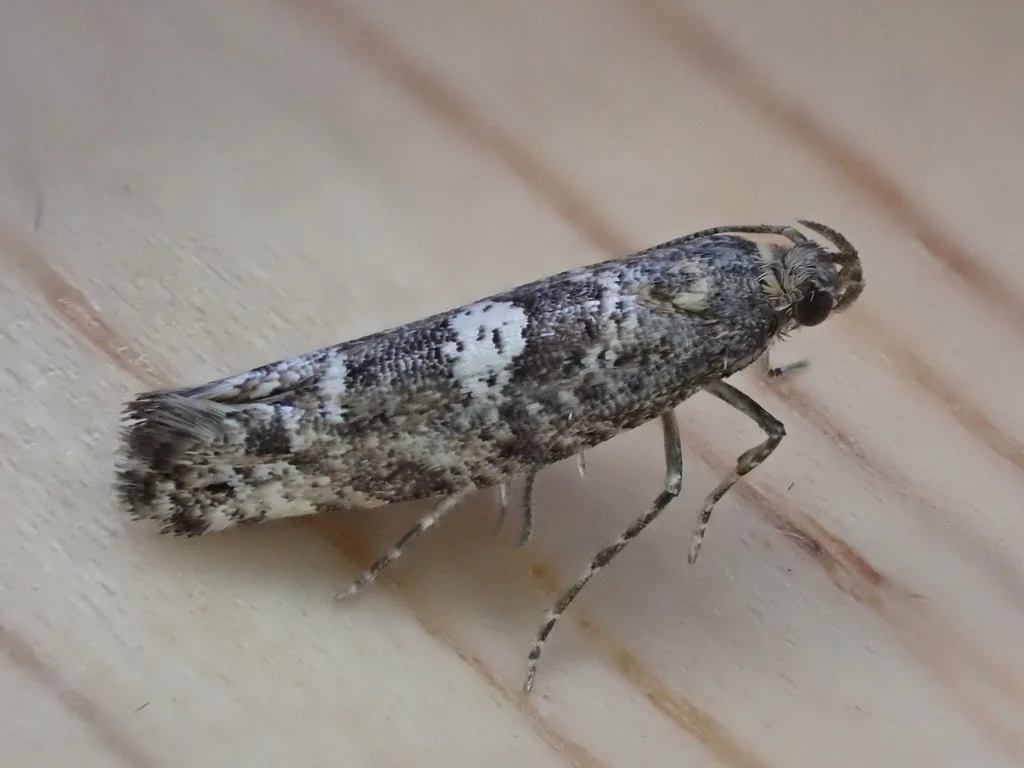
- Adults are about 3/8 inch long, brown speckled with white and black, with a distinct white triangle halfway down the wings that sits in the middle of the back at rest.[2][3]
- Larvae are slender, creamy yellow caterpillars with a brown head and small gray spots on each segment, about 1/2 inch long when grown.[2]
- Damage shows as windowpane patches where larvae eat leaf tissue but leave the outer skin; in onions, chives and shallots they tunnel inside the hollow leaves, so split damaged leaves to find larvae, frass and debris.[2]
Where it lives
Native to Europe; first found in North America in Ontario in 1993 and in the continental United States in Plattsburgh, New York, in 2009, it has since been found in northern New York, Vermont, New Hampshire and Maine.[1][2][3]
Biology and life cycle
Adults come out of overwintering in crop residue when spring temperatures reach about 50 °F, live about three weeks, and females lay 100 to 200 eggs; Maine sees three generations a year, each taking 30 to 50 days.[2][3]
Larvae appear in June and, in later generations, through September.[2]
Damage and signs
- Leeks are by far the most susceptible. Damage rarely kills plants but cuts leek yield and quality, and for garlic and onions the main concern is larvae damaging bulbs during curing.[2]
Health risk
It feeds on allium crops only; none of the sources reports harm to people or pets.[2][3]
Control
Keep them out
Row cover or insect netting over alliums keeps egg-laying moths off; the moths fly only at night, so covers can come off by day for weeding, and onions need wire hoops so the cover doesn't damage their tops.[2][3]
Sanitation
The moths overwinter in crop residue; before curing garlic and onions, strip as much foliage as possible so larvae stay in the field rather than damaging the bulbs.[3][2]
Pesticides
On larger plantings, Bacillus thuringiensis (Bt) is used in some states, timed 7 to 10 days after peak moth flights detected with pheromone traps; check what is registered in your state.[2][3]
Common questions
- What is making windowpane holes in my leek and garlic leaves?
- In the Northeast, windowpane patches with small caterpillars and frass inside the leaves point to leek moth.[2][3]
- How do I protect garlic and leeks from leek moth?
- Cover them with row cover or insect netting so the night-flying moths can't lay eggs on them.[3][2]
Sources
- University of Vermont Extension, “Leek Moth Host Plants and Distribution.” www.uvm.edu/extension/leek-moth-host-plants-and-distribution (accessed 2026-10-17)
- University of Vermont Extension and Cornell Cooperative Extension, “Leek Moth (fact sheet, 2022; UVM Extension and Cornell, SARE-funded).” projects.sare.org/wp-content/uploads/2022-Leek-Moth-Fact-Sheet-op.pdf (accessed 2026-10-17)
- Maine Organic Farmers and Gardeners Association, “Leek Moth (D. Fuller, UMaine Cooperative Extension, Franklin County; Maine Organic Farmer & Gardener, Winter 2017-2018).” www.mofga.org/resources/pest-control/leek-moth/ (accessed 2026-10-17)
- iNaturalist, “Acrolepiopsis assectella taxon page (order and family).” www.inaturalist.org/taxa/317685 (accessed 2026-10-06)