On this page
How to identify it
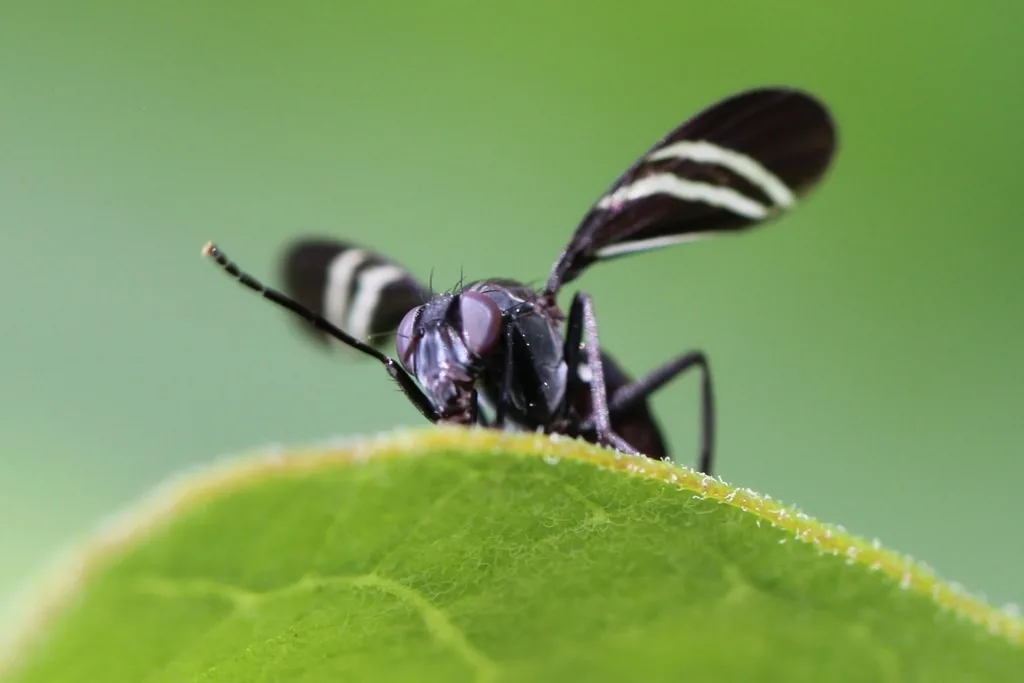
- Adults are medium-sized black flies, 1/4 to 3/8 inch long, about the size of a house fly.[1]
- Each dark wing has three white crossbands; the inner band is small and straight.[1]
- It belongs to the picture-winged flies, a family of about 130 North American species named for their spotted or banded wings.[3][1]
- The maggots look like house fly maggots and can be told apart only by their host plant and microscopic features.[1]
- Adults turn up in landscapes, fields and meadows.[1]
Look-alikes
| Look-alike | How to tell them apart |
|---|---|
| Other picture-winged flies | Other picture-winged flies also have patterned wings, but most breed in decaying plant matter such as compost. The black onion fly is black with three white crossbands on each dark wing and breeds in onions and their close relatives.[1][3] |
| House fly maggots | Black onion fly maggots look like house fly maggots, but they are found feeding inside allium bulbs.[1] |
Where it lives
It is a native North American fly. A 1927 account by F. H. Chittenden of the U.S. Bureau of Entomology noted records from New Jersey and onion injury in Ohio, Illinois, Indiana, Pennsylvania, Wisconsin and Minnesota, and NC State reports it in North Carolina.[2][1]
Biology and life cycle
Females lay tiny, narrow, cylindrical eggs, singly or in groups, under a leaf sheath, and the maggots feed on the bulb.[1]
Third-stage maggots spend the winter inside the infested bulb, then pupate in the soil around its base in spring. Adults emerge 5 to 17 days later.[1]
In North Carolina, adults have been collected in May, July and September and maggots in February, March, April and August. There are at least three generations a year, so ornamental alliums can be infested almost anytime during the growing season.[1]
Adults probably sip flower nectar.[1]
Damage and signs
- Onions, garlic and other alliums, including ornamental alliums, are its only listed host plants; the maggots feed on the bulbs.[1]
- By the time maggots are found damaging an ornamental allium, it is too late to save that plant.[1]
- It is a minor pest of commercial onions, noted as an enemy of onions as early as 1865.[1][2]
Health risk
NC State describes it only as a plant pest, and the Missouri Department of Conservation calls picture-winged flies, the family it belongs to, harmless.[1][3]
Control
Prevention
An ornamental allium with black onion fly maggots can't be saved, so focus on protecting the rest of the bed and future plantings.[1]
Pesticides
NC State suggests spraying the foliage of the remaining plants with a pyrethroid insecticide to repel adults before they lay eggs. Pyrethroids are hazardous to fish, so keep them away from pools, ponds and streams.[1]
If a few plants in a bed are infested, the bed can be drenched with imidacloprid, a systemic insecticide.[1]
Pyrethrum, an extract of the pyrethrum daisy, repels and kills flies but lasts only a very short time after it is applied.[1]
Common questions
- What are the black flies with white-banded wings around my onions?
- They may be black onion flies: black, house-fly-sized picture-winged flies with three white bands on each dark wing, whose maggots feed in the bulbs of onions, garlic and ornamental alliums.[1]
- Can I save an allium that has black onion fly maggots?
- No. NC State notes that by the time the maggots are found, it is too late for that plant, so protect the rest of the bed and future plantings instead.[1]
Sources
- NC State Extension, “Black Onion Fly (PDIC factsheet, J. Baker; reviewed May 8, 2025).” content.ces.ncsu.edu/black-onion-fly (accessed 2026-11-08)
- Entomological Society of Canada / Cambridge University Press, “Tritoxa flexa Wied., the Black Onion Fly (Ortalidae, Dipt.) (F. H. Chittenden, The Canadian Entomologist 59(1): 1-4, 1927; extract).” www.cambridge.org/core/journals/canadian-entomologist/article/tritoxa-flexa-wied-the-black-onion-fly-ortalidae-dipt/D06CEB9B1BA665CBC0CC1462202A2909 (accessed 2026-11-08)
- Missouri Department of Conservation, “Picture-Winged Flies (Field Guide).” mdc.mo.gov/discover-nature/field-guide/picture-winged-flies (accessed 2026-11-08)
- iNaturalist, “Tritoxa flexa taxon page (order and family).” www.inaturalist.org/taxa/325644 (accessed 2026-11-08)