❓ Common Questions About 🦋 Case-Bearing Clothes Moth
How do I confirm I actually have this pest (not something similar)?
The most reliable confirmation is a physical specimen — capture one and compare to reference images on this page. For cryptic pests (bed bugs, termites), look for secondary signs: frass, shed skins, mud tubes, or bites with a specific pattern. When uncertain, a professional inspection is faster than months of misidentification.
Can I treat this myself or do I need a professional?
DIY is effective for small, accessible infestations caught early. Professionals are worth the cost when: the infestation is inside wall voids or structural elements, multiple rooms are affected, you have health-risk pests (hantavirus, venomous species), or DIY has already failed twice.
How long until the infestation is completely gone?
Expect 3–8 weeks for most infestations with proper treatment. Insects with dormant life stages (pupae, eggs) extend the timeline because those stages are impervious to most insecticides. Follow-up treatments at 2 and 4 weeks catch each new cohort as they emerge.
What's the most common mistake people make treating this pest?
Treating only the visible pest population while ignoring the harborage site, entry point, or breeding location. Killing adults provides temporary relief but the population rebuilds from hidden egg cases, pupae, or new arrivals through unaddressed entry points.
Clothes moth prevention and treatment
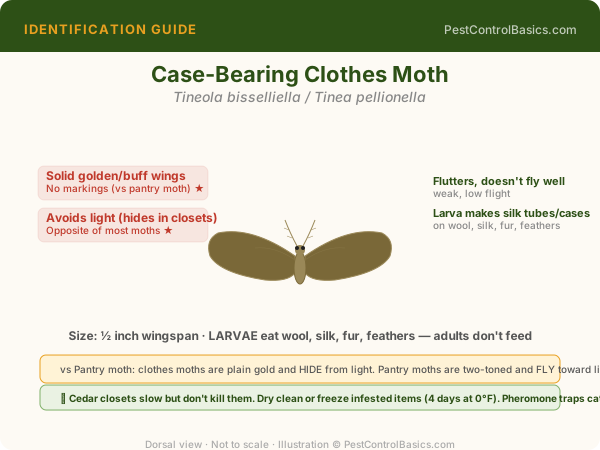
Clothes moth larvae do the damage; adult moths don't eat. Damage appears as small irregular holes in wool, cashmere, or silk items, often in items stored long-term, sometimes with webbing or larval cases nearby. Prevention: store seasonal natural-fiber clothing clean (larvae prefer items with sweat, food, or oil residues), in sealed bags or airtight containers, with cedar or lavender as a deterrent (these are not lethal but help with adult moth avoidance), and inspect stored items at least annually. Treatment for existing infestations: launder washable items in hot water, dry clean items that can't be washed, freeze items that can't be cleaned (sealed bag, several days at freezer temperature kills all life stages), vacuum carpets and upholstery where moth-friendly debris accumulates. Pheromone traps for casemaking and webbing clothes moths confirm presence and track elimination.
Reading pesticide labels: what most homeowners miss
The pesticide label is the most important document in any pest control decision, and it's the document most people skim. Under FIFRA (the federal law that governs pesticide registration), the label is legally binding — using a product inconsistent with its label is a violation, regardless of intent. The label has several sections that homeowners should read fully before purchase, not after: the use sites (where it can legally be applied), the target pests (some products legal indoors are not for the specific pest), the mixing rate (overdosing wastes product without improving efficacy and increases drift risk; underdosing accelerates resistance), the PPE requirements (some require respirators, not just gloves), and the re-entry interval (how long until the treated area is safe for people and pets). The signal word — Caution, Warning, Danger — indicates acute toxicity but not chronic risk; that's elsewhere on the label. Reading labels well prevents nearly every common DIY misapplication.
Pantry moth elimination protocol
Pantry moth control: empty the pantry completely, inspect every package — flour, grains, cereals, mixes, spices, nuts, dried fruit, pet food. Discard anything with visible larvae (small caterpillars, often in webbing inside packaging), pupae (small cocoons in package folds or pantry corners), or adult moths. Larvae chew through most packaging — paper, thin plastic, even some plastic bags — so visible damage on outside isn't required for contamination. Transfer remaining suspect items to the freezer for at least a week to kill any larvae. Vacuum the pantry thoroughly including all corners and shelving edges, discard the vacuum bag immediately. Wipe shelves with soap and water, then vinegar solution. Store all dry goods in airtight glass or hard plastic containers going forward. Place pheromone monitor traps to verify elimination over weeks following cleanout.
Pantry moths vs. clothes moths — different problems, different solutions
Two common household moths produce very different problems. Indianmeal moths (pantry moths) infest stored grain products — flour, cereal, dry pet food, birdseed, pasta, dried fruit. They enter homes inside infested groceries; the larvae develop in food and the adult moths fly through the home looking for more food sources. Clothes moths (webbing and casemaking species) consume natural fiber — wool, silk, cashmere, hair — and develop in stored clothing, rugs, and upholstery. Confusing the two leads to wrong treatment: pantry moth control requires food source elimination and pantry sanitation; clothes moth control requires textile inspection, cleaning, and storage management. Both respond to pheromone traps for monitoring and detection, but the trap pheromones are species-specific.
Why integrated pest management produces better outcomes
Integrated Pest Management (IPM) is the framework most pest management professionals follow and the framework the EPA recommends for residential and commercial settings. IPM is not anti-pesticide; it's a sequencing approach that uses cultural controls (sanitation, exclusion, moisture management) first, mechanical controls (traps, vacuuming, physical removal) second, biological controls (beneficial insects, microbial agents) where applicable, and chemical controls last and targeted. The benefit isn't ideological — it's empirical. IPM-treated sites have lower long-term pest pressure than chemical-only treated sites, because chemicals address the visible population without addressing why the population developed. Homeowners who adopt IPM principles see longer intervals between treatments, lower total pesticide use, and better outcomes during the times when chemicals are appropriate. The shift from 'spray when I see them' to 'fix the conditions, monitor, treat targeted' is the single highest-leverage change most DIY practitioners can make.
Clothes moth treatment and the role of cleaning
Clothes moths — primarily webbing clothes moths and casemaking clothes moths — feed specifically on protein fibers including wool, cashmere, silk, fur, feathers, and pet hair accumulations. Treatment depends on cleaning more than on chemical application because adult moths don't damage textiles; damage is done by larvae feeding on protein fibers, often with the larvae concealed in case-fragments that look like lint. Effective treatment: launder or dry-clean all protein-fiber items in the affected area (heat from drying kills all life stages); vacuum thoroughly including under furniture, in closet corners, along baseboards, and inside storage containers that held affected items; address protein debris that supports populations (pet hair accumulation, dead insect collections in window sills, bird nests in eaves, animal hair carpets); store cleaned wool and protein items in sealed containers (cedar chests, sealed plastic bins) rather than open shelving. Pheromone traps for webbing clothes moths help monitor remaining adult populations and confirm treatment success. Mothballs (naphthalene or paradichlorobenzene) work by sublimation in sealed enclosures but produce indoor air quality concerns and are inappropriate for open storage.
Reading product labels: the parts that matter and the parts that don't
Pesticide product labels are legal documents with specific use directions, but the parts that matter most for residential decisions aren't always the parts that get attention. The active ingredient and its concentration are essential — they determine what category of pest the product targets and how it compares to alternatives. The 'Directions for Use' section is binding (using a product against label instructions is technically a federal violation and may void product liability), but most homeowners skim it. The 'Precautionary Statements' section tells you exposure risks and required PPE. The 'First Aid' section matters in an emergency. What matters less in practice: marketing copy on the front of the package, brand-specific claims about superiority (federal regulations sharply limit what these can say), and 'natural' or 'organic' labeling (which can be technically accurate while still describing a product with meaningful exposure considerations — pyrethrin from chrysanthemums is 'natural' but still a neurotoxin in concentration). Reading labels critically — focusing on active ingredient, concentration, target pest list, application method, and precautions — gives a clearer picture than retail-shelf comparison ever does.
Pantry moths: source identification before treatment
Indian meal moths and similar pantry pests are nearly impossible to eliminate without identifying and discarding the source product, and most failed pantry moth treatments fail because the source product was missed. The diagnostic approach: empty the entire pantry, inspect every package of dried goods (flour, cereal, rice, grain products, dried fruit, nuts, pet food, birdseed, candy, even spices), and look specifically for webbing in the corners of packages, small caterpillars on or in the food, or the small flat-headed moths themselves. Any package showing evidence is discarded, ideally in a sealed bag taken immediately to outdoor trash. Pheromone traps (which use Plodia interpunctella pheromone) catch male moths and help confirm whether elimination has been achieved; ongoing catches after pantry cleanup indicate a remaining source. After source elimination, vacuum pantry shelves thoroughly (paying particular attention to corners, shelf-track joints, and any seams), wipe with mild soap solution, and store new dried goods in sealed glass or hard plastic containers rather than original packaging. Routine inspection of bulk-bin and warehouse-store purchases at intake (these are common introduction sources) prevents most recurrences.
Pheromone traps: useful for monitoring, weak for control
Pantry moth and clothes moth pheromone traps are sometimes marketed as control devices, but they're substantially more useful for monitoring than for actual population reduction. The traps attract adult males via species-specific pheromone, which makes them useful for detecting the presence of an infestation and for tracking its trajectory over time, but they don't affect females, eggs, or larvae, and they don't reduce the breeding population enough to control an established infestation. Used correctly, pheromone traps are diagnostic tools placed in pantries and closets to detect activity early — when one or two adults appear in a trap, the response is to inspect carefully and find the source product or fabric — rather than treatment tools relied on as the primary intervention. Households that buy pheromone traps and expect them to solve the problem usually experience continued infestation; households that use them as part of a broader program of source identification, disposal of infested materials, and storage practice changes get the diagnostic value the traps actually offer.
Pest control warranties: reading the fine print before signing
Pest control warranties are not standardized, and the differences between contracts that look superficially similar can be enormous. Termite warranties in particular vary across at least three significant dimensions: whether they cover retreatment only or also include damage repair, whether the damage coverage is capped or unlimited, and whether the warranty is transferable to subsequent owners. A retreatment-only warranty on a property with significant termite pressure is much weaker than a damage-inclusive warranty, and the difference matters most precisely in the situations where the warranty is most likely to be needed. General pest control service agreements often have similar gradations — some include unlimited callbacks during the service period, some include a fixed number, and some charge for any visit outside the regular schedule. Before signing, the question to ask is not whether the contract has a warranty, but exactly what the warranty covers, what triggers a callback at no charge, and what the renewal terms are. Companies rarely volunteer this clearly; reading the document carefully and asking specific questions is on the homeowner.
Pantry inventory rotation as preventive practice
Pantry moth infestations begin in specific products and spread from there, and the products responsible are nearly always grain-based items that have been in the pantry longer than they should have been. Flour, rice, cereals, baking mixes, pasta, dried fruit, and pet food are the typical primary sources. Items purchased and consumed within a few months almost never harbor active infestations; items that have been in the pantry for a year or more frequently do, particularly if they're in original packaging that allows moth entry through paper seams or thin plastic. Inventory rotation — first-in-first-out use of dry goods, dating items at purchase, periodic culling of items past their reasonable freshness window — is a preventive practice that addresses the source of most pantry moth problems rather than the symptom. Combined with storage of high-risk items in airtight glass or hard plastic containers, inventory rotation prevents the conditions under which pantry moths establish in the first place. The behavioral commitment is small but consistent, and households that adopt it generally have no further pantry moth issues, while households that rely on reactive treatment cycle through repeated infestations.