On this page
How to identify it
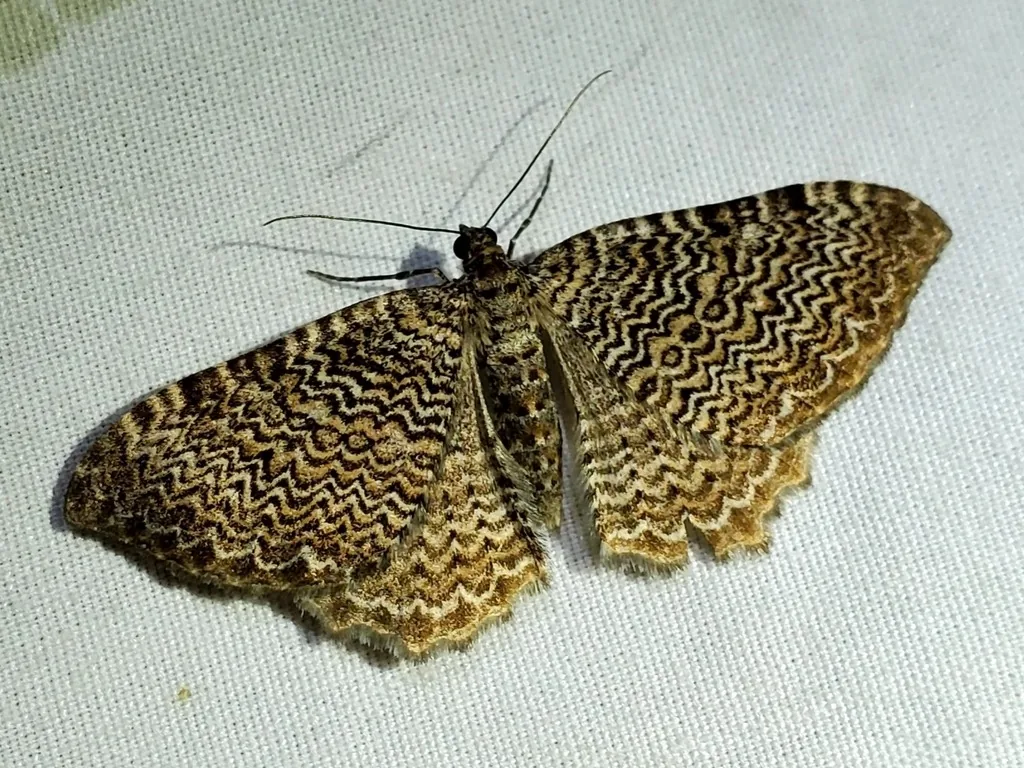
- The adult moth has alternating light and dark scalloped lines across its wings and a wingspan of about 1.45 inches.[1]
- Full-grown caterpillars are inchworms about 0.8 inch to 1 inch long, with a dark back broken by pale stripes, a white stripe along each side, a cream to lemon-yellow underside and an orange to orange-brown head.[1][2]
- The caterpillars live in groups inside a nest of tied leaves. Among inchworms, the Forest Service guide says, that nest and group habit set it apart right away.[2]
Look-alikes
| Look-alike | How to tell them apart |
|---|---|
| Uglynest caterpillar | The uglynest caterpillar (Archips cerasivoranus) also builds communal nests on black cherry, so the nest alone is not proof; check for the striped inchworms inside.[2] |
| Web-spinning sawflies on cherry | Two web-spinning sawflies (Neurotoma species) also make nests on black cherry. They are sawfly larvae, not inchworms.[2] |
Where it lives
It is found from southern Canada to Florida and Texas, along woodland edges, in overgrown fields and in hedgerows where black cherry grows.[2]
Biology and life cycle
Adults fly through the summer, roughly May to August, with a peak in June. Females lay eggs on the undersides of leaves in masses one to four layers thick.[1]
The eggs hatch from July through early August. The caterpillars feed together on the leaf surface inside their silk-tied nests, and when a leaf is stripped they move on and build a new nest.[1]
Sources differ on the number of generations. UMass Extension reports one generation a year, while the Forest Service guide reports two in Connecticut and Maryland, with mature caterpillars in June and early July and again from August to October. Caterpillars of the first brood are less boldly marked.[1][2]
In the fall the caterpillars drop to the leaf litter and soil to pupate, and the pupa spends the winter there. Some have also been seen pupating inside their leaf nests.[1][2]
Damage and signs
- It is an occasional but serious pest of cherry. Heavily infested trees can be completely stripped of leaves, and dieback and decline may follow an outbreak.[1]
- The caterpillars make their nest by tying up a whole shoot, and the terminal shoot may be killed. On black cherry, a valuable furniture and cabinet wood, that can spoil the tree's growth form.[2]
Health risk
Neither source mentions any harm to people; both treat it only as a leaf-feeding pest of cherry trees.[1][2]
Control
Traps and physical control
Look for groups of caterpillars tying cherry leaves together with silk, especially in July and August. Remove the nests before the defoliation gets extensive and drop them in a bucket of soapy water or destroy them another way.[1]
Biological control
Native parasites, predators and diseases usually keep it under control. A small Telenomus wasp that parasitizes the eggs has helped bring down outbreak populations.[1]
Pesticides
UMass Extension lists Bacillus thuringiensis (subspecies kurstaki and aizawai) among the active ingredients for this insect, but notes that contact sprays may not work well on caterpillars hidden inside their silk nests.[1]
Common questions
- What is making leafy nests full of small inchworms on my cherry tree?
- Groups of striped inchworms feeding inside leaves tied together with silk on black cherry in summer are typical of the cherry scallop shell moth.[1][2]
- Will the cherry scallop shell kill my tree?
- Usually not. It is an occasional pest that natural enemies keep in check, but heavy outbreaks can defoliate a tree completely, and dieback and decline may follow.[1]
Sources
- UMass Extension Landscape, Nursery and Urban Forestry Program (University of Massachusetts Amherst), “Rheumaptera (formerly Hydria) prunivorata, Landscape Insect & Mite Guide.” www.umass.edu/agriculture-food-environment/landscape/publications-resources/insect-mite-guide/rheumaptera-formerly-hydria-prunivorata (accessed 2026-11-09)
- USDA Forest Service, Forest Health Technology Enterprise Team, “Geometroid Caterpillars of Northeastern and Appalachian Forests, FHTET-2001-10 (D. L. Wagner, D. C. Ferguson, T. L. McCabe and R. C. Reardon, September 2001; scanned copy).” archive.org/details/geometroidcaterp00wagn (accessed 2026-11-09)
- iNaturalist, “Hydria prunivorata taxon page (order and family).” www.inaturalist.org/taxa/1454180 (accessed 2026-11-09)