On this page
How to identify it
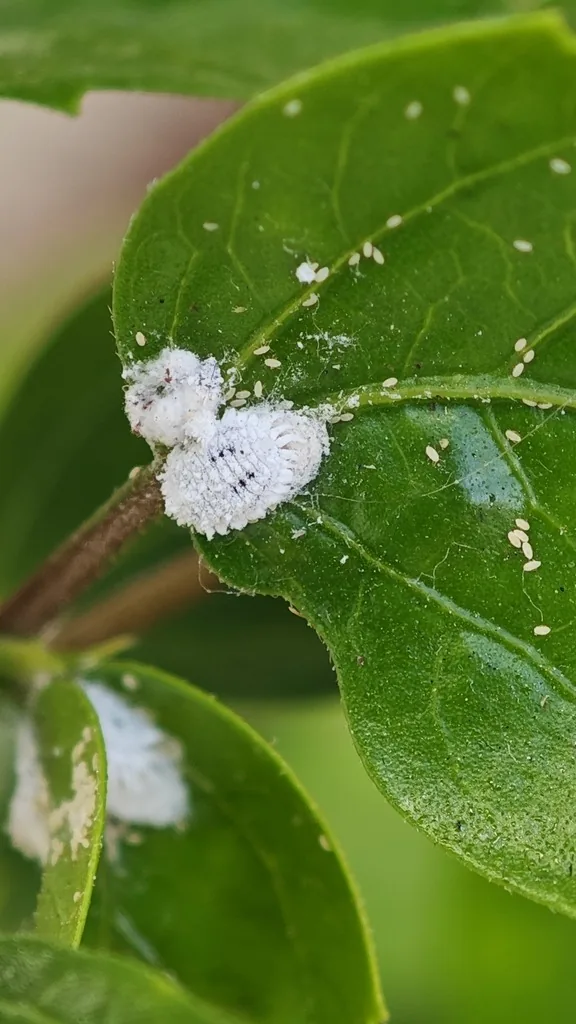
- Adult females are covered in white mealy wax, usually with patches of dark gray skin showing through where the wax is missing: three pairs along the abdomen and one pair on the thorax.[1]
- Appearance varies a lot. Some populations, including ones in California, lack the dark spots, which makes accurate identification a challenge.[1]
Where it lives
ScaleNet lists it from 20 U.S. states and the District of Columbia, from Florida and Texas to California, Washington, Michigan and New York. Abroad it has become a serious pest in cotton regions of Pakistan and India and has been reported in several Mediterranean countries, and cotton areas of India, Pakistan, Bangladesh, Myanmar and China are rated at high risk.[1][2][3]
Biology and life cycle
It usually lives above ground but sometimes turns up on roots and in fire ant nests.[1]
Warmth speeds it up. On tomato in the laboratory, females completed their life cycle in about 30 days at 35 °C (95 °F), females laid the most eggs, about 183 each, at 30 °C (86 °F), and a population could fit four overlapping generations into 90 days at the highest temperature.[2]
Invasive populations come from a few genetic lines that tolerate a wider range of climates than populations in the native range, and their spread is linked to climate and to people moving infested plants and farm goods.[3]
Damage and signs
- Since at least 2005 it has seriously damaged cotton across Sindh and Punjab in Pakistan and in northwestern India, and it has caused substantial cotton losses in other regions too.[1][3]
- In Israel, outbreaks have badly damaged ornamental plants, mainly hibiscus hedges in residential neighborhoods, and it has become a serious pest in some cotton fields and in pepper and tomato greenhouses.[1]
Health risk
The sources treat it only as a plant pest; none mentions bites or any risk to people or pets.[1][2]
Control
Prevention
Because people moving infested plants and goods help it spread, researchers stress early monitoring, rapid response and regulating those pathways.[3]
Sanitation
Around cotton in India, researchers recommend removing weed hosts such as parthenium and not growing okra near cotton fields.[1]
Biological control
Parasitic wasps, especially Aenasius bambawalei, attack it, but ants tending the mealybugs reduce parasitism, so ant activity on colonies needs to be checked.[1]
Pesticides
Researchers call for integrated management that combines biological, chemical and cultural controls rather than relying on one method.[3]
Common questions
- How can I recognize cotton mealybug?
- Look for white, mealy mealybugs with paired dark gray patches where the wax is missing, three pairs on the abdomen and one on the thorax. Some populations lack the spots, so identification can be difficult.[1]
- Is cotton mealybug a problem in the United States?
- It has been recorded in 20 states, but the severe outbreaks described in the sources are in Pakistan, India, Israel and other Mediterranean countries.[1][2]
Sources
- ScaleNet (scale insect database begun at the USDA ARS Systematic Entomology Laboratory), “ScaleNet catalogue: Phenacoccus solenopsis Tinsley.” scalenet.info/catalogue/Phenacoccus%20solenopsis/ (accessed 2026-11-09)
- MDPI (Insects), “Life history parameters of the invasive cotton mealybug Phenacoccus solenopsis on tomato at four constant temperatures (Harbi et al. 2024, Insects 16:16).” doi.org/10.3390/insects16010016 (accessed 2026-11-09)
- Elsevier (Journal of Environmental Management), “Increasing invasion risk of the global invader Phenacoccus solenopsis: environmental niche expansion and potential economic impacts on cotton production (Teng et al. 2026, Journal of Environmental Management 413:130276).” doi.org/10.1016/j.jenvman.2026.130276 (accessed 2026-11-09)
- iNaturalist, “Phenacoccus solenopsis taxon page (order and family).” www.inaturalist.org/taxa/330250 (accessed 2026-11-09)