On this page
How to identify it
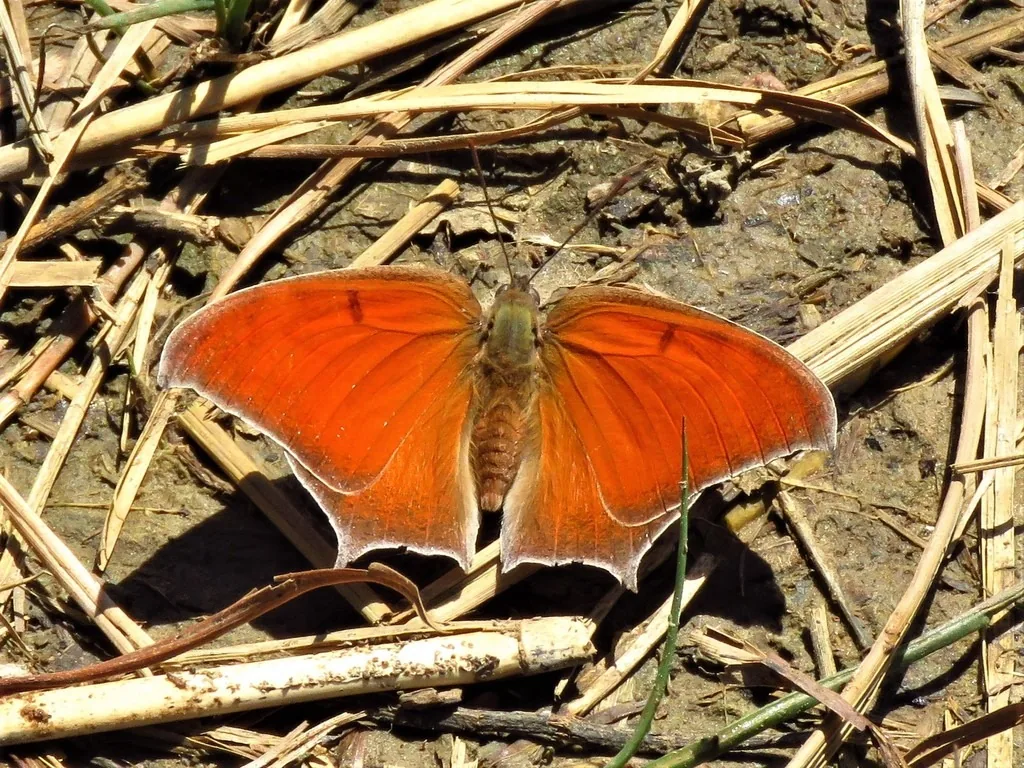
- Wingspan is about 1 3/4 to 3 inches; the upper side is orange, darker-edged in males and with a lighter yellow-orange band in females, and the underside is plain brown.[1][2]
- The wing edges are smooth, not scalloped, and the winter form has more pointed forewings and longer tails.[2]
- Caterpillars are gray-green and covered with tiny raised bumps.[1][2]
Look-alikes
| Look-alike | How to tell them apart |
|---|---|
| Commas and question mark | Anglewing butterflies with ragged, scalloped wing edges and patterned undersides.[2] |
Where it lives
Throughout the southern Midwest and South, from West Virginia to Kansas and south to Texas and central Florida; statewide in Missouri, most common in the Ozarks.[1][2]
Biology and life cycle
Day length experienced by the caterpillars decides whether adults emerge in the summer form or the winter form, which overwinters as an adult and mates in spring.[1][2]
There are two flights a year in the north and possibly three or four in parts of the South.[1]
Adults have tongues too short for most flowers and feed on sap, rotting fruit and dung; they fly fast and erratically.[1][2]
Older caterpillars fold or roll host leaves into shelters.[1][2]
Damage and signs
Health risk
Control
Prevention
No control is needed.[2]
Common questions
Sources
- University of Florida IFAS Extension (EDIS, Featured Creatures), “Goatweed Butterfly, Goatweed Emperor, Goatweed Leafwing, Anaea andria (EENY-055).” ask.ifas.ufl.edu/publication/IN212 (accessed 2026-10-16)
- Missouri Department of Conservation, “Goatweed Leafwing (Field Guide).” mdc.mo.gov/discover-nature/field-guide/goatweed-leafwing (accessed 2026-10-16)
- iNaturalist, “Anaea andria taxon page (order and family).” www.inaturalist.org/taxa/81561 (accessed 2026-10-06)