On this page
How to identify it
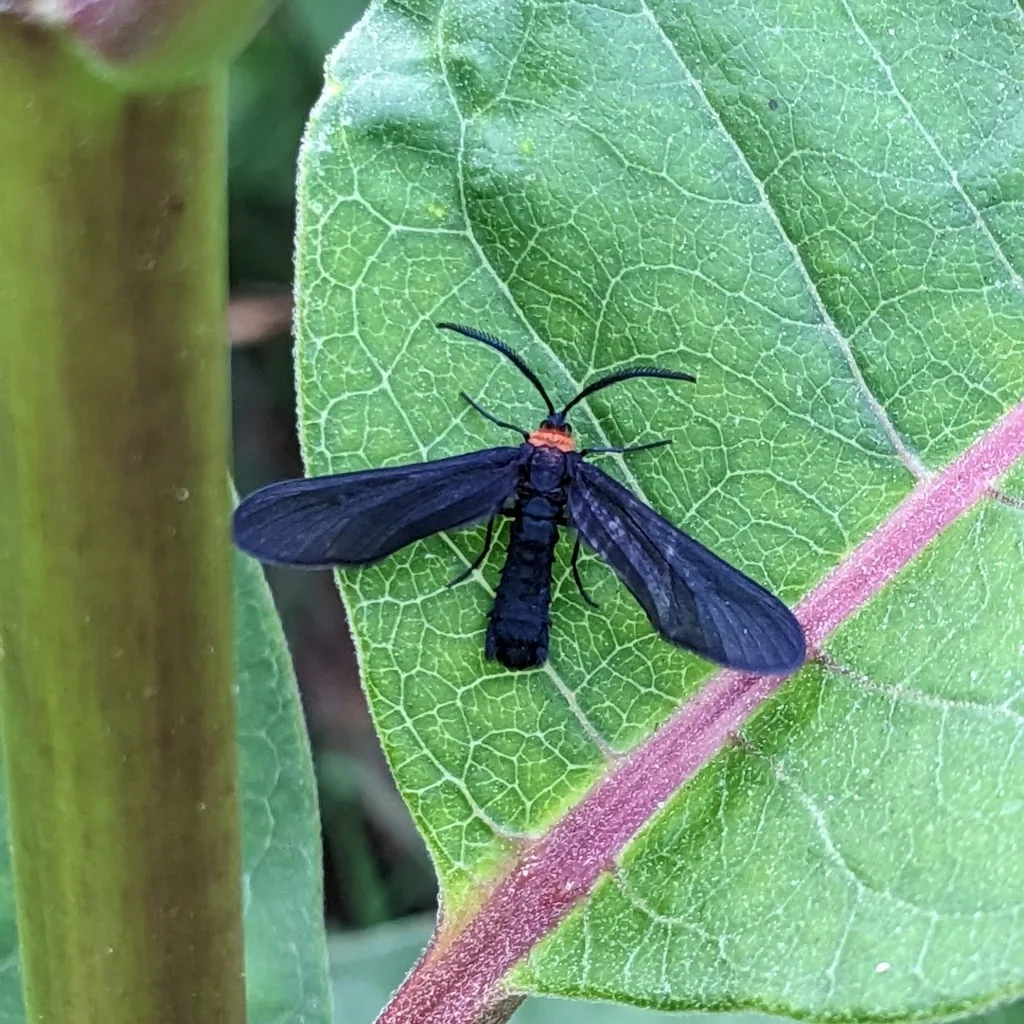
- Adults are small, narrow-winged, uniformly black moths with a yellowish or orange collar and a fan-shaped tuft at the tip of the upcurled abdomen; wingspan is about 7/8 to 1 1/8 inches (22 to 28 mm).[1][2]
- Caterpillars are yellow with black spots or bands, four black bumps on each segment, and a little over 1/2 inch long when grown.[1][2]
- Eggs are lemon yellow and laid in clusters on leaf undersides.[1][2]
Look-alikes
| Look-alike | How to tell them apart |
|---|---|
| Western grapeleaf skeletonizer | A very similar, slightly larger species that replaces it in the West.[1][2] |
| Yellow-collared scape moth | Also black with a yellow collar but thicker-bodied, with larger, partly clear hindwings and no abdominal tuft.[1] |
Where it lives
Widespread in the eastern half of the United States, including all of Florida except possibly the Keys.[1][2]
Biology and life cycle
It overwinters as a pupa in a cocoon in debris on the ground; adults emerge in late spring and lay eggs in clusters under leaves.[1][2]
There are two generations a year in Virginia, and moths fly in Florida from March to September or later.[1][2]
Larvae feed in groups at first, then disperse as they mature.[1]
Damage and signs
- Young larvae skeletonize leaves, leaving brown patches; older larvae eat whole leaves down to the large veins.[1][2]
- Native hosts are wild grapes and Virginia creeper; among cultivated grapes it prefers tender, choice varieties, and it is mostly a problem on home grapevines rather than sprayed vineyards.[1]
Health risk
Control
Sanitation
Because they spin cocoons in leaves and trash under the vines, cleaning up that debris helps.[1]
Traps and physical control
Handpick the caterpillar clusters as soon as you see them, while each egg cluster's larvae are still together in one group.[1]
Biological control
Bacillus thuringiensis controls the caterpillars.[1]
Common questions
Sources
- University of Florida IFAS Extension (EDIS, Featured Creatures), “Grapeleaf Skeletonizer, Harrisina americana (EENY-191).” ask.ifas.ufl.edu/publication/IN348 (accessed 2026-10-16)
- Virginia Tech Department of Entomology (Virginia Cooperative Extension), “Grapeleaf skeletonizer, Harrisina americana (Virginia Fruit pages, from Va. Coop. Ext. Serv. 444-567).” www.virginiafruit.ento.vt.edu/grapeskel.html (accessed 2026-10-16)
- iNaturalist, “Harrisina americana taxon page (order and family).” www.inaturalist.org/taxa/126905 (accessed 2026-10-06)