On this page
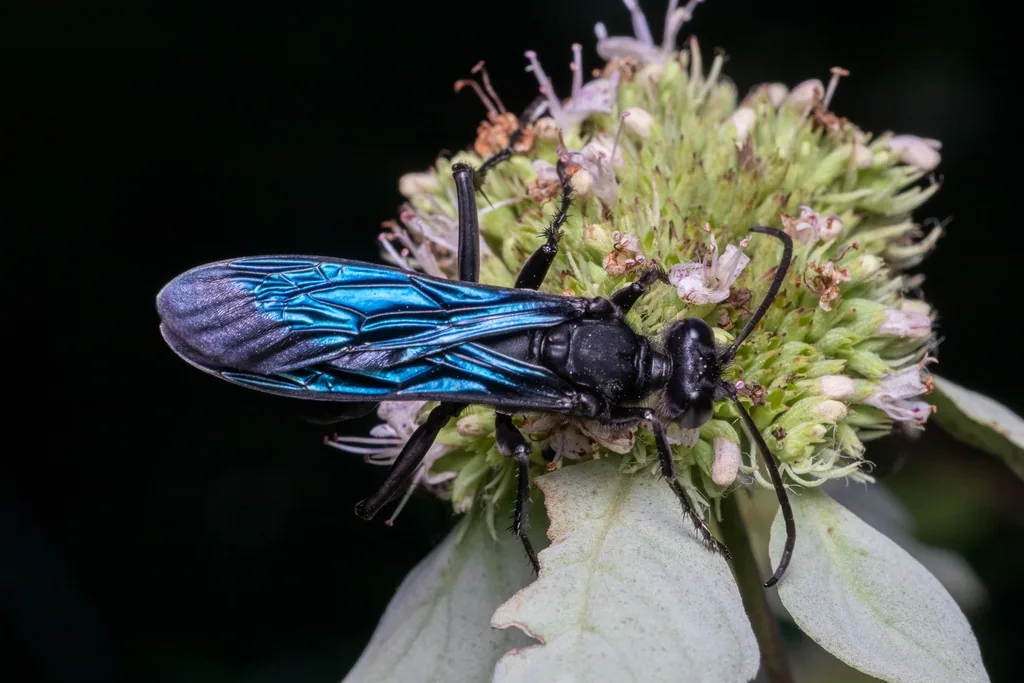
How to identify it
Look-alikes
| Look-alike | How to tell them apart |
|---|---|
| Great golden digger wasp | A very close relative in the same genus with orange on the body.[1] |
| Mud daubers | Relatives in the same family of thread-waisted digger wasps.[1] |
| Cicada killer | Another large solitary ground-nesting wasp that hunts cicadas rather than katydids.[1] |
Where it lives
Common across the eastern and central United States, including Missouri, Minnesota and Illinois.[1][2][3]
Biology and life cycle
Adults are seen on flowers in open areas from July through September.[1][2][3]
Females hunt grasshoppers, katydids and crickets, sting each to paralyze it, and fly it back to an underground nest, placing two to six in each cell with one egg; a single female can catch 16 hoppers a day.[1][3]
The larva feeds on the paralyzed prey for about 10 days; birds such as catbirds and sparrows sometimes steal the prey.[1][3]
Damage and signs
Health risk
It can sting if disturbed and the sting is reportedly painful, but it is not aggressive, rarely stings and is dangerous only to people allergic to stings.[1][2]
Control
Prevention
No control is needed; it is a gardener's friend that helps control grasshoppers and katydids.[1][2]
Common questions
Sources
- Missouri Department of Conservation, “Great Black Wasp (Field Guide).” mdc.mo.gov/discover-nature/field-guide/great-black-wasp (accessed 2026-10-16)
- University of Minnesota Extension, “Great black wasp (What insect is this? diagnostic pages).” apps.extension.umn.edu/garden/diagnose/insect/garden/flies/large/greatblackwasp.html (accessed 2026-10-16)
- Illinois Department of Natural Resources, “great black wasp, Sphex pensylvanicus (Biodiversity of Illinois).” dnr.illinois.gov/education/wildaboutpages/wildaboutinvertebrates/wildaboutwasps/wabwgreatblackwasp.html (accessed 2026-10-16)
- iNaturalist, “Sphex pensylvanicus taxon page (order and family).” www.inaturalist.org/taxa/48738 (accessed 2026-10-06)