On this page
How to identify it
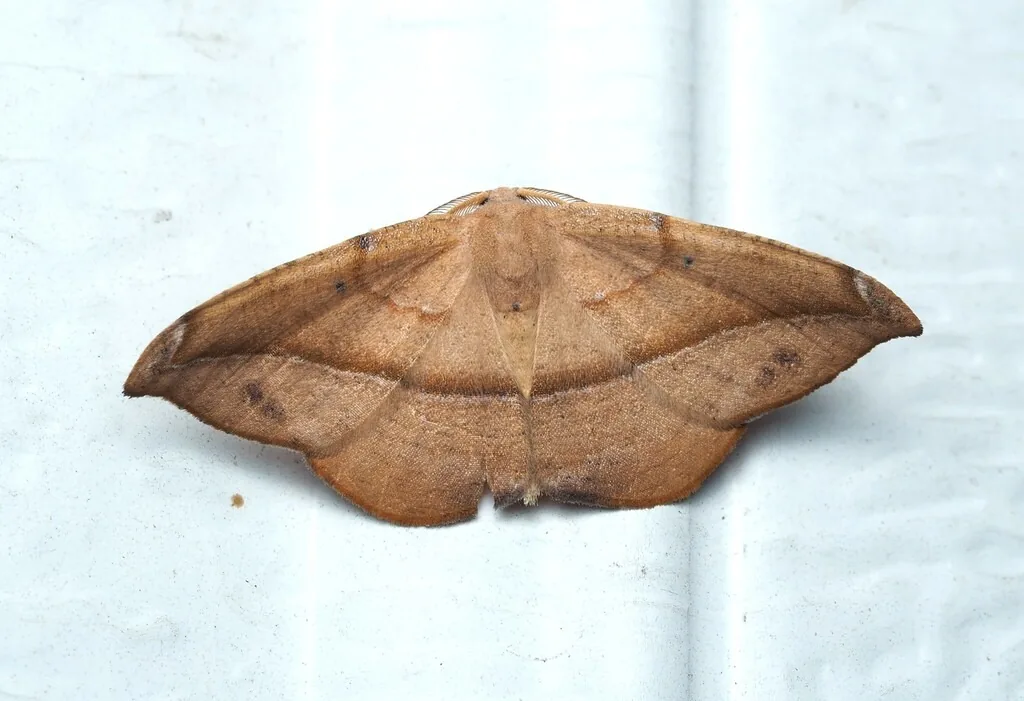
- The moth looks like a dried-up leaf. It is tan overall, often tinted orangish, pinkish, rusty or reddish brown, with a wingspan of 3/4 to 1 inch. Like other geometrids it has a thin body and rests with its wide wings spread flat, and the lines on the forewings and hindwings meet so they look continuous across all four wings.[1]
- A conspicuous, usually dark line runs just beyond the middle of the wings. Where it reaches the front edge of the forewing it bends back toward the wing tip, and across the hindwing it runs straight. The forewing tip is hooked, most sharply in females, and the outer edge of the hindwing is smoothly rounded. Some moths have a pair of large dark spots near the outer edge of the forewing.[1]
- The caterpillar is a slender inchworm up to 3 cm (a little over an inch) long, brown or gray and checkered with white, gray and black like the bark of its host. Slanted dark lines along the back and sides form alternating brown and gray diamonds, and the darkened back is edged with a broken black-and-white stripe that wavers along its length.[1][2][3]
- Each of the first six abdominal segments has a broad pale green to cream patch in front of the breathing pore, and long pale antennae stick out from the head.[3][2]
Look-alikes
| Look-alike | How to tell them apart |
|---|---|
| Other leaf-colored geometrid moths | MDC lists the confused eusarca, curve-toothed geometer, large maple spanworm, rose hooktip and moths in the genera Osydia, Synaxis and Tetracis as common lookalikes. Check the wing line that bends back at the forewing's front edge but runs straight across the hindwing, the hooked forewing tip and the smoothly rounded hindwing edge.[1] |
| Other caterpillars on cedar | The juniper geometer's complex pattern of diamonds, dashes and lines sets it apart from other caterpillars that feed on cedar.[2] |
Where it lives
MDC calls it common in the eastern United States and reports it statewide in Missouri, and the USDA Forest Service guide's range for it extends south to Texas and Florida.[1][2]
Biology and life cycle
Eastern red cedar is the main food plant in Missouri. The caterpillars also feed on other junipers and on Atlantic white cedar, and possibly on arborvitae; MDC adds that pines and cultivated junipers and cedars may also be eaten.[1][2]
The moth lives where cedars grow: fields, open woodlands and cedar swamps, and in Missouri the cedar groves and thickets that spring up in abandoned lots, old fields, pastures and woodland edges. The caterpillars grow up and pupate on and near cedars, and females stay near them to lay eggs on the host.[2][1]
There are two or three generations a year. In Missouri adults fly from April until the first hard frosts. In Connecticut and Maryland there are at least two generations, with full-grown caterpillars from June onward.[1][2]
At rest the caterpillar grips its perch with its hind legs and holds its body straight and stiff at an angle, front end raised, attached only by a silk safety line.[1][2]
Summer caterpillars pupate in a sparse cocoon among the foliage. Even dark brown caterpillars turn green before pupating, and the green-and-white pupa is nearly impossible to find among the scale-like leaves.[2]
The sources disagree on how it gets through winter: the USDA Forest Service guide says it overwinters as a pupa, while MDC says it apparently overwinters as an egg.[2][1]
Bats hunt the moths at night, birds look for them by day, and spiders catch them in webs. Warblers, titmice, vireos, grackles and catbirds search cedar branches for the caterpillars.[1]
Damage and signs
Health risk
Neither the Missouri Department of Conservation nor the USDA Forest Service mentions any bite, sting or other risk to people.[1][2]
Control
Prevention
Neither source recommends any control. MDC describes the juniper geometer as a resident moth and notes that the moths and caterpillars are food for bats, birds and spiders.[1][2]
Common questions
- Will juniper geometer caterpillars hurt my cedars or junipers?
- They eat the foliage, but neither the Missouri Department of Conservation nor the USDA Forest Service describes damage or recommends any control.[1][2]
- Why are the caterpillars so hard to see?
- They match cedar foliage in color, pattern, texture, shape and reflectance, and they rest like a stiff twig held out at an angle. Even the pupa is green and white and nearly impossible to find among the scale-like leaves.[2][1]
- When are juniper geometer moths flying?
- In Missouri, from April until the first hard frosts, with two or three broods a year.[1]
Sources
- Missouri Department of Conservation, “Juniper-Twig Geometer (Field Guide).” mdc.mo.gov/discover-nature/field-guide/juniper-twig-geometer (accessed 2026-11-09)
- USDA Forest Service, Forest Health Technology Enterprise Team, “Geometroid Caterpillars of Northeastern and Appalachian Forests, FHTET-2001-10 (D. L. Wagner, D. C. Ferguson, T. L. McCabe and R. C. Reardon, September 2001; scanned copy).” archive.org/details/geometroidcaterp00wagn (accessed 2026-11-09)
- USDA Forest Service, Forest Health Technology Enterprise Team, “Caterpillars of Eastern Forests, FHTET-96-34 (D. L. Wagner, V. Giles, R. C. Reardon and M. L. McManus, November 1997; scanned copy).” archive.org/details/caterpillarsofea001997 (accessed 2026-11-09)
- iNaturalist, “Patalene olyzonaria taxon page (order and family).” www.inaturalist.org/taxa/227307 (accessed 2026-11-09)