On this page
How to identify it
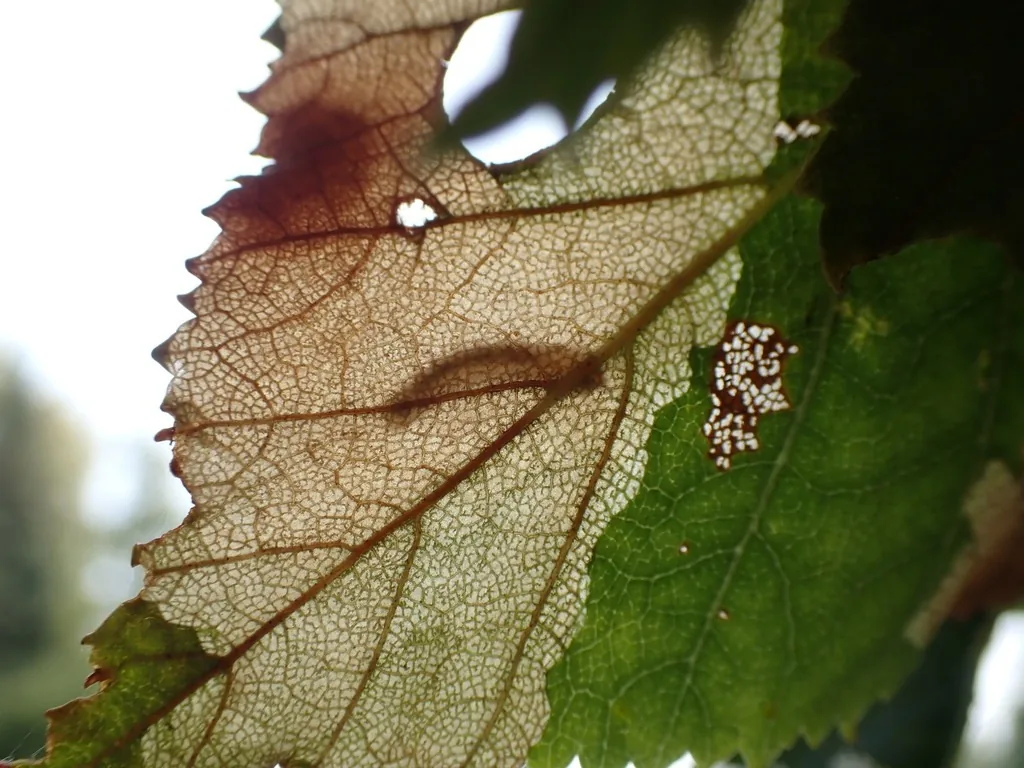
- The mine is a reddish ring at the edge of a birch leaf that expands inward and holds little frass. Amber-marked birch leafminer mines start near the middle of the leaf by a lateral vein, spread outward and are packed with dark frass; the two species can share a tree or even a leaf.[2]
- Larvae cut small slits in the leaf to push out frass and shed skins, a habit that appears unique among the birch-mining sawflies. The whitish, slightly flattened larva (6 to 7 mm when full grown) can be seen by peeling back the leaf surface or holding the leaf up to the light.[2][1]
- Adults of all three birch leaf miner species are small black sawflies, 3 to 4 mm long with a wingspan of 6 to 7 mm. Black marks on the undersides of the larvae separate the species.[1]
- Mines appear on mature leaves in July or later, not on the newly flushed spring leaves that the birch leafminer (Fenusa pumila) prefers.[1][2]
Look-alikes
| Look-alike | How to tell them apart |
|---|---|
| Amber-marked birch leafminer | Also mines mature birch leaves in late summer, but its mines begin in the center of the leaf near a major vein, spread outward, and contain notable dark frass; the edgeminer's start at the margin, work inward, and are reddish with little frass. The amber-marked species overwinters in soil cocoons; the edgeminer stays inside the fallen leaf.[2] |
| Birch leafminer (Fenusa pumila) | The first species to attack in spring, preferring newly formed leaves in the exposed crown and producing two or sometimes three generations a year. The edgeminer attacks mature leaves from July on and has one generation.[1] |
| Early fall color | Mined leaves turn a sickly yellowish brown rather than the vibrant gold of autumn birch, and the leaf surfaces separate into a flattened blister. Hold the leaf to the light to find the larva or its mine.[2][1] |
Where it lives
Introduced from Europe early in the 20th century; now widely distributed in Canada and the northern United States. The invasive birch leafminers spread west across Canada and reached Alaska in the early 1990s, where this species displaced the amber-marked birch leafminer in the Anchorage area and is one of the two most commonly observed birch leafminers in Southcentral and Interior Alaska.[1][2]
Biology and life cycle
The larvae feed inside the leaf blade, between the upper and lower surfaces, on birch. All native and exotic birches are susceptible to at least one of the birch leaf miner species.[1]
Adults lay eggs on the outer edges of mature leaves in July, later than the spring-active birch leafminer, so there is one generation a year. Feeding continues into early September or until the first frost.[1][2]
Unlike the other birch leafminers, which leave the leaf to pupate in the soil, the edgeminer pupates in the fall inside the leaf and overwinters in a cocoon within the fallen leaf on the ground.[2][1]
Research outside Alaska suggests the amber-marked birch leafminer favors the lower canopy and the edgeminer the upper canopy, but in Alaska both attack leaves throughout the crown and are often found in the same leaf.[2]
Damage and signs
- First signs are small light green or gray spots on the leaves where eggs were laid; these grow into brown blotches, usually more than one per leaf, that merge until most of the leaf is mined. Although most of the inner leaf tissue may be destroyed, this need not harm the tree seriously.[1]
- Impacts are primarily aesthetic. In outbreaks more than 90 percent of a tree's leaves can be infested, but most mining happens late in summer after the tree has done most of its growing, and no birch mortality has been recorded from these insects. A healthy tree withstands many years of light to moderate attack; mining stress combined with drought and other insects can bring on branch and top dieback.[2][1]
Health risk
These are stingless sawflies that live inside birch leaves; the sources describe no effect on people or pets.[2]
Control
Prevention
Keep birches healthy so they tolerate mining: water the root zone in fall before frost, apply a suitable fertilizer each spring, and water during dry spells in summer, especially in July and August, because ornamental birches are shallow-rooted.[1]
Sanitation
Because this species pupates inside fallen leaves, raking up and disposing of birch leaves in autumn reduces its numbers. The other birch leafminers leave the leaf to pupate in the soil, so this step is specific to the edgeminer.[1]
Biological control
A parasitoid wasp, Lathrolestes thomsoni, was released against birch leafminers in Alaska from 2004 to 2008 and is now established and spreading. Its effect on leafminer populations there is still being evaluated.[2]
Scientific name
The birch leafminer is named here as Fenusa pumila, the name used by the U.S. Forest Service Alaska Region and GBIF and by a 2014 checklist of British and Irish sawflies that treats the older use of Fenusa pusilla as a misidentification. The ITIS database still calls the birch leafminer Fenusa pusilla, while iNaturalist now uses that name for an elm leafminer.[2][4][3][5][7]
Common questions
- My birch leaves have brown patches starting at the edges in August. Is the tree dying?
- Probably not. The late birch leaf edgeminer mines mature leaves from the margin inward late in the season, after most of the year's growth is done. Damage is mostly cosmetic, and no birch deaths have been attributed to it; a healthy tree tolerates many years of light to moderate mining.[2][1]
- How do I tell the edgeminer from the amber-marked birch leafminer?
- Look at where the mine starts and what is in it. Edgeminer mines are a reddish ring at the leaf edge expanding inward with little frass inside; amber-marked mines begin near the leaf center by a vein, spread outward, and are full of dark frass. Both can be in the same leaf.[2]
- Is there anything worth spraying?
- The sources describe no insecticide program for this insect. Raking and destroying fallen birch leaves in autumn removes the overwintering pupae, and keeping the tree watered and fed helps it shrug off the mining.[1]
Sources
- Natural Resources Canada, Canadian Forest Service, “Late birch leaf edgeminer, Trees, insects, mites, and diseases of Canada's forests.” tidcf.nrcan.gc.ca/en/insects/factsheet/7775 (accessed 2026-11-10)
- USDA Forest Service, Alaska Region, “Birch Leafminers (Forest Health, Alaska Region).” www.fs.usda.gov/r10/natural-resources/forest-health/birch-leafminers (accessed 2026-11-11)
- Biodiversity Data Journal, “Checklist of British and Irish Hymenoptera - Sawflies, 'Symphyta' (Liston, Knight, Sheppard, Broad and Livermore 2014).” doi.org/10.3897/BDJ.2.e1168 (accessed 2026-11-11)
- Global Biodiversity Information Facility (GBIF), “Fenusa pumila Leach, 1817 (GBIF Backbone Taxonomy).” api.gbif.org/v1/species/4490761 (accessed 2026-11-11)
- Integrated Taxonomic Information System (ITIS), “Fenusa pusilla (Lepeletier), TSN 152814.” www.itis.gov/servlet/SingleRpt/SingleRpt?search_topic=TSN&search_value=152814 (accessed 2026-11-11)
- iNaturalist, “Heterarthrus nemoratus taxon page (order and family).” www.inaturalist.org/taxa/774922 (accessed 2026-11-10)
- iNaturalist, “Fenusa pusilla (elm leafminer) taxon page.” www.inaturalist.org/taxa/1028796 (accessed 2026-11-11)