On this page
How to identify it
Where it lives
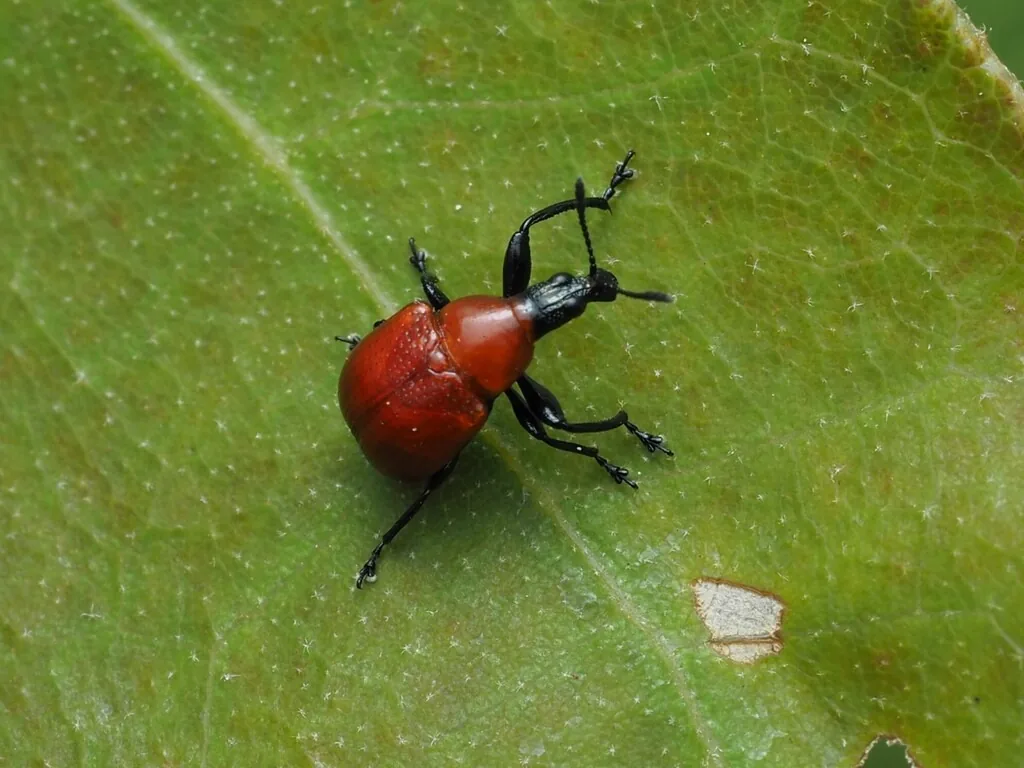
Homoeolabus analis lives in coastal states from the Northeast to Louisiana, including peninsular Florida, and is more common near the coast in North Carolina.[1][2]
Biology and life cycle
The female cuts slits on both sides of the leaf midrib, lays an egg near the tip, then folds and rolls the leaf into a neat roll called a nidus.[1][2]
The grub feeds on the leaf tissue inside the roll and pupates there.[1][2]
Damage and signs
- They roll leaves of about 16 oak species and two chestnuts, but are seldom abundant enough to be pests.[1]
Health risk
None to people or pets.[1]
Control
Prevention
Control is rarely needed; if weevils are truly out of hand, NC State says a home-landscape pyrethroid applied early in the season should protect trees.[1]
Common questions
Sources
- NC State Extension, “Leafroller Weevils (PDIC Factsheet).” content.ces.ncsu.edu/leafroller-weevils (accessed 2026-10-16)
- University of Florida IFAS Extension (EDIS, Featured Creatures), “Leaf-Rolling Weevil, Homoeolabus analis (EENY-420).” ask.ifas.ufl.edu/publication/IN753 (accessed 2026-10-16)
- iNaturalist, “Homoeolabus analis taxon page (order and family).” www.inaturalist.org/taxa/71259 (accessed 2026-10-06)