On this page
How to identify it
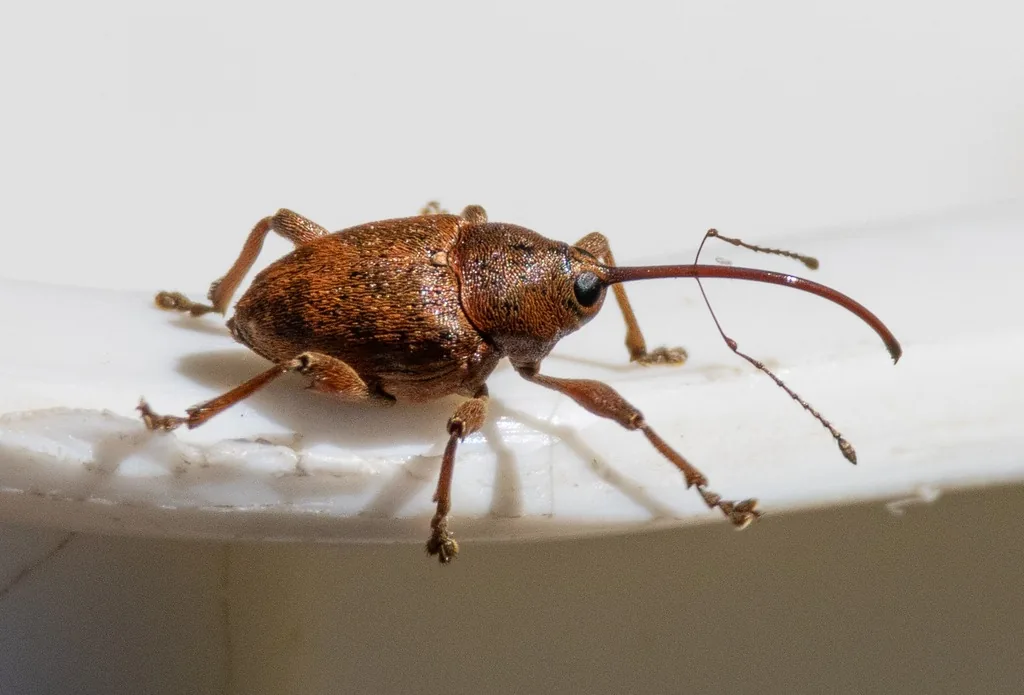
- Adults are about 3/8 inch long, brown and mottled, with a very long, thin snout; females have longer snouts than males.[1][2][3]
- Grubs are creamy white, legless and curved, fattest in the middle, with brown heads, growing to about 3/8 inch.[1][2]
- Infested acorns show a perfectly round hole about 1/8 inch across where the grub chewed its way out.[1][2]
Look-alikes
| Look-alike | How to tell them apart |
|---|---|
| Pecan weevil | Another Curculio nut weevil; about 30 species of the genus live in North America.[3] |
| Plum curculio | Called a curculio, but in a different genus; it attacks stone fruits.[3] |
Where it lives
Found wherever oaks grow; about 30 Curculio species live in North America north of Mexico.[3]
Biology and life cycle
In summer, females bore holes into developing acorns on the tree and lay one or more eggs inside.[1][2][3]
Grubs feed inside the nut until fall, leave fallen acorns in late fall or early winter, and live in the soil for one to two years before emerging as adults.[1][2]
Damage and signs
Health risk
Control
Sanitation
To save acorns for planting, collect them as soon as they fall and refrigerate them, then freeze them to kill grubs, or soak them 20 minutes in 120 degree F water.[1]
Pesticides
Insecticide control in backyard oaks and hickories is not practical, since adults emerge from soil all summer.[1][2]
Common questions
Sources
- NC State Extension, “Acorn Weevil (PDIC Factsheet).” content.ces.ncsu.edu/acorn-weevil (accessed 2026-10-16)
- Iowa State University Extension and Outreach (Yard and Garden), “Acorn and Nut Weevils (Yard and Garden encyclopedia).” yardandgarden.extension.iastate.edu/encyclopedia/acorn-and-nut-weevils (accessed 2026-10-16)
- Missouri Department of Conservation, “Nut Weevils (Acorn Weevils) (Field Guide).” mdc.mo.gov/discover-nature/field-guide/nut-weevils-acorn-weevils (accessed 2026-10-16)
- iNaturalist, “Curculio glandium taxon page (order and family).” www.inaturalist.org/taxa/148145 (accessed 2026-10-06)