On this page
How to identify it
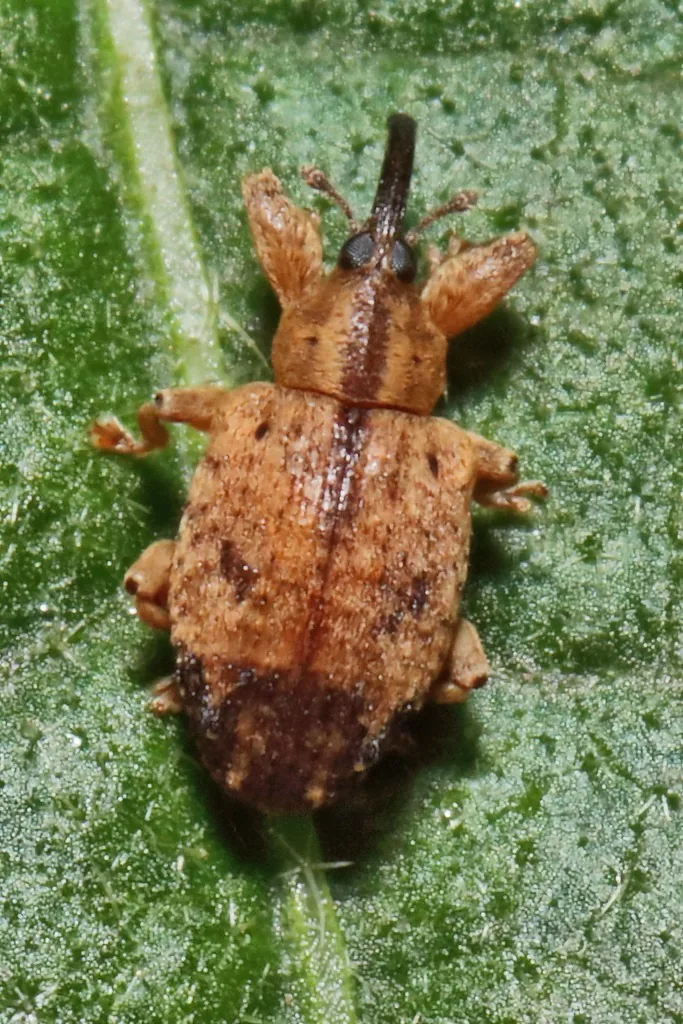
- A small weevil about 3/16 inch long (females about 3.9 mm, males about 3.7 mm), shiny brown and covered with golden-yellow hairs.[1][2]
- Seen from above, the thorax is wider than long and strongly rounded on the sides, usually with a clear stripe down the middle and fainter stripes at the sides.[1][2]
- The snout is conspicuous, and longer in females (1.4 mm) than in males (1.1 mm). The front legs carry a large triangular tooth, a mark of the genus.[1][2]
- The larva is a soft, cream-colored, legless, somewhat C-shaped grub found inside a privet seed, one per seed. A small hardened point at the tip of its abdomen sets it apart from most weevil larvae.[2]
Where it lives
As of 2005, UF/IFAS listed it from Virginia, North Carolina, South Carolina, Georgia and northern Florida, where established populations are known in Jefferson and Leon Counties.[2]
Biology and life cycle
Adults are most active in late June and early July. They feed mostly at night, prefer wilted foliage and drop to the ground as soon as they are disturbed, so they are hard to spot.[1][2]
Around the first of July, once the fruit is well formed, females lay their eggs in the seed capsules or fleshy fruit. A small, slightly curved slit marks each egg site.[1][2]
The eggs hatch within a few weeks. The grubs feed in the fruit and seed capsule, then bore into the seed, and keep feeding through fall and winter.[1][2]
The grubs pupate in April, and new adults emerge from the seeds from mid-May and feed on leaves and pollen. There is one generation a year.[1][2]
Damage and signs
- Adults chew small, jagged holes, about 1/8 inch long, mostly on the undersides of privet leaves. They sometimes destroy the buds, causing bunchy growth and a tattered look.[1][2]
- Japanese privet is the favored host; the weevil also feeds on common privet, glossy privet and lilac and has been reported on grape. It is not clear whether lilac or grape can support the grubs, which have been found developing only in privet.[1][2]
- NC State calls it a minor and infrequent pest of privet plantings. Damage does not occur every year, and although it is unsightly it does not threaten the health of the shrubs.[1]
- The grubs destroy the seeds they develop in. In a sample of Chinese privet seed from Tallahassee, Florida, larvae were found in 89 of 358 seeds, about 25 percent.[2]
Health risk
It is a leaf- and seed-feeding weevil of privet. Neither NC State nor UF/IFAS describes any risk to people.[1][2]
Control
Prevention
Weigh whether control is needed at all. Chinese privet is listed as a Category I invasive plant in Florida, and UF/IFAS notes that by attacking its seeds the ligustrum weevil may help slow the spread of privet in natural areas, though field studies are still needed to show how much.[2]
Traps and physical control
Shearing off and destroying the flowers or berries in fall or winter removes the seeds the grubs live in and should help reduce the weevils.[1][2]
Pesticides
Where protection is wanted, NC State suggests a contact insecticide labeled for residential landscape pests applied in late June.[1]
Common questions
- What is chewing holes in my privet leaves?
- The ligustrum weevil is one possibility. It chews small, jagged holes, mostly on the undersides of the leaves, in late June and early July. Look for the beetles at night, since they feed in the dark and drop to the ground when disturbed.[1]
- Will ligustrum weevils kill my privet hedge?
- No. NC State says the damage is unsightly but does not threaten the health of the shrubs, and it does not occur every year.[1]
- Is the ligustrum weevil a beneficial insect?
- It can be. Where privet is grown as an ornamental the weevil is a minor pest, but where Chinese privet has invaded natural areas, its seed-feeding grubs may help limit the plant's spread.[2]
Sources
- NC State Extension, “Ligustrum Weevil, PDIC factsheet.” content.ces.ncsu.edu/ligustrum-weevil (accessed 2026-11-09)
- University of Florida IFAS Extension (EDIS), “Ligustrum Weevil (suggested common name), Ochyromera ligustri Warner, Featured Creatures EENY-343 (J. P. Cuda, M. C. Zeller and M. C. Thomas, 2005).” journals.flvc.org/edis/article/view/114922 (accessed 2026-11-09)
- iNaturalist, “Ochyromera ligustri taxon page (order and family).” www.inaturalist.org/taxa/498012 (accessed 2026-11-09)