On this page
How to identify it
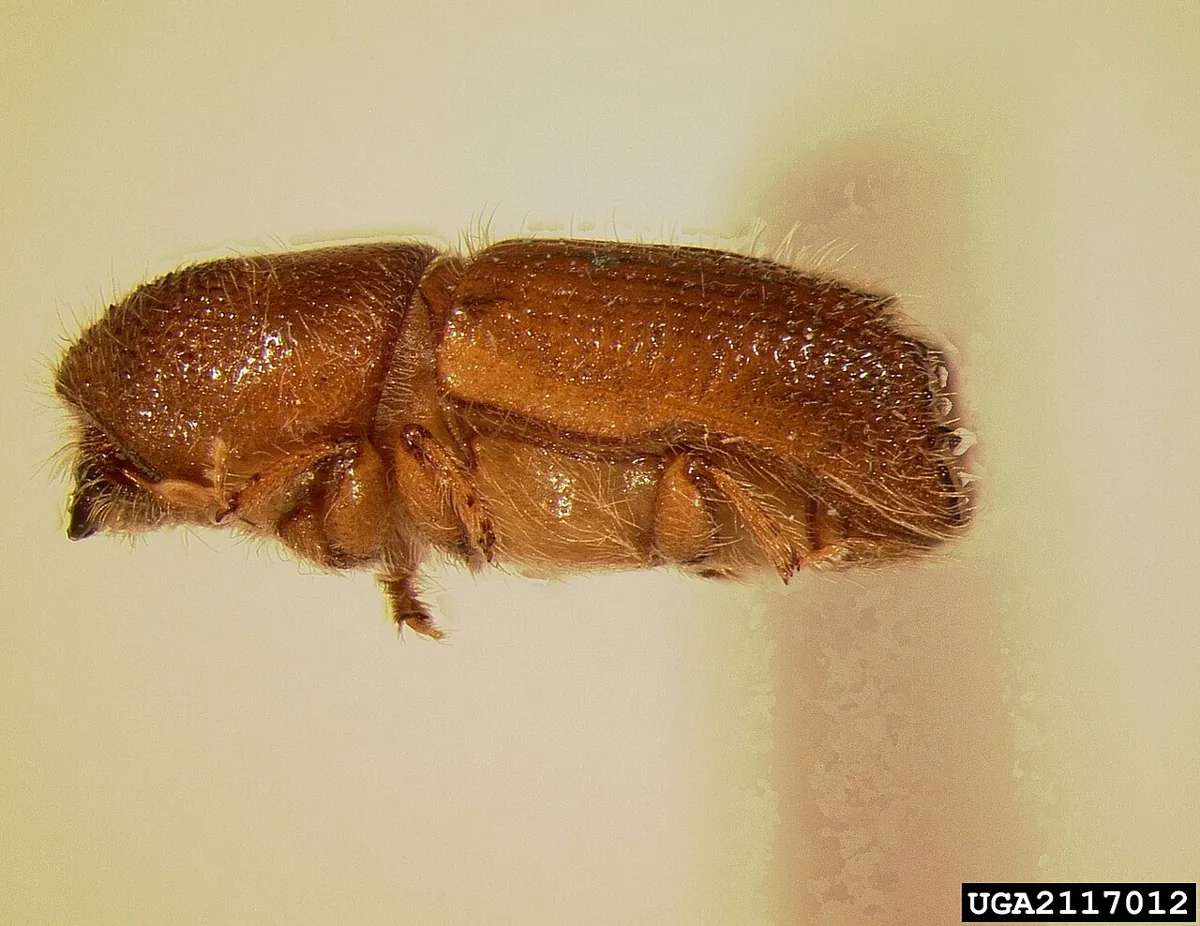
- Adults are dark brown and only 2 to 3 mm long. The hollowed rear end of the wing covers (the declivity) carries four spines; the second spine is the largest and very pronounced in males.[1]
- Under the bark, two or three females share a male's mating chamber, each cutting an egg gallery outward from it in a different direction.[1]
Look-alikes
| Look-alike | How to tell them apart |
|---|---|
| Pine engraver (Ips pini) | Also has four spines on the declivity, but in males the third spine is the large one, and in females all four are about equal. The native Orthotomicus caelatus and Ips latidens have only three spines.[1] |
Where it lives
Native to central Asia, China, the Mediterranean and the Middle East, and introduced to Chile, South Africa, Swaziland and the United States. In the U.S. it is known from California: in 2007 it was in six Central Valley counties and occasionally coastal areas, and UC IPM describes it colonizing Mediterranean pines in and around the Los Angeles Basin and the Central Valley.[1][2]
Biology and life cycle
It was first detected in May 2004 in traps at the Fresno Zoo, during a California Department of Food and Agriculture survey.[1]
Hosts are pines, especially Mediterranean species such as Aleppo and Italian stone pine. The Forest Service's host list, drawn from field, laboratory and overseas records, also includes Austrian, Brutia, Canary Island, Coulter, maritime, Mexican weeping, Monterey, Scots and slash pines, among others, and cedar.[1][2]
The male bores a mating chamber and releases an aggregation pheromone. Two or three females mate with each male, and each female lays 26 to 75 eggs along her gallery; adults may move on and start new galleries elsewhere.[1]
In California there are three to four generations a year. Adults fly in every month except late December and January, new eggs have been seen from early March to late November, and larvae, pupae and adults overwinter under the bark.[1][2]
Blue-stain fungi travel with the beetles; Ophiostoma ips was the fungus most often isolated from beetles infesting cut pine logs in California.[1]
Damage and signs
- It breeds in the trunk and large limbs of pines. In Southern Hemisphere Monterey pine plantations it has killed drought- and fire-stressed trees.[2][1]
- Because it accepts so many pines, the Forest Service warned it could spread through California to coastal Monterey pines and native mountain pines, and to warm regions such as the Southeast with loblolly, shortleaf and slash pine.[1]
Health risk
The Forest Service and UC IPM describe it only as a pest of pines; neither mentions any risk to people or pets.[1][2]
Control
Prevention
Water landscape pines adequately so they aren't stressed, which makes them less likely to be attacked.[1][2]
UC IPM advises against pruning pines from February to mid-October, when the beetles are flying.[2]
Sanitation
Remove infested trees and wood and burn, debark or chip it so beetles don't build up and spread. Don't pile freshly cut wood near landscape plants or move firewood to new areas.[1][2]
When to call a professional
Registered preventive insecticides, such as carbamates or pyrethroids, must be applied before a high-value tree is attacked. UC IPM notes they won't save a heavily infested tree and the bark-spray products are not available to home users; ask your state Department of Agriculture or county extension office which products are registered.[1][2]
Common questions
- Which pines does it attack?
- Mainly Mediterranean pines such as Aleppo and Italian stone pine, but many others are listed as hosts, including Canary Island, Monterey, Coulter, Scots and slash pines.[2][1]
- Is it only in California?
- In the U.S., yes, as far as these sources report: it was first found in Fresno in 2004 and is now in the Central Valley and around the Los Angeles Basin.[1][2]
- When are the beetles active?
- Almost all year in California: adults fly in every month except late December and January, with three to four generations a year.[1][2]
Sources
- USDA Forest Service, “Invasive Bark Beetles (Forest Insect & Disease Leaflet 176).” www.fs.usda.gov/foresthealth/docs/fidls/FIDL-176-InvasiveBarkBeetles.pdf (accessed 2026-11-08)
- University of California Statewide IPM Program, “Pest Notes: Bark Beetles (Publication 7421).” ipm.ucanr.edu/PMG/PESTNOTES/pn7421.html (accessed 2026-11-08)
- iNaturalist, “Orthotomicus erosus taxon page (order and family).” www.inaturalist.org/taxa/176312 (accessed 2026-11-08)