On this page
How to identify it
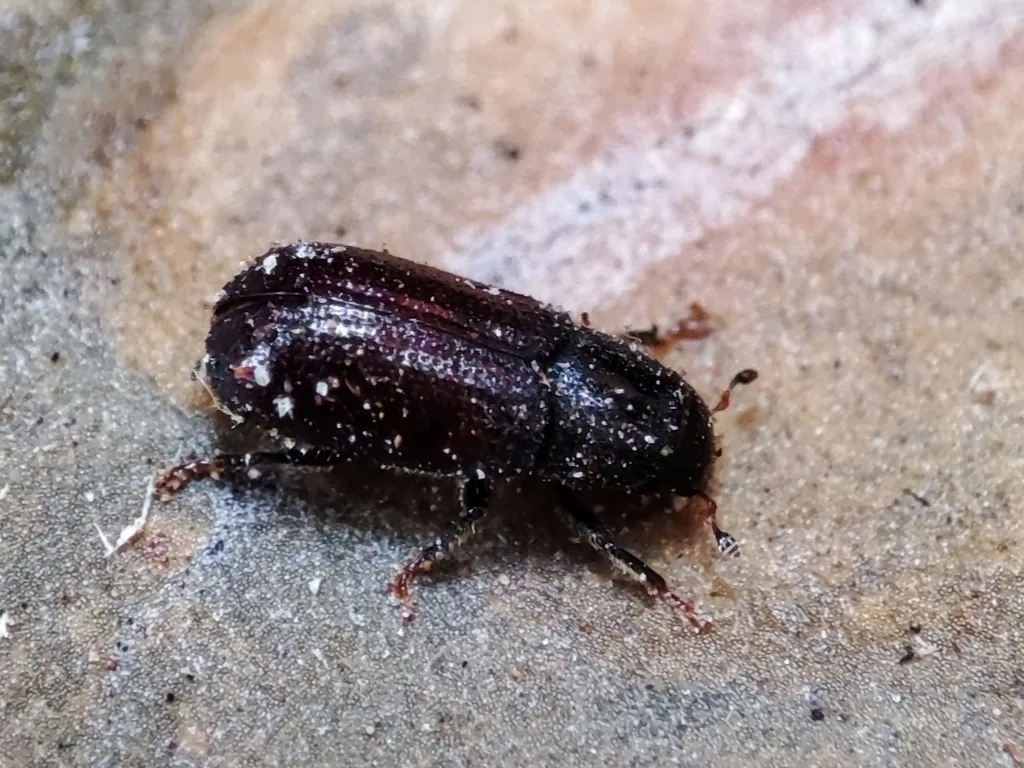
- Adults are cylindrical and 3 to 5 mm long, about the size of a match head, with a shiny black head and thorax and reddish-brown to black wing covers.[2]
- They resemble Dendroctonus bark beetles such as the southern pine beetle and the black turpentine beetle, but the funicle of the antenna has six segments. A smooth second interval on the sloping rear of the wing covers separates this species from others in its genus.[1]
- Larvae are legless, slightly curved and white with a brown head, reaching about 1/4 inch (5 mm). Eggs are 1 mm long, oval and shiny white.[2]
- On the tree, look for hollowed shoots with round holes 2 to 3 mm across near the broken ends, first- and second-year shoots that droop and turn yellow or red in early summer, and dead, bored-out shoots littering the ground underneath.[1]
- Under the bark of infested logs and stumps are vertical egg galleries 4 to 10 inches long, with the larvae's horizontal galleries, 1.5 to 3.5 inches long, running off them.[2]
Look-alikes
| Look-alike | How to tell them apart |
|---|---|
| Southern pine beetle and Ips engravers | Dendroctonus beetles such as the southern pine beetle look similar in general appearance, but the pine shoot beetle's antennal funicle has six segments. UF/IFAS also notes that Ips engraver damage can resemble pine shoot beetle injury.[1] |
| Pine tip moths | UF/IFAS warns that damage from pine tip moths (Rhyacionia species) can resemble pine shoot beetle injury, so examine any damaged shoot carefully. The beetle leaves round 2 to 3 mm holes near the broken ends of the shoots.[1] |
Where it lives
Native to Europe and Asia. Since its discovery in Ohio in 1992 it has spread through the Great Lakes region and northeastern North America; UF/IFAS counted 17 northeastern and north central states as of 2010, along with the Great Lakes regions of Ontario and Quebec. Maine first recorded it in 2000.[3][1]
Biology and life cycle
There is one generation a year in its native range, and Canadian Forest Service studies cited by UF/IFAS found the same in Canada and the northern United States.[2][1]
Overwintered adults take flight on the first warm days of spring, when highs reach about 50 to 54°F, which the Forest Service alert places in February or March in the Lake States.[2][1]
They colonize recently cut pine stumps, logs and slash, and sometimes the trunks of badly weakened trees, flying half a mile or more to find them. Pine is the main host, though in heavy populations they also breed in spruce, fir and larch logs in stands mixed with pine.[2][1]
Each female starts a gallery and is joined by one male. She cuts a vertical egg gallery in the inner bark and outer sapwood and lays eggs one at a time in niches along both sides.[2]
Most larvae finish feeding, pupate and become adults in May and June. The new adults chew out through round holes about 2 mm across and fly to the crowns of living, healthy pines of all ages, favoring the taller trees, where they bore up to 10 cm into the pith of the shoots.[2][1]
Each adult can kill one to six shoots, usually side shoots in the upper crown. In October the adults move to the base of pine trees or into the soil to spend the winter.[3][1]
Blue stain fungi are associated with this beetle. Adults find breeding material by host odors such as alpha-pinene and do not appear to produce an aggregation pheromone.[2]
Damage and signs
- Scotch pine is the preferred host, and Austrian, eastern white, red and jack pines are also susceptible.[3][1]
- The worst injury is the shoot feeding, which destroys growing points and deforms trees. UF/IFAS expects this to be especially severe in Christmas tree plantations, where tree form is the main consideration and the injury is permanent.[1]
- In Europe it is considered the most serious bark beetle pest of pines. It favors weakened, stressed or dying trees but will also attack and kill apparently healthy ones, through shoot feeding, trunk feeding, or stress that lets other insects attack.[1]
- UF/IFAS lists four pines native to Florida that might be susceptible, based mainly on their resin flow and bark: sand, spruce, pond and loblolly pine.[1]
- In Maine the beetle occurs in low numbers in scattered pockets of Franklin and Oxford Counties, without detectable damage. USDA APHIS considers it a potentially serious pest, particularly in the southern United States.[3]
Health risk
A tree pest. The UF/IFAS, Forest Service and Maine Forest Service sources describe damage to pines only and mention no risk to people or pets.[1][2][3]
Control
Prevention
Moving infested trees and pine products is the main way the beetle spreads long distances. The Maine Forest Service page still describes a Maine quarantine area covering every county except Aroostook and Washington, and UF/IFAS advises checking whether a state has a pine shoot beetle compliance program before moving or accepting trees from infested areas.[3][1]
The federal domestic quarantine ended on November 2, 2020: USDA APHIS removed it, along with its restrictions on importing host material from Canada, after finding that the regulatory program was ineffective at slowing the beetle's spread and that the damage it causes has been minimal.[4]
Sanitation
Cultural practices used in Europe include precisely timed cutting operations and debarking cut timber. The adults breed in freshly cut pine stumps, logs and slash.[1][2]
Biological control
A predatory beetle, Thanasimus formicarius, can eat several pine shoot beetles a day. It waits on fallen pines and, like the bark beetles, is drawn to monoterpenes released from damaged areas of the fallen trees.[1]
Pesticides
UF/IFAS reports that there appears to be no practical chemical control for this pest.[1]
Common questions
- Why are dead pine shoot tips dropping under my Scotch pine?
- One cause is the pine shoot beetle: adults bore into the shoots to feed, and dead, bored-out shoots littering the ground under infested trees are a key symptom. Look for round holes 2 to 3 mm across near the broken ends, and keep in mind that pine tip moth and Ips damage can look similar.[1]
- Can I spray for pine shoot beetle?
- UF/IFAS reports there appears to be no practical chemical control. Management relies on handling cut pine material and on rules that limit moving infested trees and pine products.[1][3]
- Is it safe to move pine logs or Christmas trees?
- Moving infested trees and pine products is the main way this beetle spreads over long distances. USDA lifted its federal quarantine in November 2020, but check your state's current rules before moving or accepting pine trees from an infested area.[3][1][4]
Sources
- University of Florida IFAS Extension (Featured Creatures), “Pine Shoot Beetle, Tomicus piniperda, EENY-321 (M. C. Thomas, W. N. Dixon and T. R. Fasulo; revised September 2010; archival copy).” journals.flvc.org/edis/article/download/118803/116730/174395 (accessed 2026-11-08)
- USDA Forest Service, Northeastern Area, “New Introduction: Common Pine Shoot Beetle, Tomicus piniperda, pest alert NA-TP-05-93 (copy hosted by the New Jersey Department of Agriculture).” www.nj.gov/agriculture/divisions/pi/pdf/PSB_Pest%20Alert.pdf (accessed 2026-11-08)
- Maine Forest Service, Maine Department of Agriculture, Conservation and Forestry, “Pine Shoot Beetle, Forest Pest Index.” www.maine.gov/dacf/mfs/forest_health/insects/pine_shoot_beetle.htm (accessed 2026-11-08)
- USDA Animal and Plant Health Inspection Service (Federal Register), “Deregulation of Pine Shoot Beetle, final rule (85 FR 61806, October 1, 2020; effective November 2, 2020).” www.govinfo.gov/content/pkg/FR-2020-10-01/pdf/2020-21800.pdf (accessed 2026-11-08)
- iNaturalist, “Tomicus piniperda taxon page (order and family).” www.inaturalist.org/taxa/178812 (accessed 2026-11-08)