On this page
How to identify it
- The caterpillar is long and slender, up to about 3.5 to 4 cm (roughly 1.5 inches). It is generally brown, tan or yellowish, finely striped, with a dark line down the middle of the back and scattered dark warts.[1][2][3]
- The head is angular, with swollen, almost pointed lobes and a cleft top. It is dark brown or gray with rust or lighter markings.[2][3]
- On the third abdominal segment there is a prominent swelling around the breathing hole, with a large dark bump below it. Natural Resources Canada also notes parallel dark streaks on the back of the third and fourth abdominal segments.[2][3]
- At rest it holds its front end raised, anchored by a silk safety line, with its short thoracic legs pressed against the body.[1][2]
Look-alikes
| Look-alike | How to tell them apart |
|---|---|
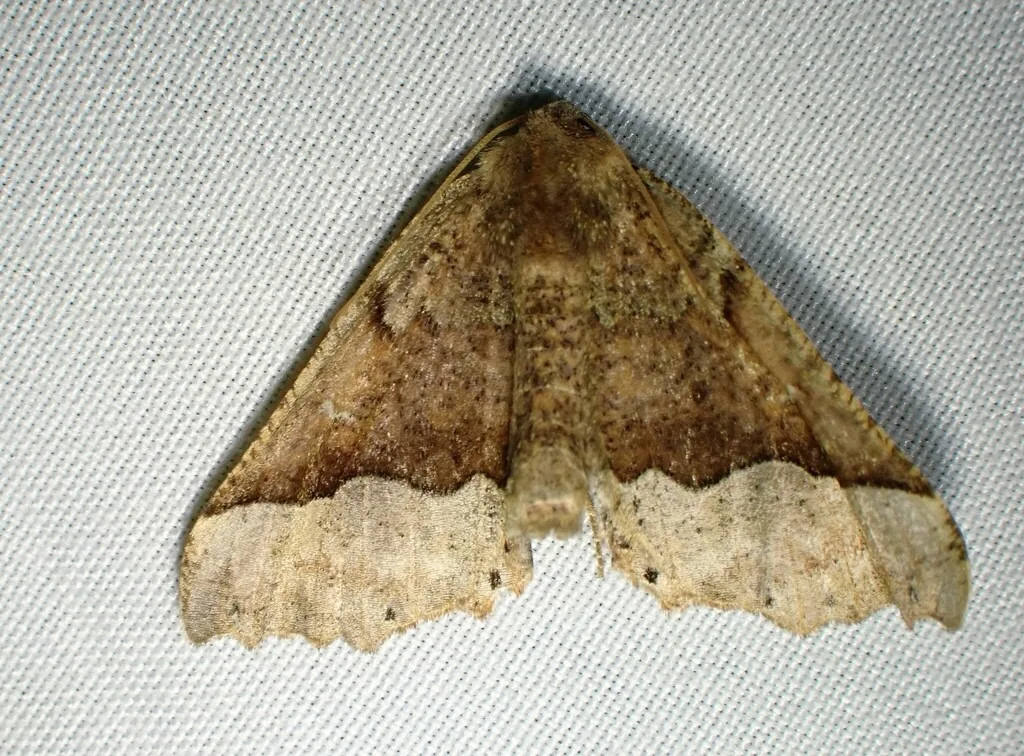
| Hübner's pero (Pero hubneraria) and honest pero (Pero honestaria) | These two co-occur with Morrison's pero over much of the East, and the USDA Forest Service authors know of no way to tell their caterpillars apart. Host is the best clue: Morrison's pero usually feeds on conifers, while the other eastern peros are thought to prefer broadleaf plants. Even the adults are hard to separate.[1] |
Where it lives
It ranges across Canada, from British Columbia east to Newfoundland, and in the eastern United States south to the upper Midwest and the mountains of Georgia. It lives in forests, woodlands and wooded swamps.[1][3]
Biology and life cycle
Hosts are mainly conifers: fir, hemlock, larch, pine and spruce in the East, and Douglas-fir and western hemlock in British Columbia. Reports from birch and other broadleaf plants may be misidentifications, although Natural Resources Canada lists willow and alder as hosts in Canada.[1][2][3]
Pero moths lay their eggs in rows. The pupa spends the winter in the soil or leaf debris.[1][2]
The number of generations varies by source and region: the 2001 geometroid guide reports two in Connecticut and Maryland, with full-grown caterpillars in June and July and again in fall, while the 2004 conifer guide gives one generation with grown caterpillars mainly in July and August. In British Columbia the moths fly in July and caterpillars feed from July to September.[1][2][3]
Damage and signs
- The caterpillars feed alone on the foliage. Natural Resources Canada calls Morrison's pero an innocuous defoliator.[3]
Health risk
The USDA and Canadian forest sources describe Morrison's pero only as a foliage feeder and report no harm to people.[1][2][3]
Control
Prevention
No control is suggested. Natural Resources Canada considers the species innocuous, and the USDA Forest Service guides cover only its identification and life history.[3][1][2]
Common questions
- What is the brown inchworm that looks exactly like a twig on my spruce?
- It could be Morrison's pero, an excellent twig mimic that rests with its front end raised on a silk safety line. Pero caterpillars on conifers are most likely to be this species.[1][2]
- Is Morrison's pero harmful?
- Natural Resources Canada calls it an innocuous defoliator; each caterpillar feeds alone.[3]
Sources
- USDA Forest Service, Forest Health Technology Enterprise Team, “Geometroid Caterpillars of Northeastern and Appalachian Forests, FHTET-2001-10 (D. L. Wagner, D. C. Ferguson, T. L. McCabe and R. C. Reardon, September 2001; scanned copy).” archive.org/details/geometroidcaterp00wagn (accessed 2026-11-09)
- USDA Forest Service, Forest Health Technology Enterprise Team, “Morrison's pero (Pero morrisonaria), from Caterpillars on the Foliage of Conifers in the Northeastern United States, FHTET-2004-01 (C. T. Maier, C. R. Lemmon, J. M. Fengler, D. F. Schweitzer and R. C. Reardon, 2004), Bugwood wiki archive.” wiki.bugwood.org/Archive:Caterpillars/Pero_morrisonaria (accessed 2026-11-09)
- Natural Resources Canada, Canadian Forest Service, “Pero moth, Trees, insects and diseases of Canada's forests.” tidcf.nrcan.gc.ca/en/insects/factsheet/8972 (accessed 2026-11-09)
- iNaturalist, “Pero morrisonaria taxon page (order and family).” www.inaturalist.org/taxa/227514 (accessed 2026-11-09)