On this page
How to identify it
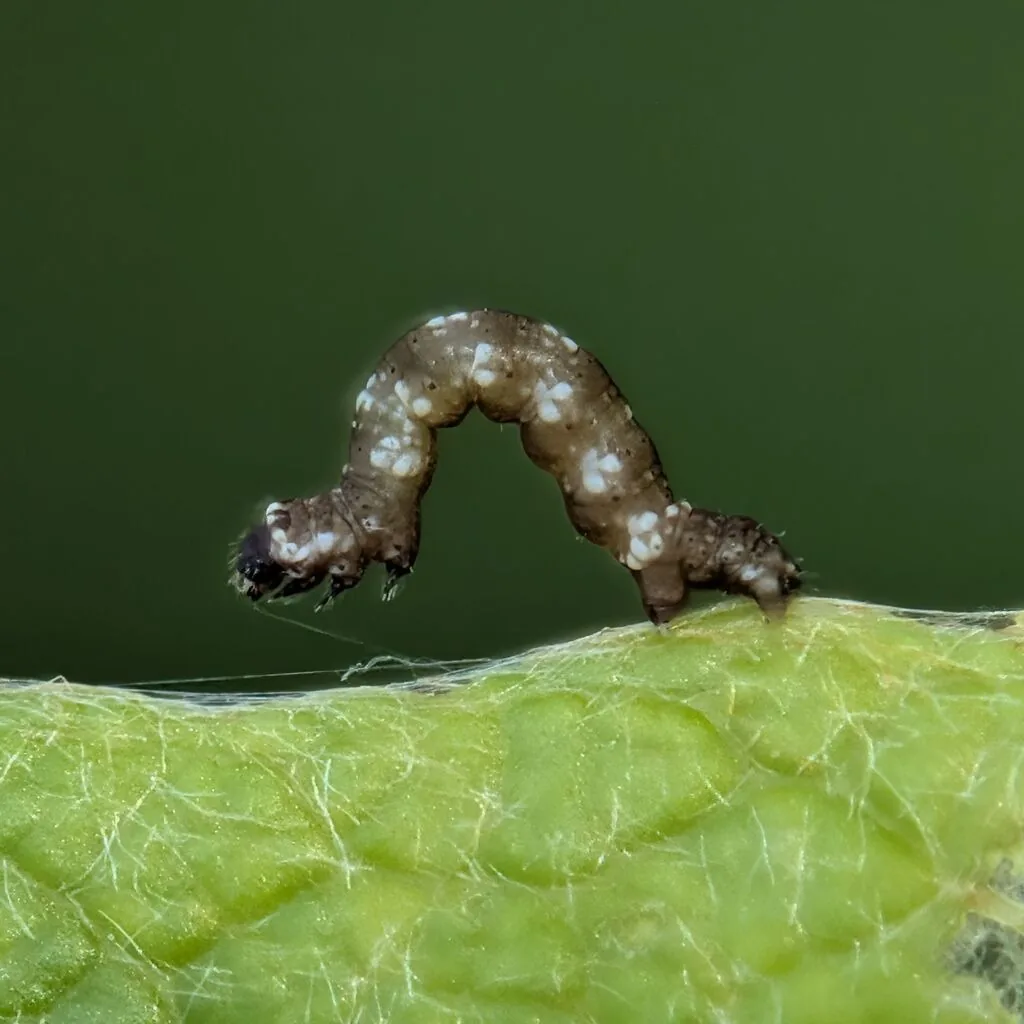
- The caterpillar is a stocky inchworm, gray to brown and marked with black and pale (sometimes pinkish) areas; some are mottled red, purple or brown. Full grown it reaches about 35 millimeters (1.4 inches).[2][1][3]
- The best mark to look for is a low, dark-edged, V-shaped ridge across the top of the eighth abdominal segment, near the rear. Many caterpillars also have a dark V or chevron on top of the second abdominal segment.[1][2][3]
- The top of the second segment behind the head is slightly humped. The head is pale and mottled, and the body has a faint, broken pale line down the middle of the back and thin double black lines along each side of it.[3][2]
- Some caterpillars have a dark saddle over the fourth abdominal segment and black lines below the breathing holes, while others are plain.[1]
- At rest the caterpillar holds the front of its body raised, like a twig. It trails a silk thread wherever it walks and can drop from its perch on that line.[1]
Where it lives
It occurs across Canada and, in the eastern United States, south to Florida and Texas, in forests and woodlands. Natural Resources Canada lists western conifers such as western hemlock, Sitka spruce and Douglas-fir among its hosts.[1][3]
Biology and life cycle
The host list is long. It includes apple, ash, birch, blackberry, cherry, cranberry, currant, maple, oak, pear, poplar, sweetfern, walnut, witch-hazel and willow, as well as fir, hemlock, larch and spruce. In Canada alder, Douglas-fir, tamarack, western redcedar and white birch are also recorded.[1][3]
The pupa spends the winter buried in the forest duff. In Canada the moths come out in May and lay eggs in groups of 10 to 20 in bark crevices and under moss on tree trunks; caterpillars are present from June to August and pupate in August and September.[3][1]
Farther south there are more generations. Connecticut has two, with grown caterpillars in June and July and again from August to October. Maryland has at least three, with grown caterpillars from April until the first hard frost.[1][2]
Damage and signs
Health risk
The sources describe it only as a forest caterpillar and moth; they mention no harm to people.[1][3]
Control
Prevention
Neither the USDA Forest Service guides nor Natural Resources Canada recommend any control for the saddleback looper.[1][3]
Common questions
- What is the inchworm that looks exactly like a twig?
- Several loopers mimic twigs, but the saddleback looper is a good example: it is gray to brown, rests with its front end raised, and has a low V-shaped ridge near its rear end.[1]
- When are saddleback loopers around?
- In the North, caterpillars can be found from about April to October. In Canada they are present from June to August, while in Maryland there are several broods from April until the first hard frost.[2][3][1]
Sources
- USDA Forest Service, Forest Health Technology Enterprise Team, “Geometroid Caterpillars of Northeastern and Appalachian Forests, FHTET-2001-10 (D. L. Wagner, D. C. Ferguson, T. L. McCabe and R. C. Reardon, September 2001; scanned copy).” archive.org/details/geometroidcaterp00wagn (accessed 2026-11-09)
- USDA Forest Service, Forest Health Technology Enterprise Team, “Caterpillars of Eastern Forests, FHTET-96-34 (D. L. Wagner, V. Giles, R. C. Reardon and M. L. McManus, 1997; scanned copy).” archive.org/details/caterpillarsofea001997 (accessed 2026-11-09)
- Natural Resources Canada, Canadian Forest Service, “Saddleback looper, Trees, insects and diseases of Canada's forests.” tidcf.nrcan.gc.ca/en/insects/factsheet/8578 (accessed 2026-11-09)
- iNaturalist, “Ectropis crepuscularia taxon page (order and family).” www.inaturalist.org/taxa/143009 (accessed 2026-11-09)