On this page
How to identify it
- The full-grown caterpillar is up to 35 mm long, elongate and twig-like, and highly variable in color: rusty brown is most common, but it ranges from light tan to dark grey. The head is tan with rust mottling and moderately notched at the top.[1]
- Prominent bumps (tubercles) sit below the spiracles on the second abdominal segment, and raised pairs of dark tubercles run along the back near the rear edge of abdominal segments 2 through 8.[1]
- It feeds in the open on Douglas-fir, western hemlock, western redcedar and true firs such as grand fir.[1][2]
Look-alikes
| Look-alike | How to tell them apart |
|---|---|
| Saddleback looper | The saddleback looper (Ectropis crepuscularia) is another 35 mm mottled grey-to-brown inchworm on the same western conifers, but it carries a single pair of blunt tubercles on the eighth abdominal segment, whereas the brownlined looper has raised pairs of dark tubercles on abdominal segments 2 through 8 plus prominent bumps on the second segment.[2][1] |
| Greenstriped forest looper | The greenstriped forest looper (Melanolophia imitata) shares the Northwest conifer hosts; the brownlined looper is told by its twig-like rusty-to-grey body with paired dark tubercles along the back.[1][2] |
Where it lives
Natural Resources Canada records it in British Columbia; the USDA manual gives Oregon and British Columbia.[1][2]
Biology and life cycle
The caterpillar is a solitary, free-living defoliator that moves about on the foliage. Its principal hosts are Douglas-fir, western hemlock, western redcedar and true firs, with grand fir named by Natural Resources Canada.[2][1]
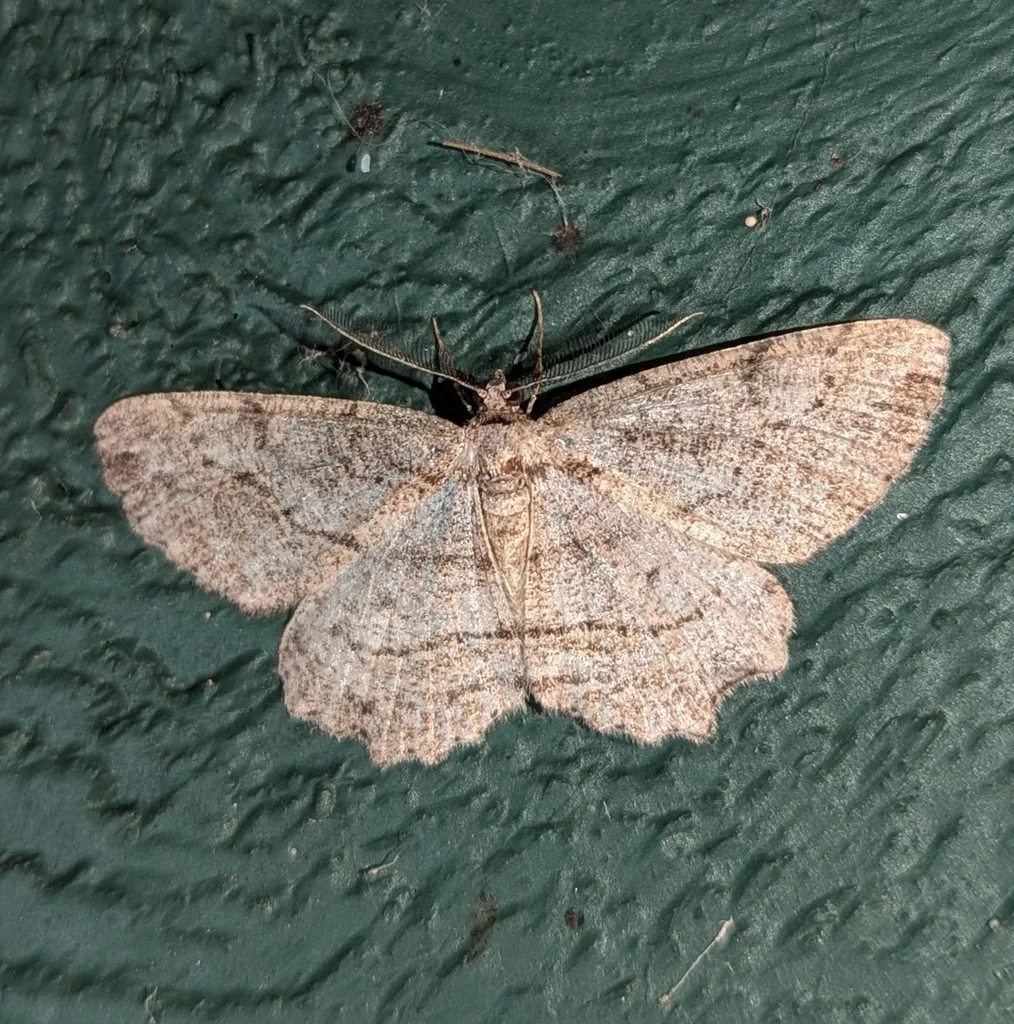
The species overwinters as a part-grown (mid-instar) caterpillar. Feeding resumes in spring and continues until June; pupation is in June or July; the moths emerge in August, mate and lay eggs, and the new caterpillars hatch soon after and feed into the fall.[1]
Damage and signs
Health risk
The sources describe it only as a conifer needle feeder and mention no effect on people.[1][2]
Control
Prevention
No control is needed. The caterpillars feed singly and both sources describe the species as innocuous or nondestructive on its conifer hosts.[1][2]
Common questions
- What is the twig-like brown inchworm with bumps on my Douglas-fir?
- In British Columbia or Oregon, an elongate twig-mimic caterpillar up to 35 mm long, rusty brown to grey, with paired dark bumps along its back and a bump below the spiracle on the second abdominal segment, is the brownlined looper.[1][2]
- Will it hurt the tree?
- No. Natural Resources Canada rates it innocuous and the USDA Forest Service manual calls it nondestructive.[1][2]
- When are the caterpillars present?
- Overwintered caterpillars feed in spring until June, and a new generation hatches after the August moth flight and feeds into the fall.[1]
Sources
- Natural Resources Canada, Canadian Forest Service, “Brownlined looper, Trees, insects and diseases of Canada's forests.” tidcf.nrcan.gc.ca/en/insects/factsheet/1000024 (accessed 2026-11-10)
- USDA Forest Service, “Western Forest Insects, Miscellaneous Publication 1339 (R. L. Furniss and V. M. Carolin, November 1977; scanned copy).” archive.org/details/CAT78702369 (accessed 2026-11-10)
- iNaturalist, “Neoalcis californiaria taxon page (order and family).” www.inaturalist.org/taxa/225567 (accessed 2026-11-10)