On this page
How to identify it
- The full-grown caterpillar is up to 32 mm long (the USDA manual gives 26 to 31 mm). The head is light brown with darker mottling. The body is rusty brown, with yellowish patches on the back, a dark Y-shaped mark at the rear edge of each segment, broken blackish lines above and beside the midline, and a broad creamy yellow stripe along the spiracles edged above by a broken dark line.[1][2]
- The USDA manual sums up the larva as pale golden brown with a lengthwise pattern of several broken blackish lines.[2]
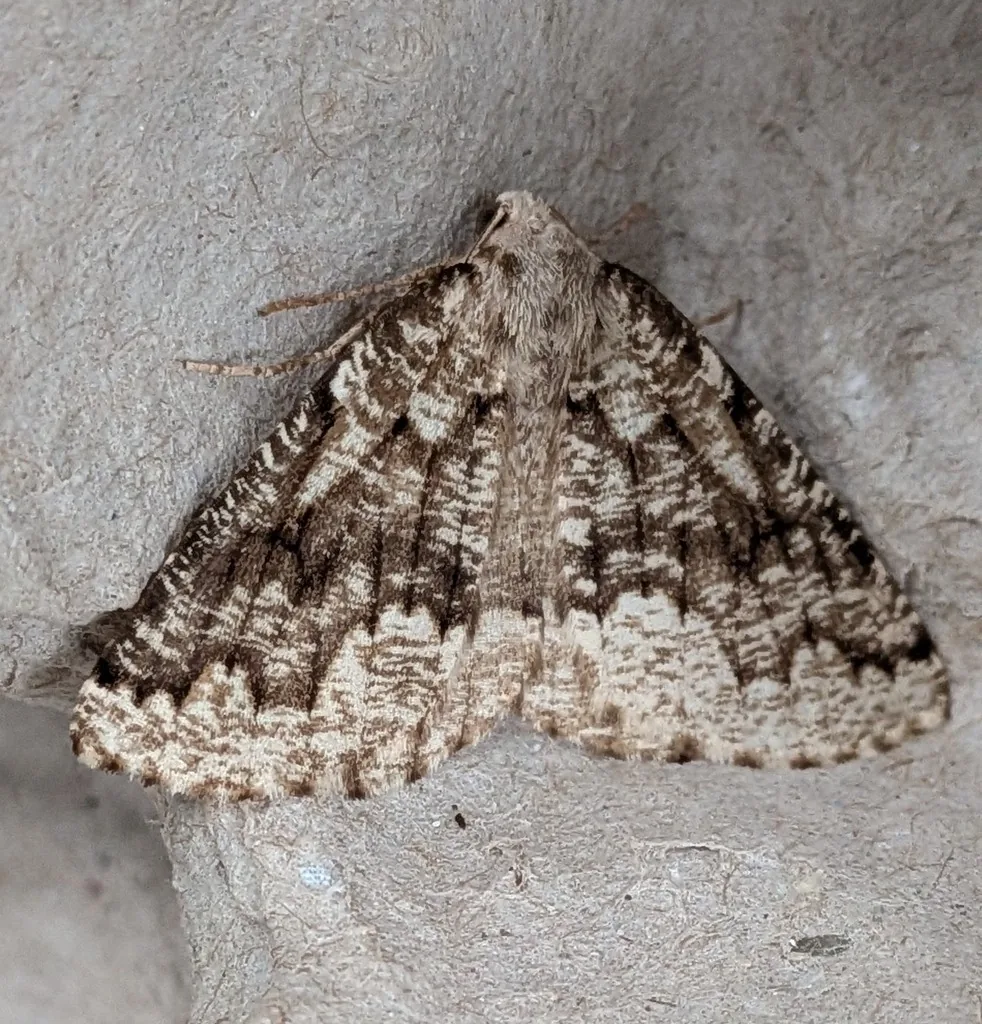
- The moth has a wingspan of 37 to 39 mm; its wings are pale gray brown with fine darker bands and indistinct markings.[2]
Look-alikes
| Look-alike | How to tell them apart |
|---|---|
| Packard's girdle moth | Packard's girdle moth (Sabulodes packardata, the redheaded looper) is a coastal relative on the same hosts; its caterpillar is green with two conspicuous near-white stripes down the back, whereas the variable girdle caterpillar is rusty or golden brown with broken blackish lines. The moths are similar.[2] |
Where it lives
It occurs from southern Alaska to southern Arizona and New Mexico and east to Alberta and Colorado; Natural Resources Canada records it in British Columbia and Alberta.[2][1]
Biology and life cycle
The caterpillars feed singly, moving freely over the current year's foliage of western hemlock, Douglas-fir, true firs (amabilis, grand and subalpine fir), spruce (Engelmann, Sitka and white), mountain hemlock, western white pine and western redcedar.[2][1]
The species overwinters as a part-grown (fourth- or fifth-instar) caterpillar. Feeding resumes in spring and continues until late June; pupation follows in June and July, and the moths emerge 16 to 38 days later and lay eggs. The new caterpillars hatch soon after and feed until cooler weather arrives.[1]
Damage and signs
Health risk
The sources describe it only as a conifer needle feeder and mention no effect on people.[1][2]
Control
Prevention
No control is needed. The caterpillars feed singly on current-year needles and the sources record no significant damage.[1][2]
Common questions
- Why is it called Enypia venata in forestry references?
- Natural Resources Canada and the USDA Forest Service manual both treat it under the genus Enypia; iNaturalist now places it in Sabulodes as the variable girdle.[1][2][3]
- Will the caterpillars damage my hemlock or fir?
- No. Natural Resources Canada rates the species innocuous, and the USDA manual says the four Enypia species feed singly and cause no significant damage.[1][2]
- When are the caterpillars active?
- Overwintered caterpillars feed in spring until late June; the next generation hatches in summer, after the moths emerge, and feeds until the weather cools.[1]
Sources
- Natural Resources Canada, Canadian Forest Service, “Enypia venata, Trees, insects and diseases of Canada's forests.” tidcf.nrcan.gc.ca/en/insects/factsheet/1000013 (accessed 2026-11-10)
- USDA Forest Service, “Western Forest Insects, Miscellaneous Publication 1339 (R. L. Furniss and V. M. Carolin, November 1977; scanned copy).” archive.org/details/CAT78702369 (accessed 2026-11-10)
- iNaturalist, “Sabulodes venata taxon page (order and family).” www.inaturalist.org/taxa/1378553 (accessed 2026-11-10)