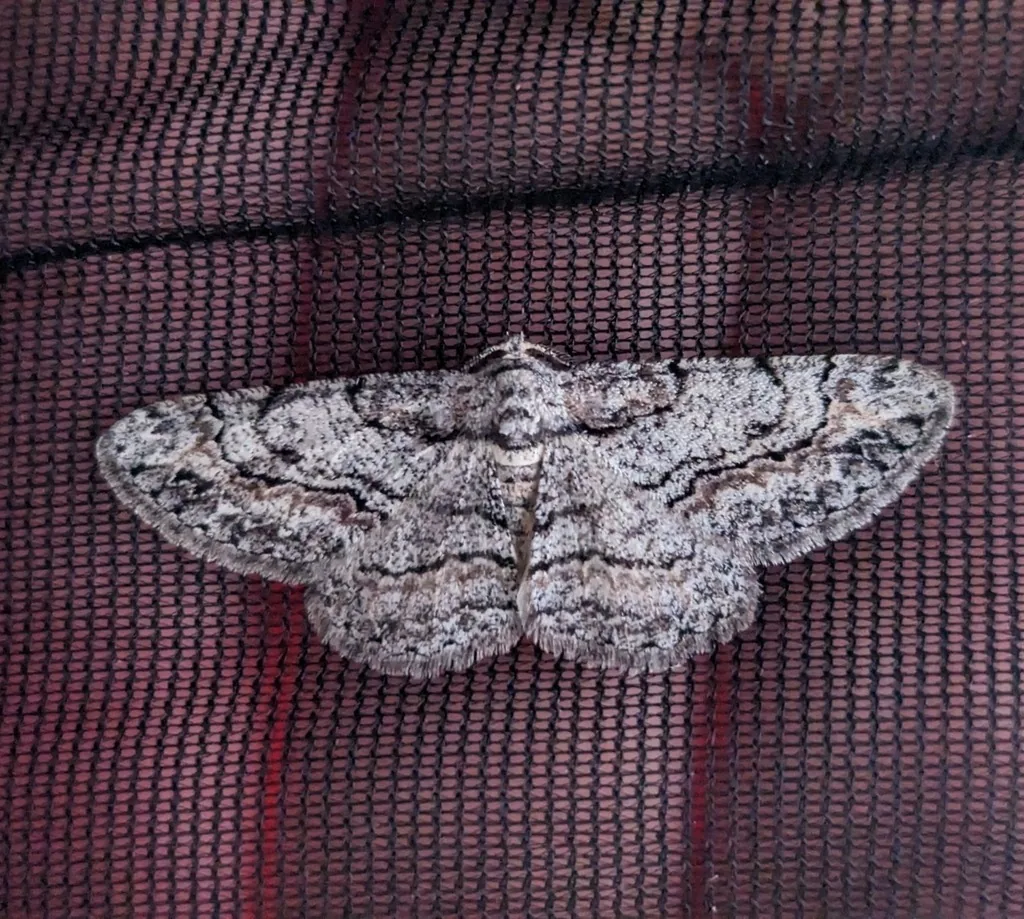
On this page
How to identify it
- The caterpillar is a tannish stick mimic, up to 3 cm (about 1.2 inches) long. Its color varies so much, and its shape is so plain, that the USDA Forest Service guide calls it somewhat difficult to recognize.[1][2]
- Many have a dark V or fine, closely paired black lines on top of the thoracic segments, and dark spots down the middle of the back on the second to fourth abdominal segments.[1][2]
- Look for a low, often yellowish-orange swelling on the side of the second abdominal segment that takes in the breathing hole, and a pair of close-set, darkened pointed warts on top of the eighth segment.[1][2]
- The head is squarish and flat-faced, mottled with tan, white, black and sometimes pink, usually with a dark bar or dark blotches around the triangle on the face.[1][2]
Where it lives
It ranges across Canada and, in the eastern United States, south to Florida and Texas, in many habitats including forests, woodlands, fields and waste lots. GBIF holds about 11,000 US records since 1990 from 46 states, most from Texas and Illinois.[1][6]
Biology and life cycle
Recorded hosts include alder, apple, birch, blueberry, carrot, chinaberry, cotton, cranberry, Douglas fir, goldenrod, larch, locust, maple, oak, orange, raspberry, soybean, spruce and willow, plus clover and grasses. There is even a report from ginkgo.[1][2]
It is one of the most common geometrid caterpillars swept from open fields.[1]
There are at least two extended generations a year in the North. The Forest Service field guide gives the caterpillar season as May to November, and in Connecticut and Maryland full-grown caterpillars are present from late May through October. The pupa spends the winter.[1][2]
At 24°C in the lab, larvae took about 24 days to mature, and the whole cycle from egg to adult took 42 days.[4]
In a 1990 field study of synthetic sex attractants for geometrid moths, male common grays were caught in traps baited with a particular pair of 19-carbon epoxide compounds.[3]
In a trapping study of apple odors released by caterpillar feeding, male and female moths of its genus were caught in traps baited with benzyl nitrile plus acetic acid.[5]
Damage and signs
- The caterpillars chew the leaves of a very wide range of woody and herbaceous plants, including some fruit and field crops. The USDA Forest Service guides record these hosts but do not describe the common gray as a pest of them.[1][2]
- In mid-Missouri it became common in experimental soybean plots in 1978, peaking at 0.45 larvae per 10 sweeps in late August and early September, but was rare there in 1980. Each larva ate about 72.3 square centimeters of soybean leaf over its development.[4]
Health risk
The forest caterpillar guides treat the common gray purely as a plant feeder and say nothing about it harming people.[1][2]
Control
Prevention
No control is called for. The USDA Forest Service guides give no control advice, and the Missouri soybean study set economic injury levels of 17.2 to 93.0 larvae per 10 sweeps depending on crop stage, far above the numbers found, and concluded it is not a significant pest.[1][2][4]
Where sources disagree
Range: the Forest Service guide describes it as transcontinental in Canada but, in the United States, an eastern species reaching south to Florida and Texas. GBIF holds records from 46 states, including Montana, Colorado, New Mexico and Arizona.[1][6]
Season: the geometroid guide puts full-grown caterpillars in Connecticut and Maryland from late May through October; the eastern forests guide lists caterpillars from May to November.[1][2]
Common questions
- What is the tan inchworm that looks like a twig?
- Many inchworms mimic sticks, but the common gray is one of the most common in open fields. Its caterpillar is tan, flat-faced, and has a pair of dark pointed warts on top near the rear.[1][2]
- What does the common gray caterpillar eat?
- Almost anything: evergreens, broadleaf trees, shrubs and herbaceous plants, from oak and spruce to soybean, cotton, cranberry, clover and grasses.[1][2]
- Is the common gray a soybean pest?
- Not a significant one. In a Missouri study the larvae were common in soybean plots one year and rare two years later, and their numbers stayed far below the levels that would cause economic loss.[4]
Sources
- USDA Forest Service, Forest Health Technology Enterprise Team, “Geometroid Caterpillars of Northeastern and Appalachian Forests, FHTET-2001-10 (D. L. Wagner, D. C. Ferguson, T. L. McCabe and R. C. Reardon, September 2001; scanned copy).” archive.org/details/geometroidcaterp00wagn (accessed 2026-11-11)
- USDA Forest Service, Forest Health Technology Enterprise Team, “Caterpillars of Eastern Forests, FHTET-96-34 (D. L. Wagner, V. Giles, R. C. Reardon and M. L. McManus, November 1997; scanned copy).” archive.org/details/caterpillarsofea001997 (accessed 2026-11-11)
- Journal of Chemical Ecology (via NCBI PubMed), “Synthesis and field testing of enantiomers of 6Z,9Z-cis-3,4-epoxydienes as sex attractants for geometrid moths (J. G. Millar et al., Journal of Chemical Ecology, 1990; abstract).” pubmed.ncbi.nlm.nih.gov/24264097/ (accessed 2026-11-11)
- Scientific Reports (full text via PubMed Central), “Caterpillar-induced plant volatiles attract conspecific adults in nature (El-Sayed et al. 2016).” pmc.ncbi.nlm.nih.gov/articles/PMC5124949/ (accessed 2026-11-11). Cited from the full text in PubMed Central.
- iNaturalist, “Anavitrinella pampinaria taxon page (order and family).” www.inaturalist.org/taxa/63750 (accessed 2026-11-11)