On this page
How to identify it
- Young caterpillars, which hatch in June, have a dark gray body, a rusty head and a yellowish rear tip.[2]
- Older caterpillars are gray-brown to light brown with very fine, vague markings. There is a black spot on the side just ahead of mid-body, often with a small white patch in front of it, and four small black spots along the rear half of the body.[2]
- The USDA Forest Service guide describes the caterpillar as green, gray, brown or rust, with a wart on the side of the second abdominal segment that is often dark, and often a dark spot behind each breathing hole on the abdomen.[1]
- There is a modest hump over the eighth abdominal segment, and the head is abruptly flattened in front, with the face lighter than the top and sides. Full grown the caterpillar is 22 to 26 millimeters (about 1 inch) long.[1][2]
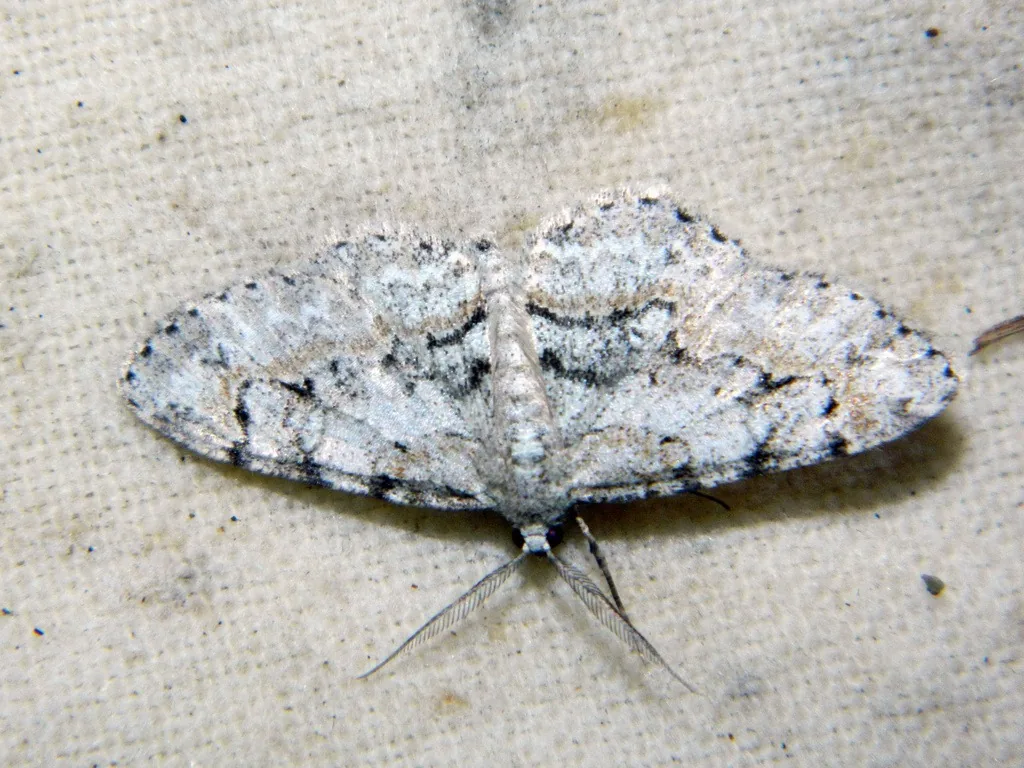
- The moths fly at night and are very hard to see when resting on tree trunks, because their coloring blends in with moss and lichen.[2]
Look-alikes
| Look-alike | How to tell them apart |
|---|---|
| Bent-line gray (Iridopsis larvaria) | Its caterpillar resembles the pale-winged gray's in many respects. Unlike other Iridopsis, the pale-winged gray spends the winter as an egg.[1] |
Where it lives
It ranges from Nova Scotia to southeastern Alberta and south to Georgia, Alabama (in the mountains) and Texas, in forests and woodlands. Its hosts and range suggest it is mainly a species of eastern hardwood forests.[2][1]
Biology and life cycle
Hosts include apple, ash, birch, cherry, chokecherry, cranberry, currant and gooseberry, maple, oak, pear, viburnum, elm and willow, as well as balsam fir, eastern hemlock and other conifers.[2][1]
There is one generation a year. Unlike other Iridopsis, it overwinters as an egg on tree bark. The eggs are tiny (about 0.68 millimeter), oval with one flat end, and turn from greenish to rusty.[2][1]
In July the grown caterpillars drop to the ground and pupate just under the leaf litter, down to about 10 centimeters (4 inches) in the soil. The brown pupae are 10 to 11 millimeters long.[2]
Moths emerge 13 to 20 days later and are active from July to mid-August. Females lay their eggs on bark rather than on the foliage.[2]
In Connecticut grown caterpillars are found in June and July and the species is locally common; in Maryland they mature as early as May and it is uncommon.[1]
Damage and signs
- On eastern hemlock, young caterpillars feed on new shoots and older ones eat older needles. Look for missing or red needles, especially on understory trees or the lower branches of larger trees.[2]
- In the first year of an outbreak the caterpillars feed on understory trees. Over the next few years, as the understory is stripped, they move up into the crowns of mature trees. When populations are high they can completely defoliate and kill a tree within 2 years.[2]
Health risk
The sources describe it only as a tree-feeding caterpillar and a night-flying moth; they mention no harm to people.[2][1]
Control
Prevention
Neither source recommends a specific control. Natural Resources Canada's early signs to watch for are missing or red needles on understory hemlocks and on the lower branches of larger trees, where outbreaks begin.[2]
Common questions
- Why are the young hemlocks under my big hemlocks turning red and bare?
- One possible cause is the pale-winged gray. Its outbreaks start with caterpillars feeding on understory trees, leaving missing or red needles, before they move up into the crowns of larger trees.[2]
- Where do pale-winged gray caterpillars go after feeding?
- In July the grown caterpillars drop to the ground and pupate under the leaf litter. The moths appear 13 to 20 days later and lay eggs on the bark, where the eggs spend the winter.[2]
Sources
- USDA Forest Service, Forest Health Technology Enterprise Team, “Geometroid Caterpillars of Northeastern and Appalachian Forests, FHTET-2001-10 (D. L. Wagner, D. C. Ferguson, T. L. McCabe and R. C. Reardon, September 2001; scanned copy).” archive.org/details/geometroidcaterp00wagn (accessed 2026-11-09)
- Natural Resources Canada, Canadian Forest Service, “Pale winged grey, Trees, insects and diseases of Canada's forests.” tidcf.nrcan.gc.ca/en/insects/factsheet/1000141 (accessed 2026-11-09)
- iNaturalist, “Iridopsis ephyraria taxon page (order and family).” www.inaturalist.org/taxa/222285 (accessed 2026-11-09)